Weilbaecher K N, Hershey C L, Takemoto C M, Horstmann M A, Hemesath T J, Tashjian A H, Fisher D E
Dana Farber Cancer Institute, Department of Pediatric Oncology, Harvard Medical School, Boston, Massachusetts 02115, USA.
J Exp Med. 1998 Mar 2;187(5):775-85. doi: 10.1084/jem.187.5.775.
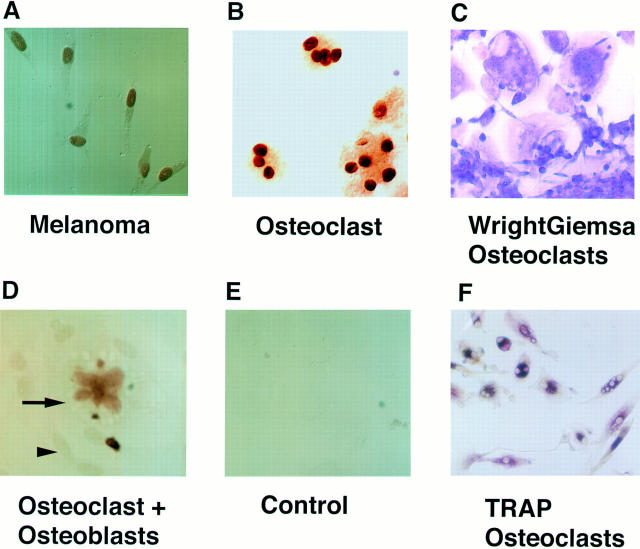
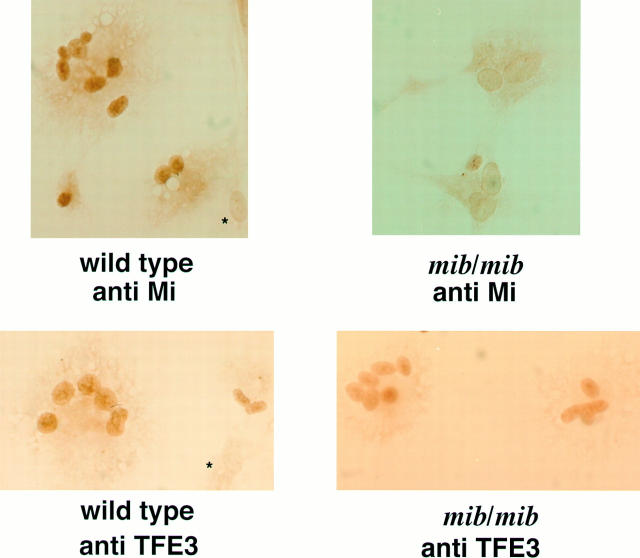
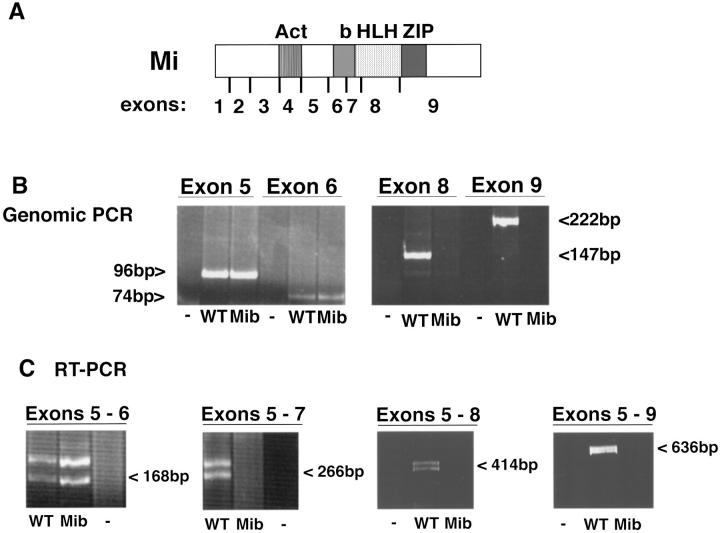
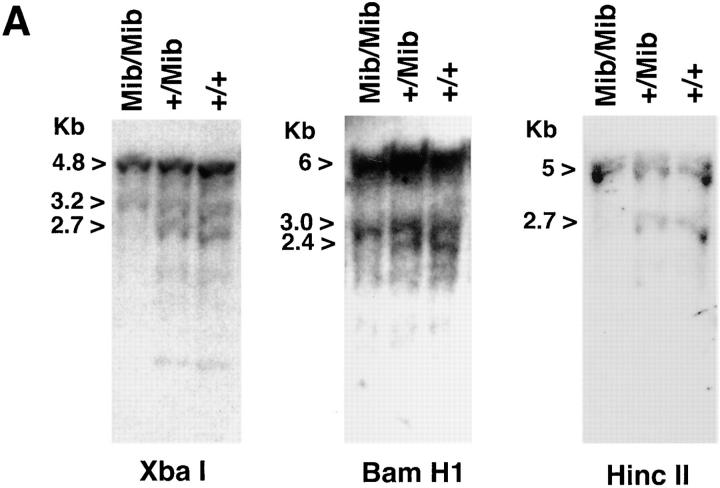
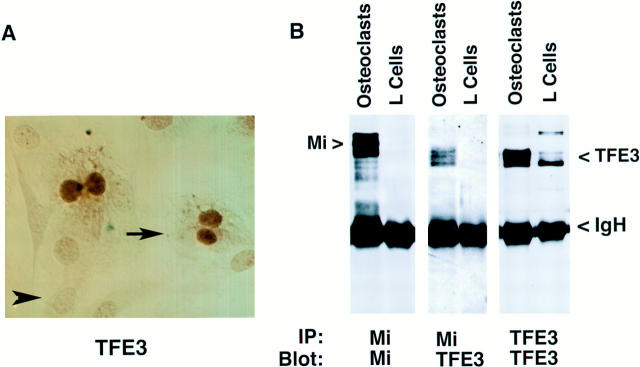
Microphthalmia (Mi) is a basic helix-loop-helix-leucine zipper (b-HLH-ZIP) transcription factor implicated in pigmentation, mast cells, and bone development. Two dominant-negative mi alleles (mi/mi and Mior/Mior) in mice cause osteopetrosis. In contrast, osteopetrosis has not been observed in a number of recessive mi alleles, suggesting the existence of Mi protein partners important in osteoclast function. An osteopetrotic rat of unknown genetic defect (mib) has been described whose skeletal sclerosis improves dramatically with age and that is associated with pigmentation defects reminiscent of mouse mi alleles. Here we report that this rat strain harbors a large genomic deletion encompassing the 3' half of mi including most of the b-HLH-ZIP region. Osteoclasts from these animals lack Mi protein in contrast to wild-type rat, mouse, and human osteoclasts. Mi is not detectable in primary osteoblasts. In addition TFE3, a b-HLH-ZIP transcription factor related to Mi, was found to be expressed in osteoclasts, but not osteoblasts, and to coimmunoprecipitate with Mi. These results demonstrate the existence of members of a family of biochemically related transcription factors that may cooperate to play a central role in osteoclast function and possibly in age-related osteoclast homeostasis.
小眼畸形(Mi)是一种碱性螺旋-环-螺旋-亮氨酸拉链(b-HLH-ZIP)转录因子,与色素沉着、肥大细胞和骨骼发育有关。小鼠中的两个显性负性mi等位基因(mi/mi和Mior/Mior)会导致骨质石化。相比之下,在一些隐性mi等位基因中未观察到骨质石化,这表明存在对破骨细胞功能很重要的Mi蛋白伴侣。已描述了一种遗传缺陷不明的骨质石化大鼠(mib),其骨骼硬化随年龄增长显著改善,且与色素沉着缺陷有关,这让人联想到小鼠的mi等位基因。在此我们报告,该大鼠品系存在一个大的基因组缺失,涵盖mi的3'端一半,包括大部分b-HLH-ZIP区域。与野生型大鼠、小鼠和人类破骨细胞不同,这些动物的破骨细胞缺乏Mi蛋白。在原代成骨细胞中检测不到Mi。此外,发现与Mi相关的b-HLH-ZIP转录因子TFE3在破骨细胞中表达,但在成骨细胞中不表达,并且能与Mi进行共免疫沉淀。这些结果证明了一个生物化学相关转录因子家族成员的存在,它们可能协同作用,在破骨细胞功能以及可能在与年龄相关的破骨细胞稳态中发挥核心作用。