Gitlits V M, Sentry J W, Matthew M L, Smith A I, Toh B H
Department of Pathology and Immunology, Monash Medical School, Prahran, Victoria, Australia.
Immunology. 1997 Nov;92(3):362-8. doi: 10.1046/j.1365-2567.1997.00355.x.
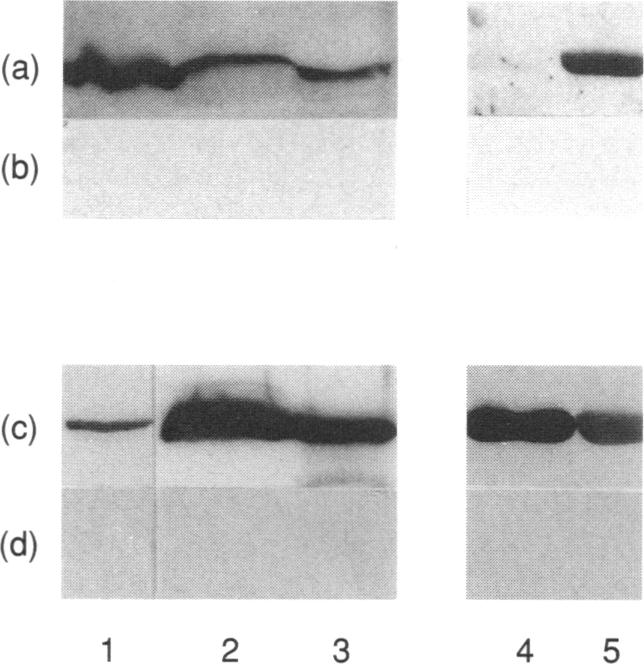
Although the pathology of discoid lupus erythematosus is well documented the causative agents are not known. Here, we report the identity of the target antigen of an autoantibody present in high titre in the serum of a patient with discoid lupus erythematosus. We have demonstrated that the antigen is enolase; first, because it has properties consistent with this glycolytic enzyme (47,000 MW, cytosolic localization and ubiquitous tissue distribution). Secondly, limited amino acid sequence determination after trypsin digestion shows identity with alpha-enolase. Finally, the autoimmune serum immunoblots rabbit and yeast enolase and predominantly one isoelectric form of enolase (PI approximately 6.1). These results indicate that the reactive autoepitopes are highly conserved from man to yeast. The results also suggest that the autoantibodies are most reactive to the alpha-isoform of enolase, although it is possible that they may also be reactive with gamma-enolase, and have least reactivity to beta-enolase. The anti-enolase autoantibodies belong to the immunoglobulin G1 (IgG1) isotype. This is the first report of IgG1 autoantibodies to evolutionarily conserved autoepitopes of enolase in the serum of a patient with discoid lupus erythematosus. Previous reports of autoantibodies to enolase have suggested associations with autoimmune polyglandular syndrome type I and cancer-associated retinopathy. This report and an earlier report of what is likely to be enolase autoantibodies in two patients without systemic disease suggest that enolase autoantibodies have a broad association and are not restricted to any particular disease.
尽管盘状红斑狼疮的病理学已有充分记载,但其致病因素尚不清楚。在此,我们报告了一名盘状红斑狼疮患者血清中高滴度存在的自身抗体的靶抗原的身份。我们已证明该抗原是烯醇化酶;首先,因为它具有与这种糖酵解酶相符的特性(分子量47,000,定位于胞质,组织分布广泛)。其次,胰蛋白酶消化后有限的氨基酸序列测定显示与α-烯醇化酶相同。最后,自身免疫血清对兔和酵母烯醇化酶进行免疫印迹,主要是一种烯醇化酶的等电形式(PI约为6.1)。这些结果表明,反应性自身表位从人到酵母高度保守。结果还表明,自身抗体对烯醇化酶的α同工型反应性最强,尽管它们也可能与γ-烯醇化酶反应,而对β-烯醇化酶反应性最低。抗烯醇化酶自身抗体属于免疫球蛋白G1(IgG1)同种型。这是关于盘状红斑狼疮患者血清中针对烯醇化酶进化保守自身表位的IgG1自身抗体的首次报道。先前关于烯醇化酶自身抗体的报道表明其与I型自身免疫性多腺体综合征和癌症相关性视网膜病变有关。本报告以及之前关于两名无全身性疾病患者中可能是烯醇化酶自身抗体的报道表明,烯醇化酶自身抗体具有广泛的关联性,并不局限于任何特定疾病。