Toellner K M, Luther S A, Sze D M, Choy R K, Taylor D R, MacLennan I C, Acha-Orbea H
Department of Immunology, University of Birmingham Medical School, Birmingham B15 2TT United Kingdom.
J Exp Med. 1998 Apr 20;187(8):1193-204. doi: 10.1084/jem.187.8.1193.
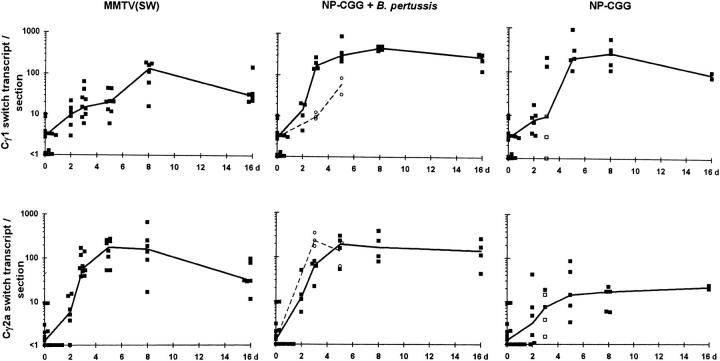
The respective production of specific immunoglobulin (Ig)G2a or IgG1 within 5 d of primary immunization with Swiss type mouse mammary tumor virus [MMTV(SW)] or haptenated protein provides a model for the development of T helper 1 (Th1) and Th2 responses. The antibody-producing cells arise from cognate T cell B cell interaction, revealed by the respective induction of Cgamma2a and Cgamma1 switch transcript production, on the third day after immunization. T cell proliferation and upregulation of mRNA for interferon gamma in response to MMTV(SW) and interleukin 4 in response to haptenated protein also starts during this day. It follows that there is minimal delay in these responses between T cell priming and the onset of cognate interaction between T and B cells leading to class switching and exponential growth. The Th1 or Th2 profile is at least partially established at the time of the first cognate T cell interaction with B cells in the T zone. The addition of killed Bordetella pertussis to the hapten-protein induces nonhapten-specific IgG2a and IgG1 plasma cells, whereas the anti-hapten response continues to be IgG1 dominated. This indicates that a Th2 response to hapten-protein can proceed in a node where there is substantial Th1 activity.
用瑞士型小鼠乳腺肿瘤病毒[MMTV(SW)]或半抗原化蛋白进行初次免疫后5天内,特异性免疫球蛋白(Ig)G2a或IgG1的各自产生为T辅助细胞1(Th1)和Th2反应的发展提供了一个模型。产生抗体的细胞源于同源T细胞与B细胞的相互作用,这在免疫后第三天通过Cgamma2a和Cgamma1转换转录本产生的各自诱导得以揭示。对MMTV(SW)的反应中T细胞增殖以及干扰素γ mRNA的上调,和对半抗原化蛋白的反应中白细胞介素4的上调也在这一天开始。因此,在T细胞致敏与T和B细胞之间同源相互作用导致类别转换和指数增长的开始之间,这些反应的延迟最小。Th1或Th2特征至少在T区T细胞与B细胞首次同源相互作用时就已部分确立。将灭活的百日咳博德特氏菌添加到半抗原-蛋白中会诱导非半抗原特异性IgG2a和IgG1浆细胞,而抗半抗原反应仍然以IgG1为主导。这表明对半抗原-蛋白的Th2反应可以在存在大量Th1活性的节点中进行。