Ma J, Maliepaard M, Nooter K, Loos W J, Kolker H J, Verweij J, Stoter G, Schellens J H
Department of Medical Oncology, Rotterdam Cancer Institute (Daniel den Hoed Kliniek)/University Hospital Rotterdam, The Netherlands.
Br J Cancer. 1998 May;77(10):1645-52. doi: 10.1038/bjc.1998.270.
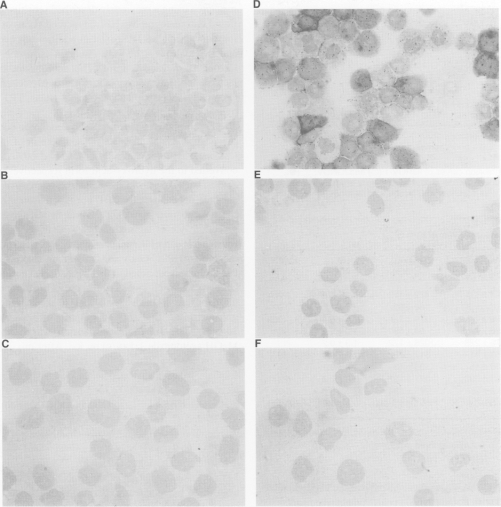
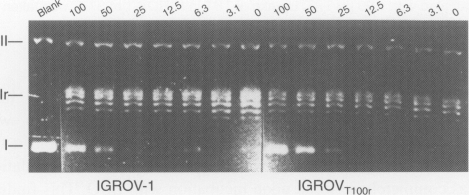
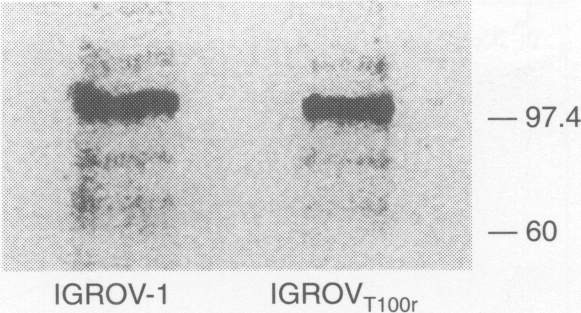
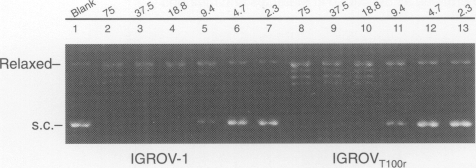
In order to unravel possible mechanisms of clinical resistance to topoisomerase I inhibitors, we developed a topotecan-resistant human IGROV-1 ovarian cancer cell line, denoted IGROV(T100r), by stepwise increased exposure to topotecan (TPT). The IGROV(T100r) cell line was 29-fold resistant to TPT and strongly cross-resistant to SN-38 (51-fold). However, the IGROV(T100r) showed only threefold resistance to camptothecin (CPT). Remarkably, this cell line was 32-fold resistant to mitoxantrone, whereas no significant cross-resistance against other cytostatic drugs was observed. No differences in topoisomerase I protein levels and catalytic activity as well as topoisomerase I cleavable complex stabilization by CPT in the IGROV-1 and IGROV(T100r) cell lines were observed, indicating that resistance in the IGROV(T100r) cell line was not related to topoisomerase I-related changes. However, resistance in the resistant IGROV(T100r) cell line to TPT and SN-38 was accompanied by decreased accumulation of the drugs to approximately 15% and 36% of that obtained in IGROV-1 respectively. No reduced accumulation was observed for CPT. Notably, accumulation of TPT in the IGROV-1 cell line decreased under energy-deprived conditions, whereas the accumulation in the IGROV(T100r) cell line increased under these energy-deprived conditions. The efflux of TPT at 37 degrees C was very rapid in the IGROV-1 as well as the IGROV(T100r) cell line, resulting in 90% efflux within 20 min. Importantly, the efflux rates of TPT in the IGROV-1 and IGROV(T100r) cell lines were not significantly different and were shown to be independent on P-glycoprotein (P-gp) or multidrug resistance-associated protein (MRP). These results strongly suggest that the resistance of the IGROV(T100r) cell line to TPT and SN-38 is mainly caused by reduced accumulation. The reduced accumulation appears to be mediated by a novel mechanism, probably related to impaired energy-dependent uptake of these topoisomerase I drugs.
为了阐明对拓扑异构酶I抑制剂产生临床耐药性的可能机制,我们通过逐步增加对拓扑替康(TPT)的暴露,建立了一种对拓扑替康耐药的人IGROV-1卵巢癌细胞系,命名为IGROV(T100r)。IGROV(T100r)细胞系对TPT的耐药性为29倍,对SN-38具有强烈的交叉耐药性(51倍)。然而,IGROV(T100r)对喜树碱(CPT)仅表现出3倍的耐药性。值得注意的是,该细胞系对米托蒽醌的耐药性为32倍,而未观察到对其他细胞毒性药物的显著交叉耐药性。在IGROV-1和IGROV(T100r)细胞系中,未观察到拓扑异构酶I蛋白水平、催化活性以及CPT对拓扑异构酶I可裂解复合物稳定性的差异,这表明IGROV(T100r)细胞系中的耐药性与拓扑异构酶I相关的变化无关。然而,耐药的IGROV(T100r)细胞系对TPT和SN-38的耐药性伴随着药物积累的减少,分别降至IGROV-1细胞系中积累量的约15%和36%。未观察到CPT的积累减少。值得注意的是,在能量缺乏条件下,IGROV-1细胞系中TPT的积累减少,而在这些能量缺乏条件下,IGROV(T100r)细胞系中TPT的积累增加。在37℃时,TPT在IGROV-1和IGROV(T100r)细胞系中的外排都非常迅速,在20分钟内导致90%的外排。重要的是,IGROV-1和IGROV(T100r)细胞系中TPT的外排速率没有显著差异,并且显示与P-糖蛋白(P-gp)或多药耐药相关蛋白(MRP)无关。这些结果强烈表明,IGROV(T100r)细胞系对TPT和SN-38的耐药性主要是由积累减少引起的。积累减少似乎是由一种新机制介导的,可能与这些拓扑异构酶I药物的能量依赖性摄取受损有关。