Xu X Z, Choudhury A, Li X, Montell C
Department of Biological Chemistry and Department of Neuroscience, The Johns Hopkins University School of Medicine, Baltimore, Maryland 21205, USA.
J Cell Biol. 1998 Jul 27;142(2):545-55. doi: 10.1083/jcb.142.2.545.
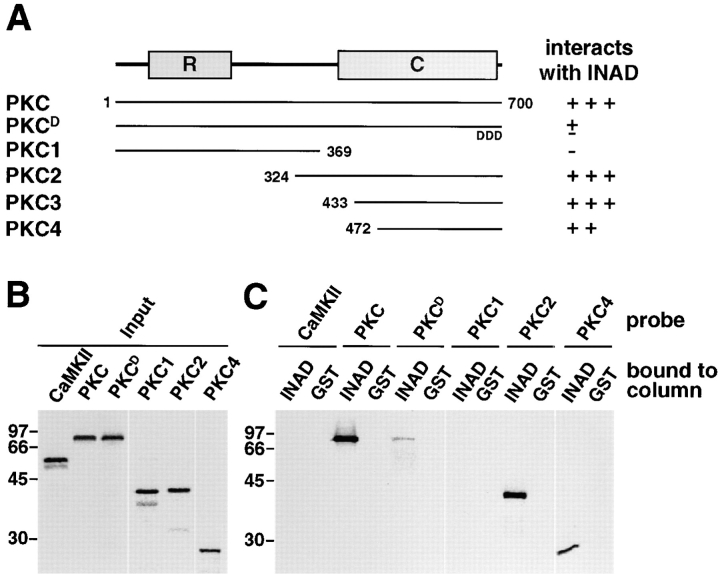
The rapid activation and feedback regulation of many G protein signaling cascades raises the possibility that the critical signaling proteins may be tightly coupled. Previous studies show that the PDZ domain containing protein INAD, which functions in Drosophila vision, coordinates a signaling complex by binding directly to the light-sensitive ion channel, TRP, and to phospholipase C (PLC). The INAD signaling complex also includes rhodopsin, protein kinase C (PKC), and calmodulin, though it is not known whether these proteins bind to INAD. In the current work, we show that rhodopsin, calmodulin, and PKC associate with the signaling complex by direct binding to INAD. We also found that a second ion channel, TRPL, bound to INAD. Thus, most of the proteins involved directly in phototransduction appear to bind to INAD. Furthermore, we found that INAD formed homopolymers and the homomultimerization occurred through two PDZ domains. Thus, we propose that the INAD supramolecular complex is a higher order signaling web consisting of an extended network of INAD molecules through which a G protein-coupled cascade is tethered.
许多G蛋白信号级联反应的快速激活和反馈调节增加了关键信号蛋白可能紧密偶联的可能性。先前的研究表明,在果蝇视觉中起作用的含PDZ结构域的蛋白INAD通过直接结合光敏感离子通道TRP和磷脂酶C(PLC)来协调信号复合物。INAD信号复合物还包括视紫红质、蛋白激酶C(PKC)和钙调蛋白,不过尚不清楚这些蛋白是否与INAD结合。在当前的研究中,我们表明视紫红质、钙调蛋白和PKC通过直接结合INAD与信号复合物相关联。我们还发现第二个离子通道TRPL与INAD结合。因此,大多数直接参与光转导的蛋白似乎都与INAD结合。此外,我们发现INAD形成同聚物,并且同多聚化通过两个PDZ结构域发生。因此,我们提出INAD超分子复合物是一个更高阶的信号网络,由INAD分子的扩展网络组成,通过该网络G蛋白偶联级联反应被束缚。