Ferrari D, Stepczynska A, Los M, Wesselborg S, Schulze-Osthoff K
Department of Internal Medicine I, Eberhard-Karls University, D-72076 Tübingen, Germany.
J Exp Med. 1998 Sep 7;188(5):979-84. doi: 10.1084/jem.188.5.979.
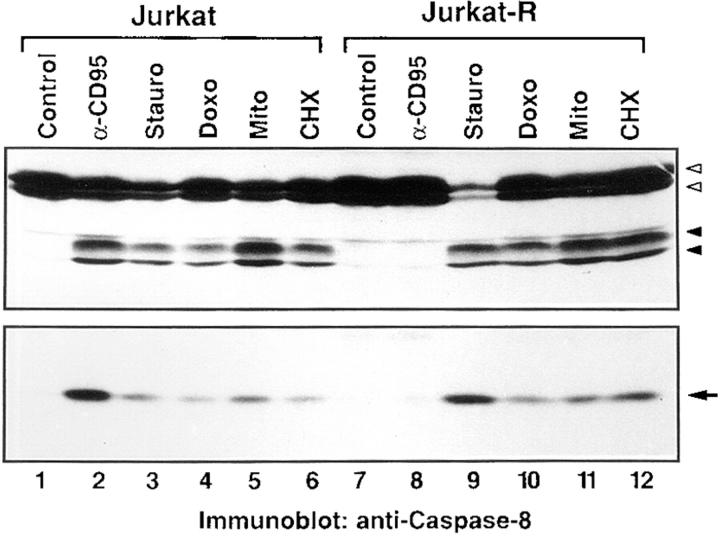
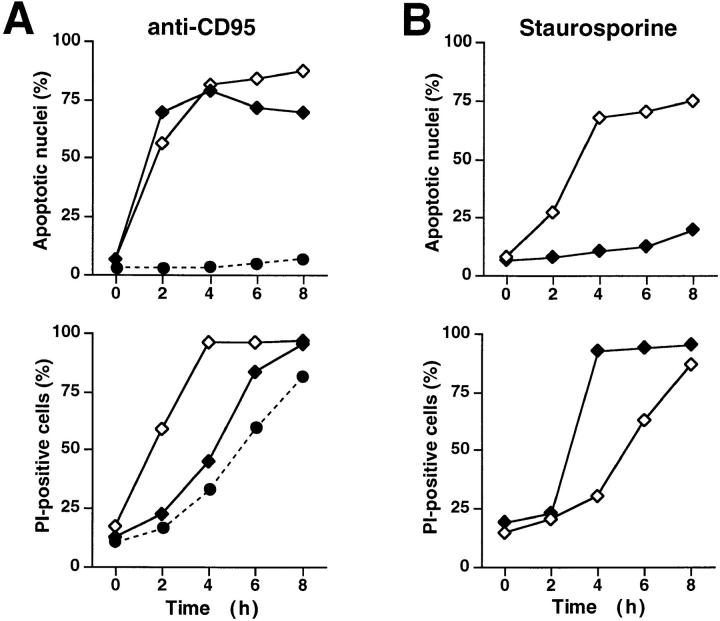
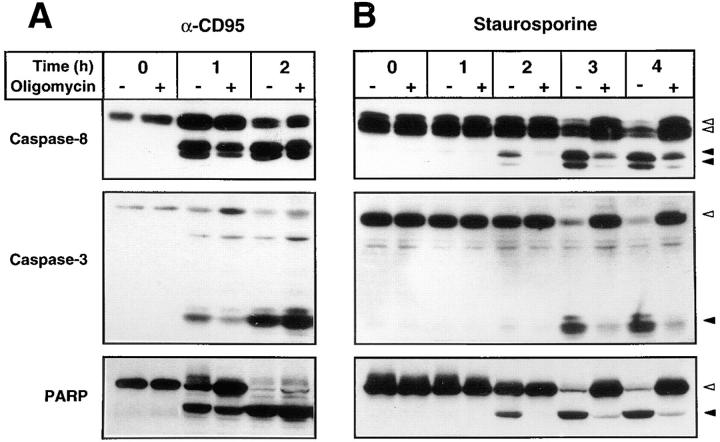
Apoptosis is induced by different stimuli, among them triggering of the death receptor CD95, staurosporine, and chemotherapeutic drugs. In all cases, apoptosis is mediated by caspases, although it is unclear how these diverse apoptotic stimuli cause protease activation. Two regulatory pathways have been recently identified, but it remains unknown whether they are functionally independent or linked to each other. One is mediated by recruitment of the proximal regulator caspase-8 to the death receptor complex. The other pathway is controlled by the release of cytochrome c from mitochondria and the subsequent ATP-dependent activation of the death regulator apoptotic protease-activating factor 1 (Apaf-1). Here, we report that both pathways can be dissected by depletion of intracellular ATP. Prevention of ATP production completely inhibited caspase activation and apoptosis in response to chemotherapeutic drugs and staurosporine. Interestingly, caspase-8, whose function appeared to be restricted to death receptors, was also activated by these drugs under normal conditions, but not after ATP depletion. In contrast, inhibition of ATP production did not affect caspase activation after triggering of CD95. These results suggest that chemotherapeutic drug-induced caspase activation is entirely controlled by a receptor-independent mitochondrial pathway, whereas CD95-induced apoptosis can be regulated by a separate pathway not requiring Apaf-1 function.
凋亡可由不同刺激诱导,其中包括死亡受体CD95的激活、星形孢菌素和化疗药物。在所有情况下,凋亡均由半胱天冬酶介导,尽管尚不清楚这些不同的凋亡刺激如何导致蛋白酶激活。最近已鉴定出两条调节途径,但它们在功能上是独立的还是相互关联的仍不清楚。一条途径是通过将近端调节因子半胱天冬酶-8募集到死亡受体复合物来介导的。另一条途径则由细胞色素c从线粒体释放以及随后依赖ATP的死亡调节因子凋亡蛋白酶激活因子1(Apaf-1)的激活所控制。在此,我们报告这两条途径均可通过消耗细胞内ATP来进行剖析。阻止ATP产生可完全抑制化疗药物和星形孢菌素诱导的半胱天冬酶激活和凋亡。有趣的是,其功能似乎仅限于死亡受体的半胱天冬酶-8,在正常条件下也可被这些药物激活,但在ATP耗竭后则不能。相反,抑制ATP产生并不影响CD95激活后半胱天冬酶的激活。这些结果表明,化疗药物诱导的半胱天冬酶激活完全由一条不依赖受体的线粒体途径控制,而CD95诱导的凋亡可由一条不依赖Apaf-1功能的独立途径调节。