Gary J D, Wurmser A E, Bonangelino C J, Weisman L S, Emr S D
Division of Cellular and Molecular Medicine and Howard Hughes Medical Institute, University of California at San Diego, School of Medicine, La Jolla, California 92093-0668, USA.
J Cell Biol. 1998 Oct 5;143(1):65-79. doi: 10.1083/jcb.143.1.65.
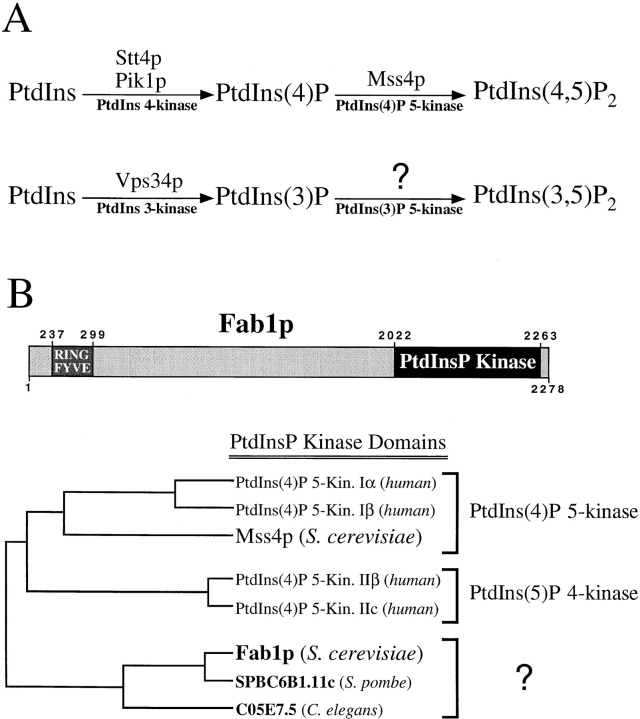
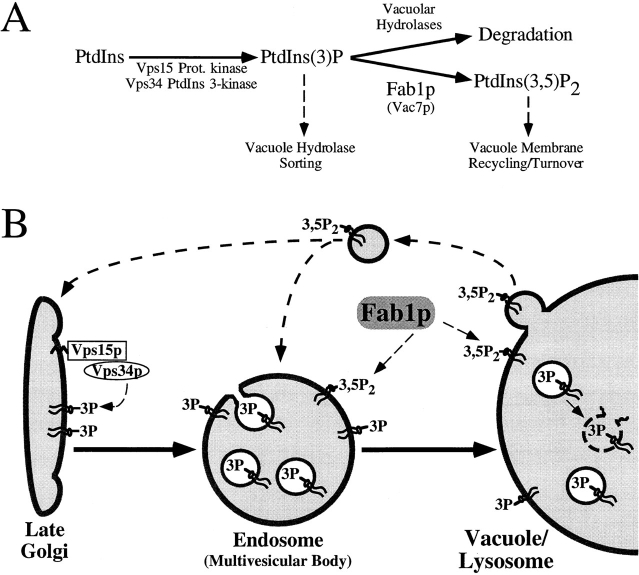
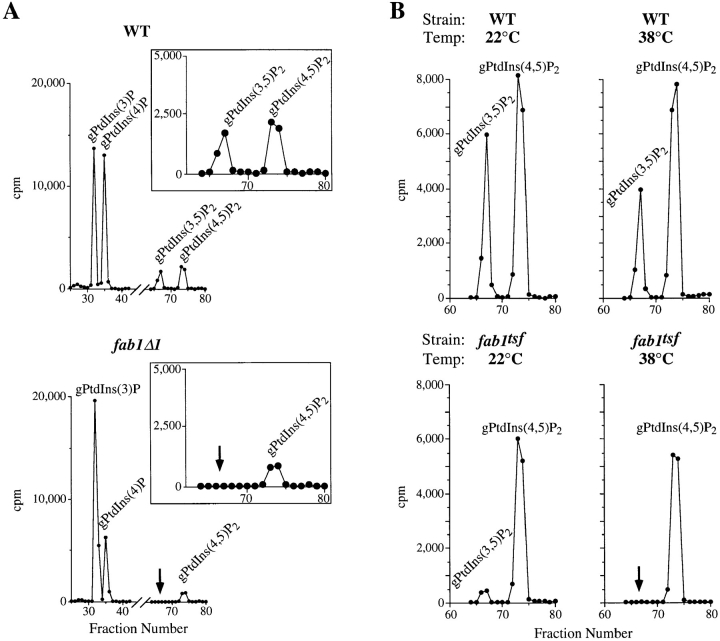
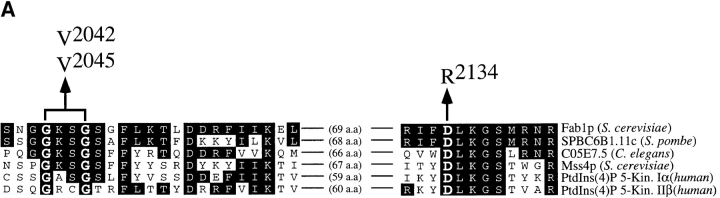
The Saccharomyces cerevisiae FAB1 gene encodes a 257-kD protein that contains a cysteine-rich RING-FYVE domain at its NH2-terminus and a kinase domain at its COOH terminus. Based on its sequence, Fab1p was initially proposed to function as a phosphatidylinositol 4-phosphate (PtdIns(4)P) 5-kinase (). Additional sequence analysis of the Fab1p kinase domain, reveals that Fab1p defines a subfamily of putative PtdInsP kinases that is distinct from the kinases that synthesize PtdIns(4,5)P2. Consistent with this, we find that unlike wild-type cells, fab1Delta, fab1(tsf), and fab1 kinase domain point mutants lack detectable levels of PtdIns(3,5)P2, a phosphoinositide recently identified both in yeast and mammalian cells. PtdIns(4,5)P2 synthesis, on the other hand, is only moderately affected even in fab1Delta mutants. The presence of PtdIns(3)P in fab1 mutants, combined with previous data, indicate that PtdIns(3,5)P2 synthesis is a two step process, requiring the production of PtdIns(3)P by the Vps34p PtdIns 3-kinase and the subsequent Fab1p- dependent phosphorylation of PtdIns(3)P yielding PtdIns(3,5)P2. Although Vps34p-mediated synthesis of PtdIns(3)P is required for the proper sorting of hydrolases from the Golgi to the vacuole, the production of PtdIns(3,5)P2 by Fab1p does not directly affect Golgi to vacuole trafficking, suggesting that PtdIns(3,5)P2 has a distinct function. The major phenotypes resulting from Fab1p kinase inactivation include temperature-sensitive growth, vacuolar acidification defects, and dramatic increases in vacuolar size. Based on our studies, we hypothesize that whereas Vps34p is essential for anterograde trafficking of membrane and protein cargoes to the vacuole, Fab1p may play an important compensatory role in the recycling/turnover of membranes deposited at the vacuole. Interestingly, deletion of VAC7 also results in an enlarged vacuole morphology and has no detectable PtdIns(3,5)P2, suggesting that Vac7p functions as an upstream regulator, perhaps in a complex with Fab1p. We propose that Fab1p and Vac7p are components of a signal transduction pathway which functions to regulate the efflux or turnover of vacuolar membranes through the regulated production of PtdIns(3,5)P2.
酿酒酵母FAB1基因编码一种257-kD的蛋白质,该蛋白质在其NH2末端含有一个富含半胱氨酸的RING-FYVE结构域,在其COOH末端含有一个激酶结构域。根据其序列,最初推测Fab1p作为磷脂酰肌醇4-磷酸(PtdIns(4)P)5-激酶发挥作用()。对Fab1p激酶结构域的进一步序列分析表明,Fab1p定义了一个假定的PtdInsP激酶亚家族,该亚家族不同于合成PtdIns(4,5)P2的激酶。与此一致的是,我们发现与野生型细胞不同,fab1Delta、fab1(tsf)和fab1激酶结构域点突变体缺乏可检测水平的PtdIns(3,5)P2,这是一种最近在酵母和哺乳动物细胞中都已鉴定出的磷酸肌醇。另一方面,即使在fab1Delta突变体中,PtdIns(4,5)P2的合成也只是受到适度影响。fab1突变体中PtdIns(3)P的存在,结合先前的数据,表明PtdIns(3,5)P2的合成是一个两步过程,需要Vps34p PtdIns 3-激酶产生PtdIns(3)P,随后由Fab1p依赖的PtdIns(3)P磷酸化产生PtdIns(3,5)P2。虽然Vps34p介导的PtdIns(3)P合成对于水解酶从高尔基体到液泡的正确分选是必需的,但Fab1p产生PtdIns(3,5)P2并不直接影响从高尔基体到液泡的运输,这表明PtdIns(3,5)P2具有独特的功能。Fab1p激酶失活导致的主要表型包括温度敏感型生长、液泡酸化缺陷以及液泡大小显著增加。基于我们的研究,我们推测,虽然Vps34p对于膜和蛋白质货物向液泡的顺向运输至关重要,但Fab1p可能在沉积在液泡的膜的回收/周转中发挥重要的补偿作用。有趣的是,VAC7的缺失也会导致液泡形态增大且没有可检测到的PtdIns(3,5)P2,这表明Vac7p作为上游调节因子发挥作用,可能与Fab1p形成复合物。我们提出Fab1p和Vac7p是信号转导途径的组成部分,该途径通过调节PtdIns(3,5)P2的产生来调节液泡膜的流出或周转。