Karupiah G, Chen J H, Mahalingam S, Nathan C F, MacMicking J D
Host Defense Laboratory, Viral Engineering and Cytokines Group, Division of Immunology and Cell Biology, The John Curtin School of Medical Research, The Australian National University, Canberra, ACT 2601, Australia.
J Exp Med. 1998 Oct 19;188(8):1541-6. doi: 10.1084/jem.188.8.1541.
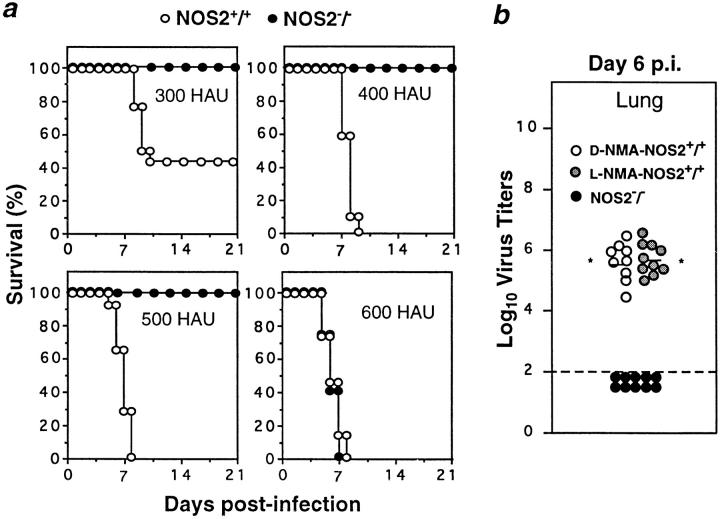
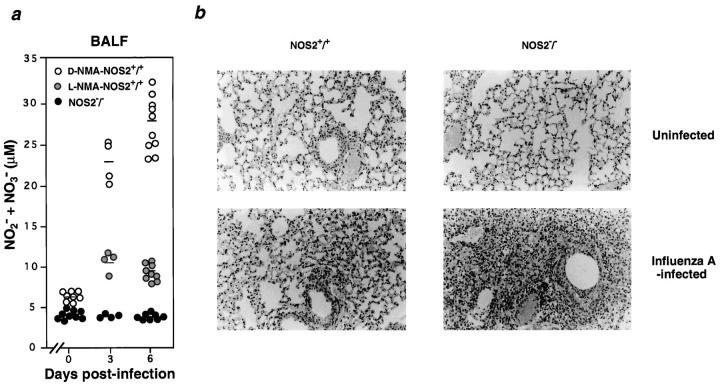
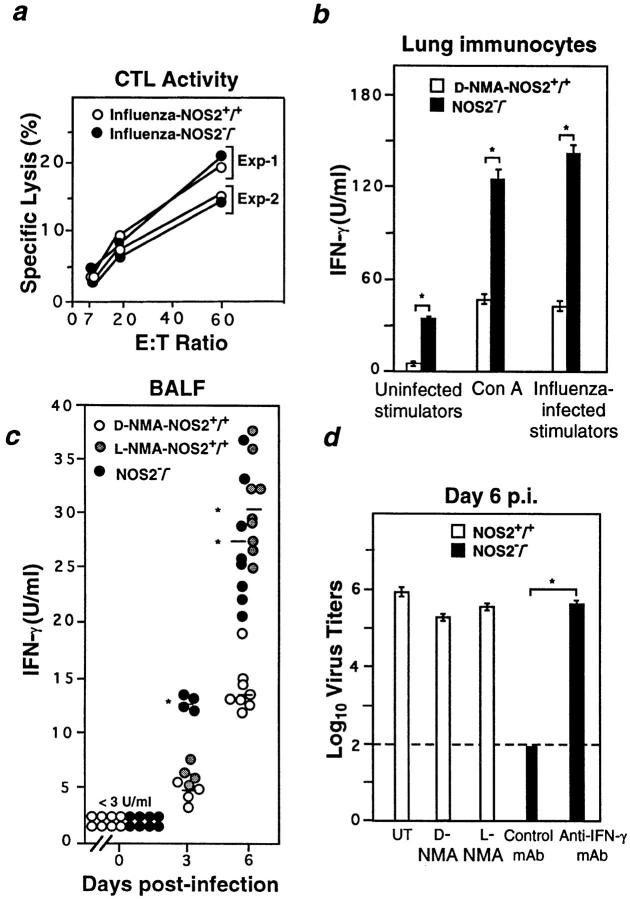
Viral infection often activates the interferon (IFN)-gamma-inducible gene, nitric oxide synthase 2 (NOS2). Expression of NOS2 can limit viral growth but may also suppress the immune system and damage tissue. This study assessed each of these effects in genetically deficient NOS2(-/-) mice after infection with influenza A, a virus against which IFN-gamma has no known activity. At inocula sufficient to cause consolidating pneumonitis and death in wild-type control mice, NOS2(-/-) hosts survived with little histopathologic evidence of pneumonitis. Moreover, they cleared influenza A virus from their lungs by an IFN-gamma-dependent mechanism that was not evident in wild-type mice. Even when the IFN-gamma-mediated antiviral activity was blocked in NOS2(-/-) mice with anti-IFN-gamma mAb, such mice failed to succumb to disease. Further evidence that this protection was independent of viral load was provided by treating NOS2(+/+) mice with the NOS inhibitor, Nomega-methyl-L-arginine (L-NMA). L-NMA prevented mortality without affecting viral growth. Thus, host NOS2 seems to contribute more significantly to the development of influenza pneumonitis in mice than the cytopathic effects of viral replication. Although NOS2 mediates some antiviral effects of IFN-gamma, during influenza infection it can suppress another IFN-gamma-dependent antiviral mechanism. This mechanism was observed only in the complete absence of NOS2 activity and appeared sufficient to control influenza A virus growth in the absence of changes in cytotoxic T lymphocyte activity.
病毒感染常常会激活干扰素(IFN)-γ诱导基因——一氧化氮合酶2(NOS2)。NOS2的表达可以限制病毒生长,但也可能抑制免疫系统并损害组织。本研究评估了甲型流感病毒感染基因缺陷型NOS2(-/-)小鼠后这些效应中的每一种,IFN-γ对该病毒没有已知活性。在接种足以在野生型对照小鼠中引起实变肺炎和死亡的剂量时,NOS2(-/-)宿主存活下来,几乎没有肺炎的组织病理学证据。此外,它们通过一种野生型小鼠中不明显的IFN-γ依赖性机制从肺部清除了甲型流感病毒。即使在用抗IFN-γ单克隆抗体阻断NOS2(-/-)小鼠中IFN-γ介导的抗病毒活性时,这些小鼠也未死于疾病。用NOS抑制剂Nω-甲基-L-精氨酸(L-NMA)处理NOS2(+/ +)小鼠,进一步证明了这种保护作用与病毒载量无关。L-NMA可预防死亡而不影响病毒生长。因此,宿主NOS2对小鼠流感肺炎发展的作用似乎比病毒复制的细胞病变效应更显著。虽然NOS2介导了IFN-γ的一些抗病毒作用,但在流感感染期间,它可以抑制另一种IFN-γ依赖性抗病毒机制。这种机制仅在完全缺乏NOS2活性时观察到,并且在细胞毒性T淋巴细胞活性没有变化的情况下似乎足以控制甲型流感病毒的生长。