Natarajan V, Scribner W M, al-Hassani M, Vepa S
Indiana University School of Medicine, Indianapolis, USA.
Environ Health Perspect. 1998 Oct;106 Suppl 5(Suppl 5):1205-12. doi: 10.1289/ehp.98106s51205.
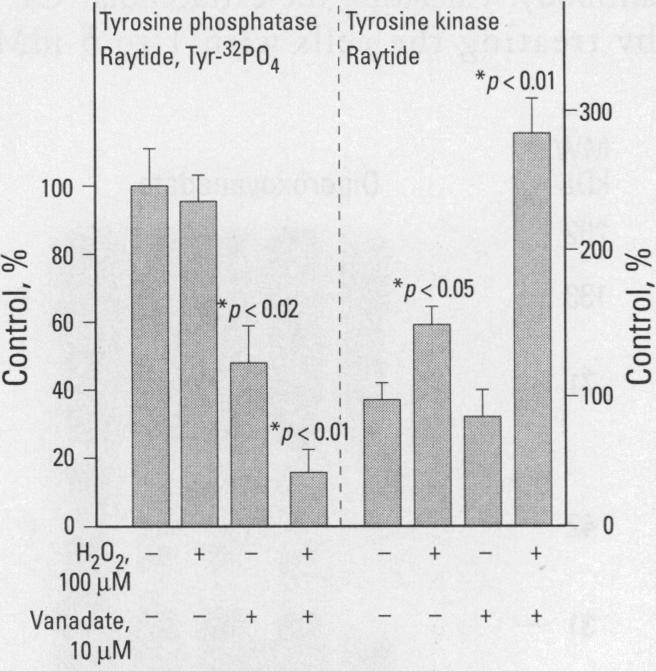
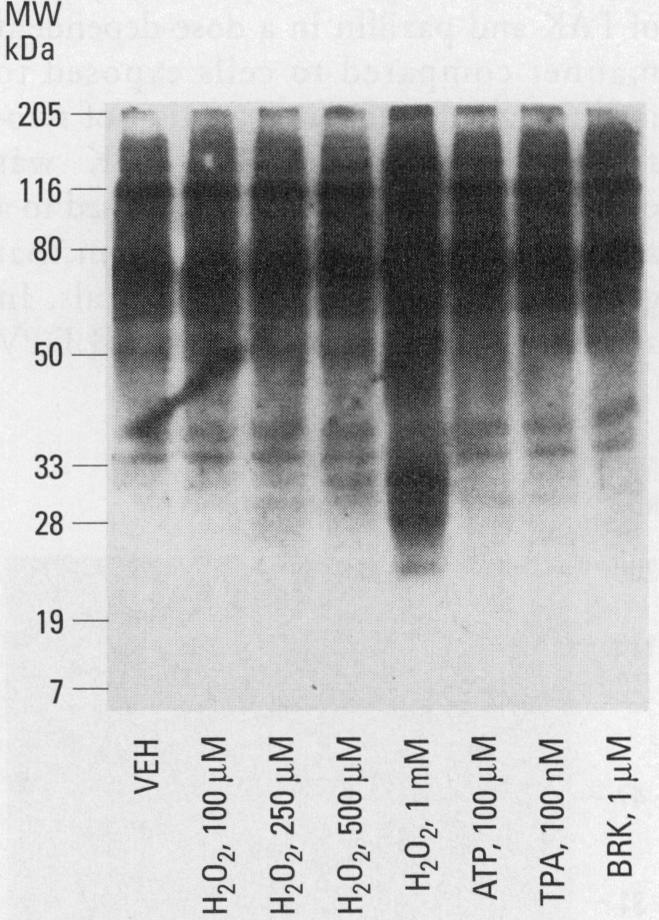
Tyrosine phosphorylation of proteins, controlled by tyrosine kinases and protein tyrosine phosphatases, plays a key role in cellular growth and differentiating. A wide variety of hormones, growth factors, and cytokines modulate cellular tyrosine phosphorylation to transmit signals across the plasma membrane to the nucleus. Recent studies suggest that reactive oxygen species (ROS) also induce cellular protein tyrosine phosphorylation through receptor or nonreceptor tyrosine kinases. To determine whether protein tyrosine phosphorylation by ROS regulates endothelial cell (EC) metabolism and function, we exposed vascular ECs to H2O2 or H2O2 plus vanadate. This resulted in a time- and dose-dependent increase in protein tyrosine phosphorylation of several proteins (M(r) 21-200 kDa), as determined by immunoprecipitation and Western blot analysis with antiphosphotyrosine antibody. Immunoprecipitation with specific antibodies identified increased tyrosine phosphorylation of mitogen-activated protein kinases (42-44 kDa), paxillin (68 kDa), and FAK (125 kDa) by ROS. An immediate signaling response to increased protein tyrosine phosphorylation by ROS was activation of phospholipases such as A2, C, and D. Suramin pretreatment inhibited ROS stimulation of phospholipase D (PLD), suggesting a role for growth factor receptors in this activation. Further, PLD activation by ROS was attenuated by N-acetylcysteine, indicating that intracellular thiol status is critical to ROS-mediated signal transduction. These results provide evidence that ROS modulate EC signal transduction via a protein tyrosine phosphorylation-dependent mechanism.
由酪氨酸激酶和蛋白酪氨酸磷酸酶控制的蛋白质酪氨酸磷酸化在细胞生长和分化中起关键作用。多种激素、生长因子和细胞因子调节细胞酪氨酸磷酸化,以将信号穿过质膜传递至细胞核。最近的研究表明,活性氧(ROS)也通过受体或非受体酪氨酸激酶诱导细胞蛋白酪氨酸磷酸化。为了确定ROS介导的蛋白酪氨酸磷酸化是否调节内皮细胞(EC)的代谢和功能,我们将血管内皮细胞暴露于过氧化氢(H2O2)或H2O2加钒酸盐中。通过免疫沉淀和用抗磷酸酪氨酸抗体进行的蛋白质印迹分析确定,这导致几种蛋白质(分子量21 - 200 kDa)的蛋白酪氨酸磷酸化呈时间和剂量依赖性增加。用特异性抗体进行免疫沉淀鉴定出ROS使丝裂原活化蛋白激酶(42 - 44 kDa)、桩蛋白(68 kDa)和粘着斑激酶(125 kDa)的酪氨酸磷酸化增加。对ROS介导的蛋白酪氨酸磷酸化增加的即时信号反应是磷脂酶如A2、C和D的激活。苏拉明预处理抑制了ROS对磷脂酶D(PLD)的刺激,表明生长因子受体在这种激活中起作用。此外,N - 乙酰半胱氨酸减弱了ROS对PLD的激活,表明细胞内硫醇状态对ROS介导的信号转导至关重要。这些结果提供了证据,证明ROS通过蛋白酪氨酸磷酸化依赖性机制调节内皮细胞信号转导。