Van de Keere F, Tonegawa S
Howard Hughes Medical Institute, the Center for Cancer Research, and the Department of Biology, Massachusetts Institute of Technology, Cambridge, Massachusetts 02139, USA.
J Exp Med. 1998 Nov 16;188(10):1875-82. doi: 10.1084/jem.188.10.1875.
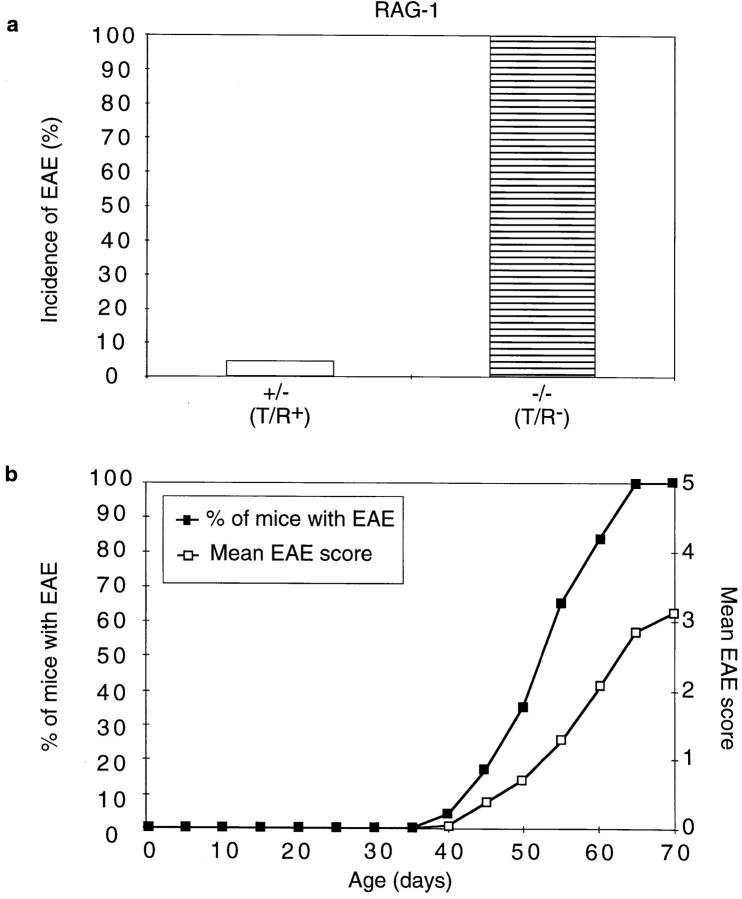
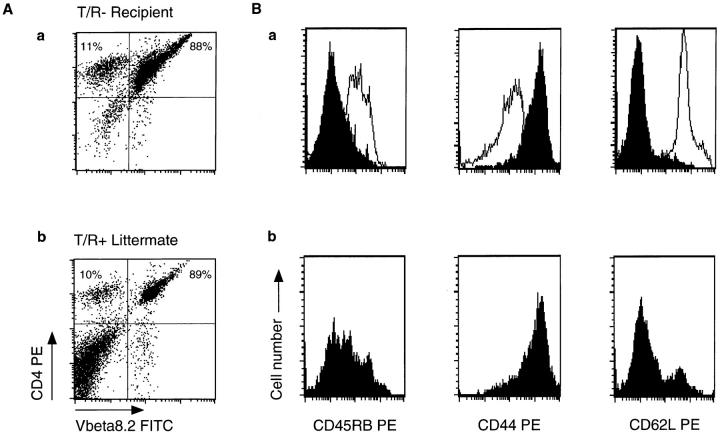
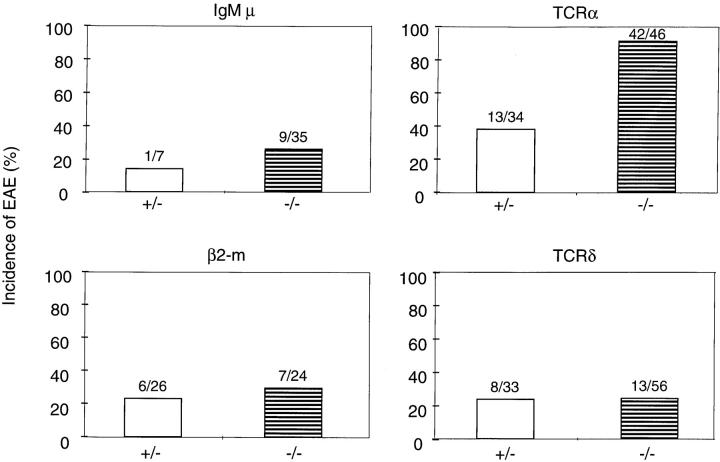
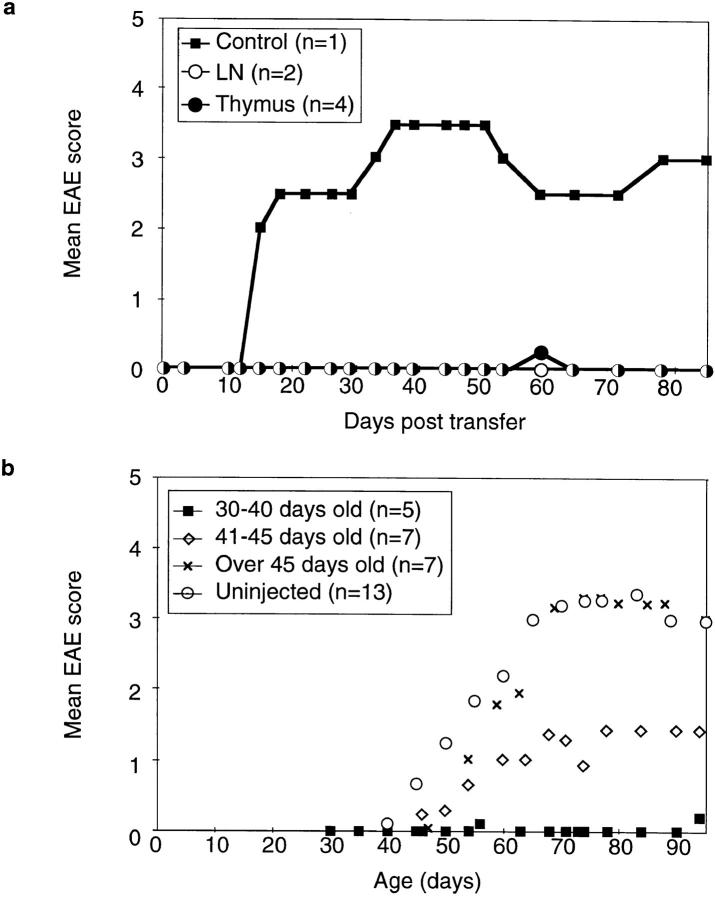
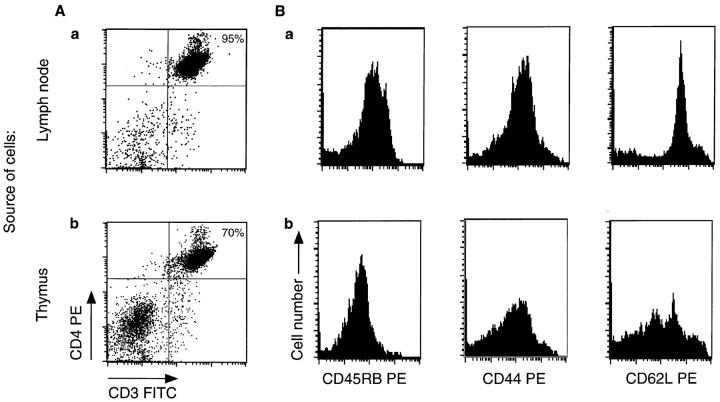
Autoimmune diseases result from a failure of tolerance. Although many self-reactive T cells are present in animals and humans, their activation appears to be prevented normally by regulatory T cells. In this study, we show that regulatory CD4(+) T cells do protect mice against the spontaneous occurrence of experimental autoimmune encephalomyelitis (EAE), a mouse model for multiple sclerosis. Anti-myelin basic protein (MBP) TCR transgenic mice (T/R+) do not spontaneously develop EAE although many self-reactive T cells are present in their thymi and peripheral lymphoid organs. However, the disease develops in all crosses of T/R+ mice with recombination-activating gene (RAG)-1 knockout mice in which transgenic TCR-expressing cells are the only lymphocytes present (T/R- mice). In this study, crosses of T/R+ mice with mice deficient for B cells, CD8(+) T cells, NK1.1 CD4(+) T (NKT) cells, gamma/delta T cells, or alpha/beta T cells indicated that alpha/beta CD4(+) T cells were the only cell population capable of controlling the self-reactive T cells. To confirm the protective role of CD4(+) T cells, we performed adoptive transfer experiments. CD4(+) T cells purified from thymi or lymph nodes of normal mice prevented the occurrence of spontaneous EAE in T/R- mice. To achieve full protection, the cells had to be transferred before the recipient mice manifested any symptoms of the disease. Transfer of CD4(+) T cells after the appearance of symptoms of EAE had no protective effect. These results indicate that at least some CD4(+) T cells have a regulatory function that prevent the activation of self-reactive T cells.
自身免疫性疾病是由免疫耐受失败引起的。尽管动物和人类体内存在许多自身反应性T细胞,但它们的激活通常似乎受到调节性T细胞的抑制。在本研究中,我们发现调节性CD4(+) T细胞确实能保护小鼠免受实验性自身免疫性脑脊髓炎(EAE)的自发发生,EAE是一种多发性硬化症的小鼠模型。抗髓鞘碱性蛋白(MBP)TCR转基因小鼠(T/R+)不会自发发生EAE,尽管其胸腺和外周淋巴器官中存在许多自身反应性T细胞。然而,T/R+小鼠与重组激活基因(RAG)-1基因敲除小鼠的所有杂交后代中都会发生疾病,在这些杂交后代中,表达转基因TCR的细胞是唯一存在的淋巴细胞(T/R-小鼠)。在本研究中,T/R+小鼠与B细胞、CD8(+) T细胞、NK1.1 CD4(+) T(NKT)细胞、γ/δ T细胞或α/β T细胞缺陷小鼠的杂交实验表明,α/β CD4(+) T细胞是唯一能够控制自身反应性T细胞的细胞群体。为了证实CD4(+) T细胞的保护作用,我们进行了过继转移实验。从正常小鼠的胸腺或淋巴结中纯化的CD4(+) T细胞可预防T/R-小鼠自发发生EAE。为了实现完全保护,必须在受体小鼠出现任何疾病症状之前转移这些细胞。在EAE症状出现后转移CD4(+) T细胞没有保护作用。这些结果表明,至少一些CD4(+) T细胞具有调节功能,可防止自身反应性T细胞的激活。