Hirschberg K, Miller C M, Ellenberg J, Presley J F, Siggia E D, Phair R D, Lippincott-Schwartz J
Cell Biology and Metabolism Branch, National Institutes of Health, National Institute of Child Health and Human Development, Bethesda, Maryland 20892, USA.
J Cell Biol. 1998 Dec 14;143(6):1485-503. doi: 10.1083/jcb.143.6.1485.
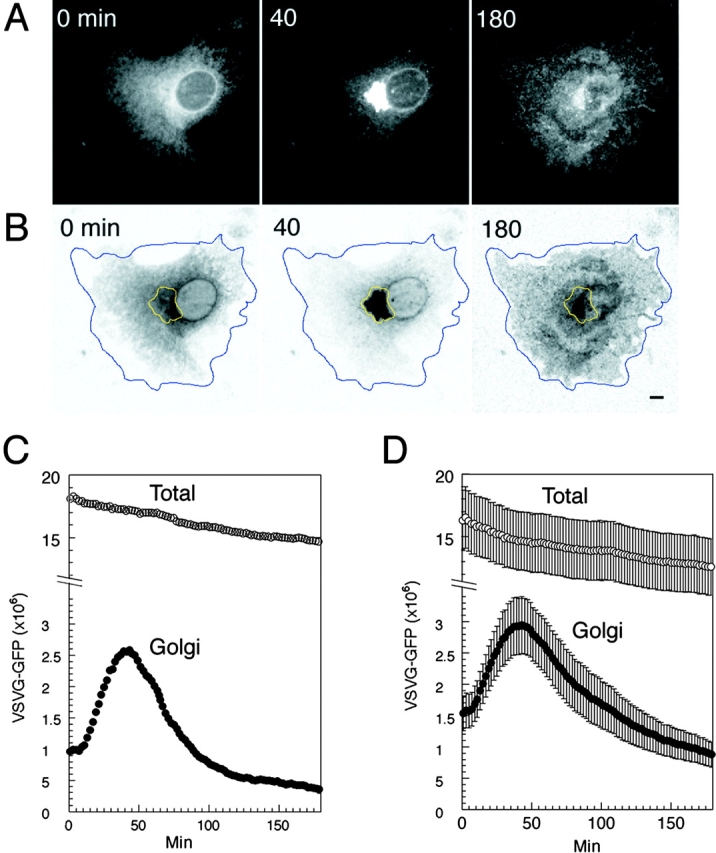
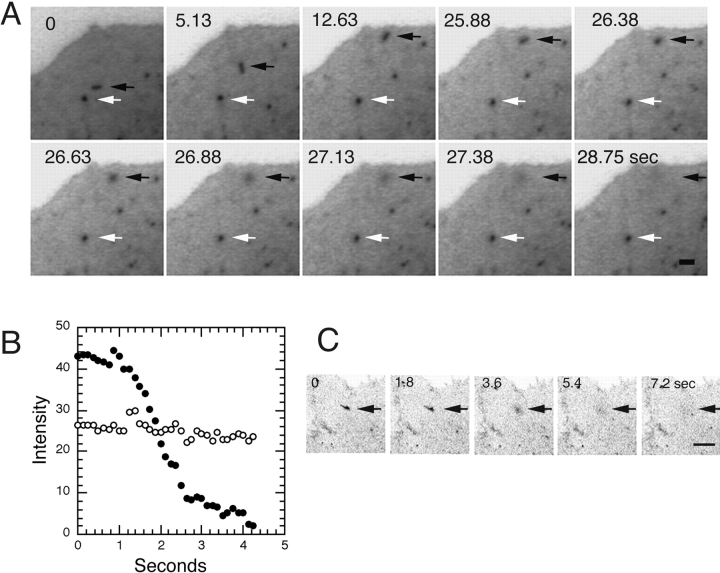
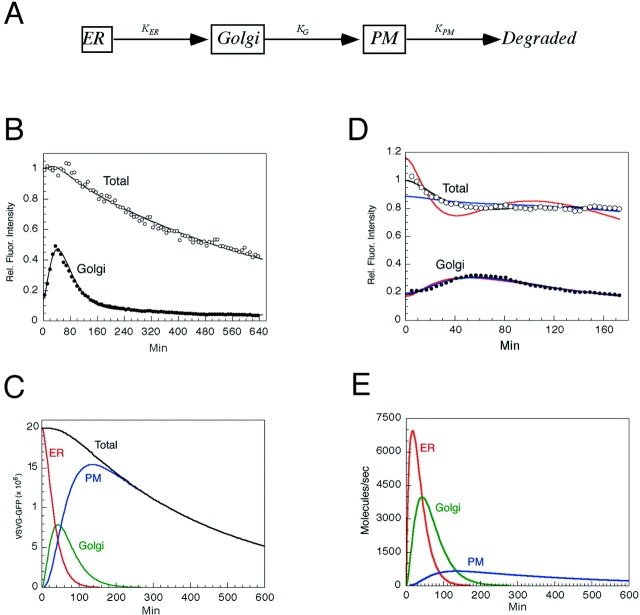
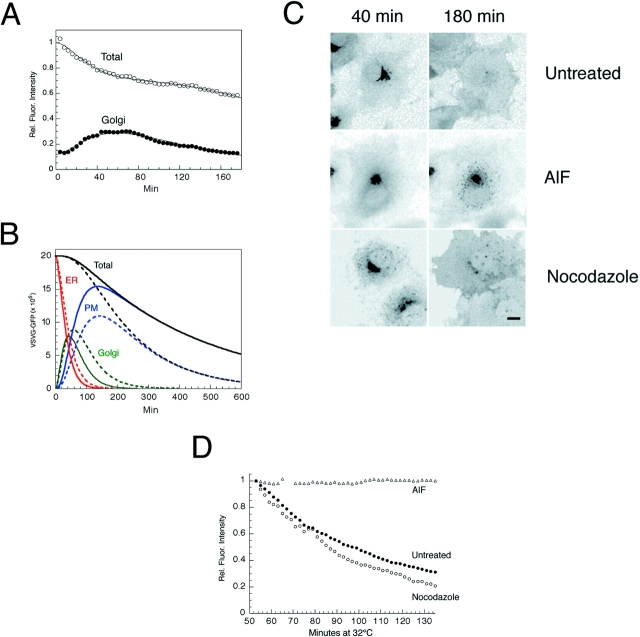
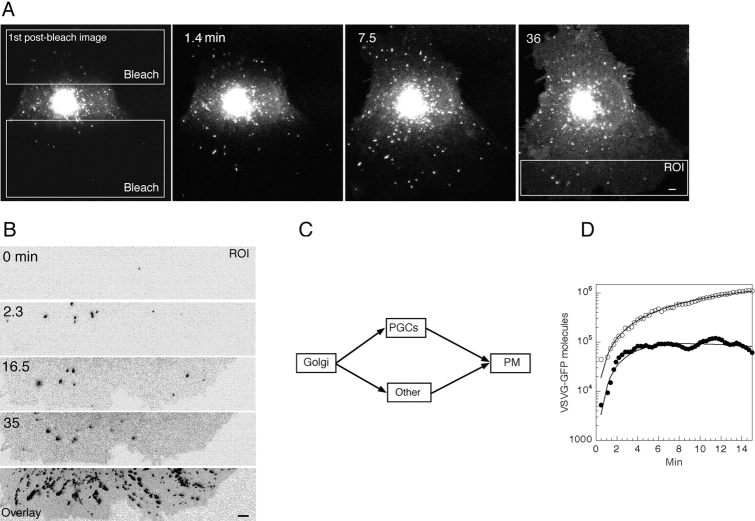
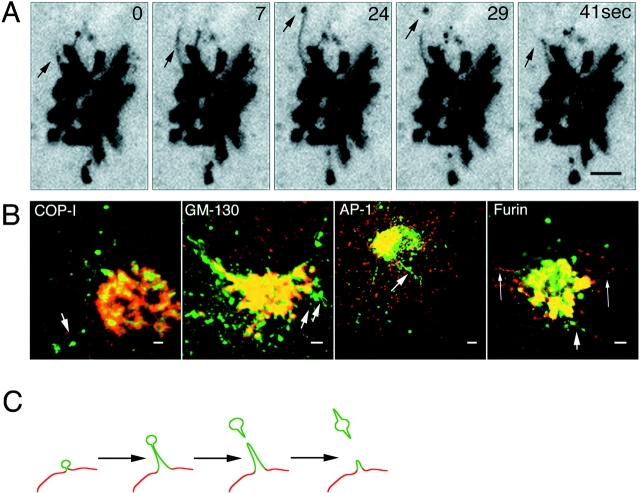
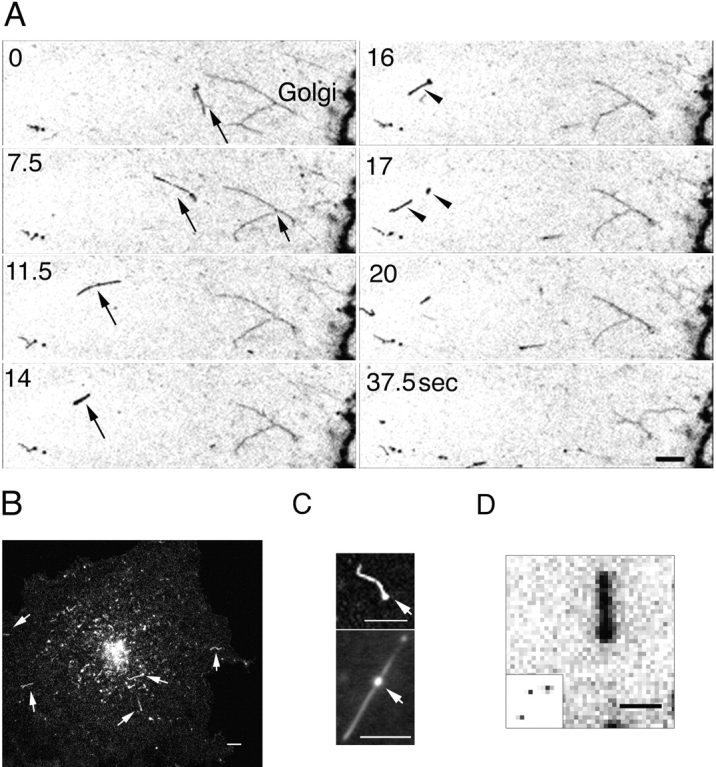
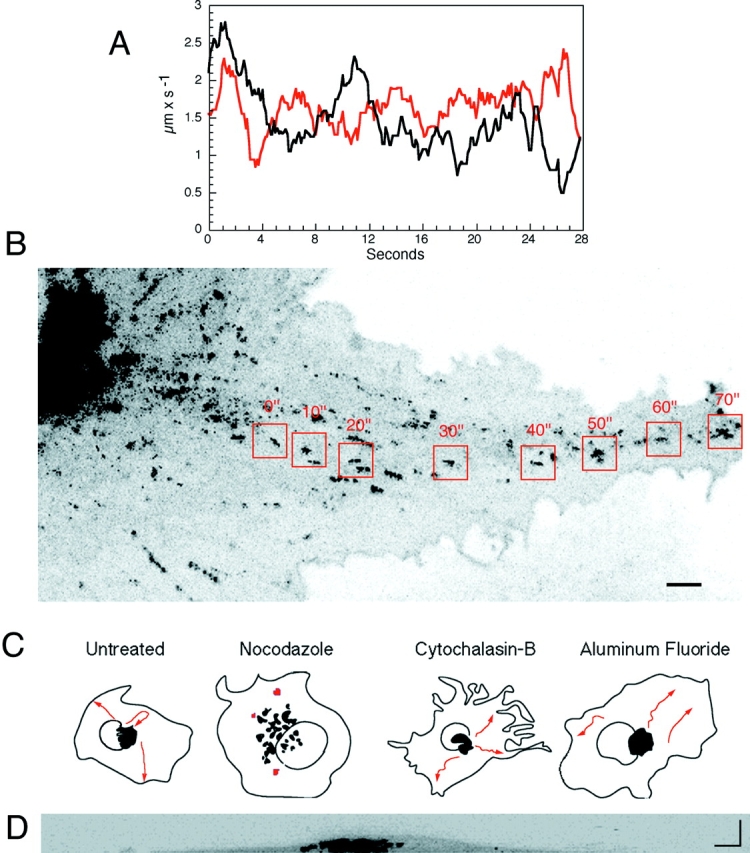
Quantitative time-lapse imaging data of single cells expressing the transmembrane protein, vesicular stomatitis virus ts045 G protein fused to green fluorescent protein (VSVG-GFP), were used for kinetic modeling of protein traffic through the various compartments of the secretory pathway. A series of first order rate laws was sufficient to accurately describe VSVG-GFP transport, and provided compartment residence times and rate constants for transport into and out of the Golgi complex and delivery to the plasma membrane. For ER to Golgi transport the mean rate constant (i.e., the fraction of VSVG-GFP moved per unit of time) was 2.8% per min, for Golgi to plasma membrane transport it was 3.0% per min, and for transport from the plasma membrane to a degradative site it was 0.25% per min. Because these rate constants did not change as the concentration of VSVG-GFP in different compartments went from high (early in the experiment) to low (late in the experiment), secretory transport machinery was never saturated during the experiments. The processes of budding, translocation, and fusion of post-Golgi transport intermediates carrying VSVG- GFP to the plasma membrane were also analyzed using quantitative imaging techniques. Large pleiomorphic tubular structures, rather than small vesicles, were found to be the primary vehicles for Golgi to plasma membrane transport of VSVG-GFP. These structures budded as entire domains from the Golgi complex and underwent dynamic shape changes as they moved along microtubule tracks to the cell periphery. They carried up to 10,000 VSVG-GFP molecules and had a mean life time in COS cells of 3.8 min. In addition, they fused with the plasma membrane without intersecting other membrane transport pathways in the cell. These properties suggest that the post-Golgi intermediates represent a unique transport organelle for conveying large quantities of protein cargo from the Golgi complex directly to the plasma membrane.
对表达与绿色荧光蛋白融合的跨膜蛋白(水泡性口炎病毒ts045 G蛋白,即VSVG-GFP)的单细胞进行定量延时成像数据,用于对蛋白质通过分泌途径各个区室的运输进行动力学建模。一系列一级速率定律足以准确描述VSVG-GFP的运输,并提供了区室停留时间以及进出高尔基体复合体和运输到质膜的速率常数。对于从内质网到高尔基体的运输,平均速率常数(即每分钟移动的VSVG-GFP的比例)为每分钟2.8%,对于从高尔基体到质膜的运输,为每分钟3.0%,而从质膜运输到降解位点的速率为每分钟0.25%。由于这些速率常数不会随着不同区室中VSVG-GFP的浓度从高(实验早期)变为低(实验后期)而改变,因此在实验过程中分泌运输机制从未饱和。还使用定量成像技术分析了携带VSVG-GFP的高尔基体后运输中间体出芽、易位和融合到质膜的过程。发现大型多形管状结构而非小囊泡是VSVG-GFP从高尔基体运输到质膜的主要载体。这些结构作为整个区域从高尔基体复合体出芽,并在沿着微管轨道向细胞周边移动时经历动态形状变化。它们携带多达10,000个VSVG-GFP分子,在COS细胞中的平均寿命为3.8分钟。此外,它们与质膜融合而不与细胞中的其他膜运输途径相交。这些特性表明,高尔基体后中间体代表了一种独特的运输细胞器,用于将大量蛋白质货物从高尔基体复合体直接运输到质膜。