Ladinsky M S, Mastronarde D N, McIntosh J R, Howell K E, Staehelin L A
Laboratory for Three-Dimensional Fine Structure, Cellular, and Developmental Biology, University of Colorado, Boulder, Colorado 80309-0347, USA.
J Cell Biol. 1999 Mar 22;144(6):1135-49. doi: 10.1083/jcb.144.6.1135.
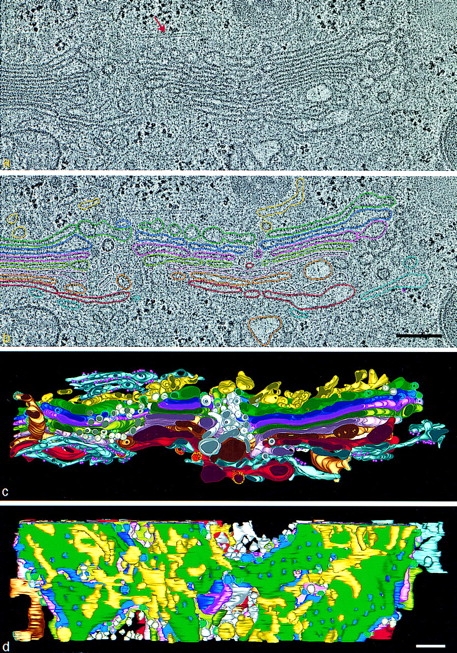
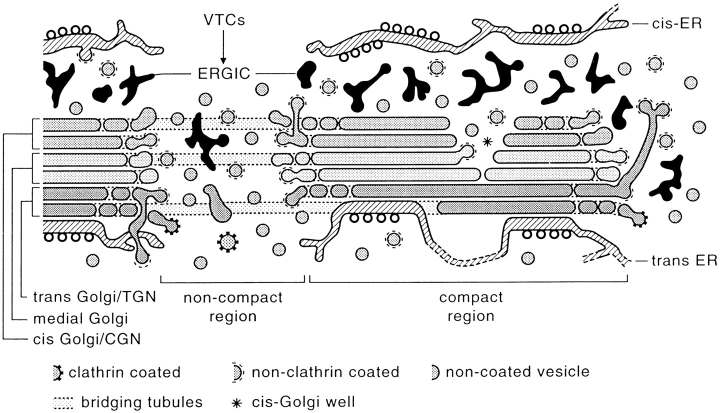
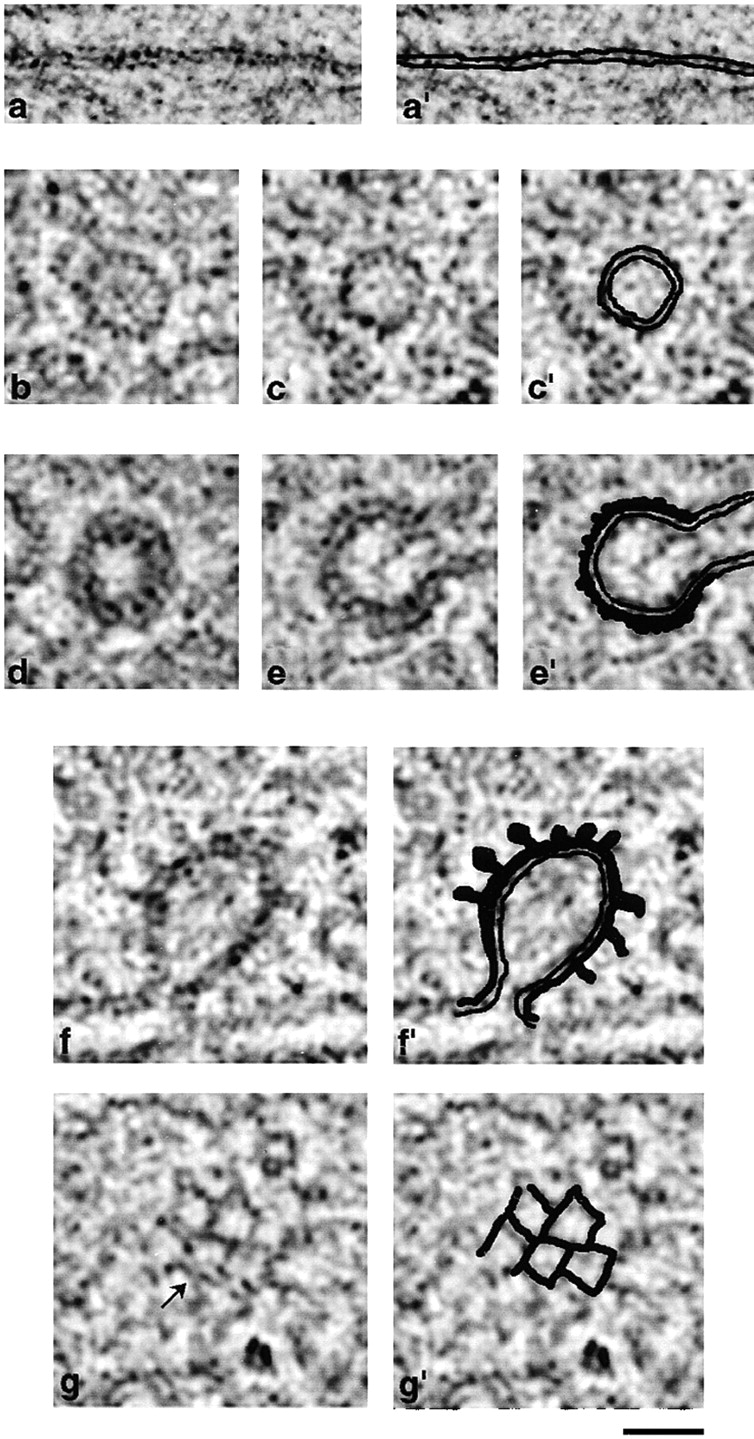
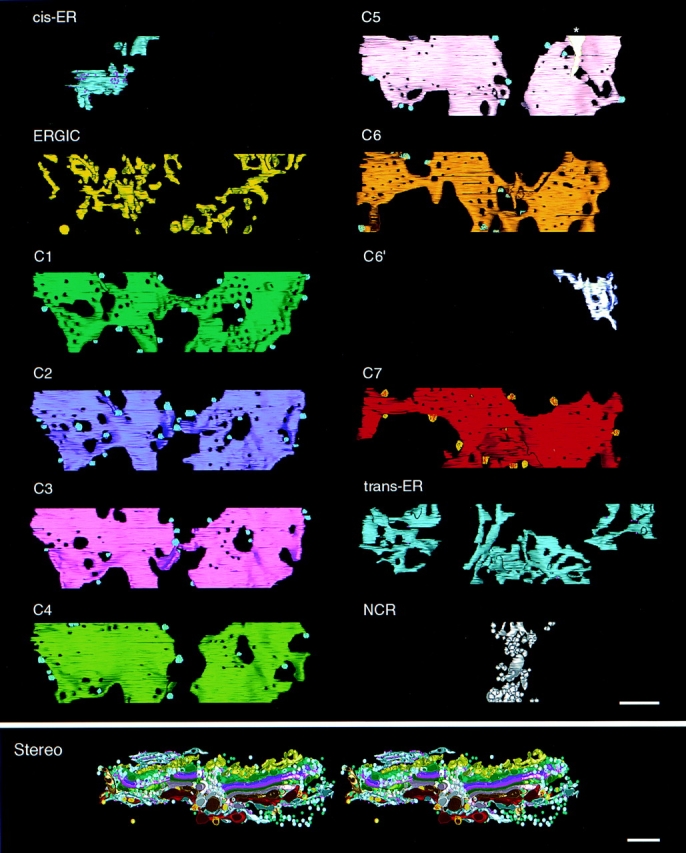
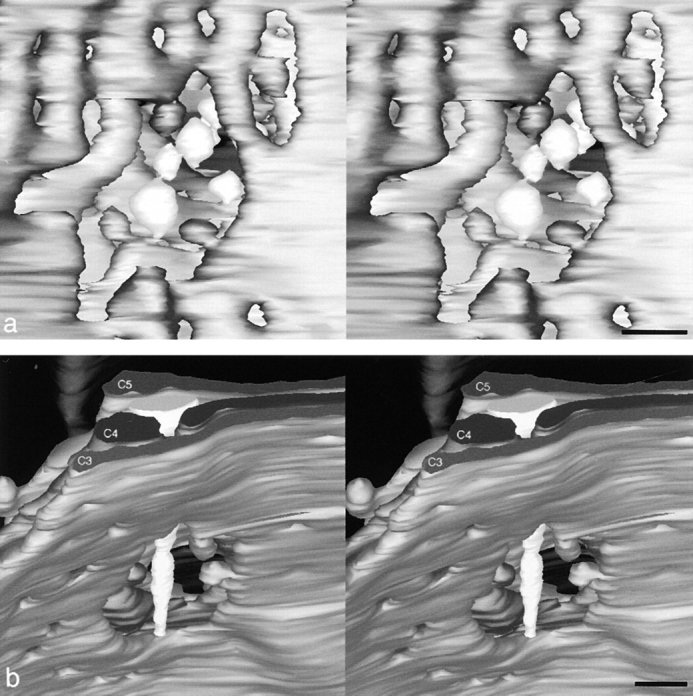
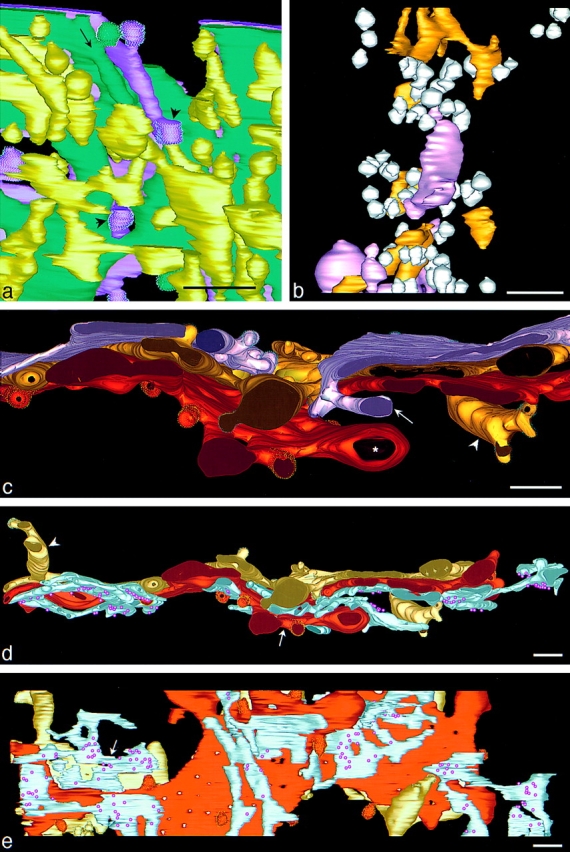
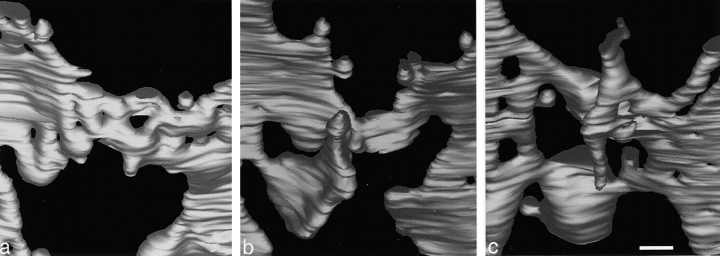
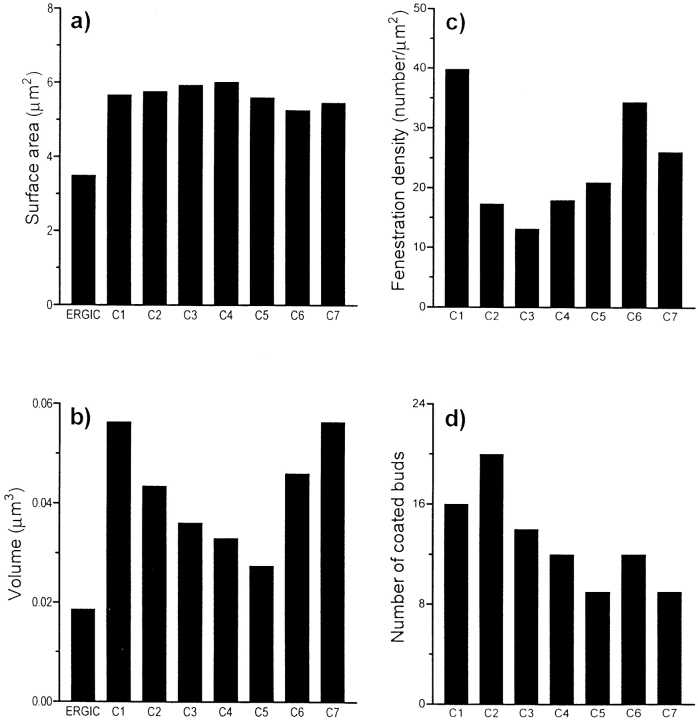
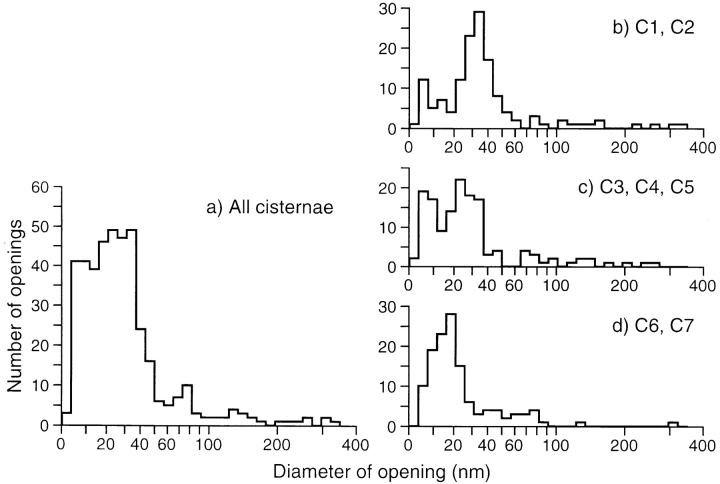
Three-dimensional reconstructions of portions of the Golgi complex from cryofixed, freeze-substituted normal rat kidney cells have been made by dual-axis, high-voltage EM tomography at approximately 7-nm resolution. The reconstruction shown here ( approximately 1 x 1 x 4 microm3) contains two stacks of seven cisternae separated by a noncompact region across which bridges connect some cisternae at equivalent levels, but none at nonequivalent levels. The rest of the noncompact region is filled with both vesicles and polymorphic membranous elements. All cisternae are fenestrated and display coated buds. They all have about the same surface area, but they differ in volume by as much as 50%. The trans-most cisterna produces exclusively clathrin-coated buds, whereas the others display only nonclathrin coated buds. This finding challenges traditional views of where sorting occurs within the Golgi complex. Tubules with budding profiles extend from the margins of both cis and trans cisternae. They pass beyond neighboring cisternae, suggesting that these tubules contribute to traffic to and/or from the Golgi. Vesicle-filled "wells" open to both the cis and lateral sides of the stacks. The stacks of cisternae are positioned between two types of ER, cis and trans. The cis ER lies adjacent to the ER-Golgi intermediate compartment, which consists of discrete polymorphic membranous elements layered in front of the cis-most Golgi cisterna. The extensive trans ER forms close contacts with the two trans-most cisternae; this apposition may permit direct transfer of lipids between ER and Golgi membranes. Within 0.2 microm of the cisternae studied, there are 394 vesicles (8 clathrin coated, 190 nonclathrin coated, and 196 noncoated), indicating considerable vesicular traffic in this Golgi region. Our data place structural constraints on models of trafficking to, through, and from the Golgi complex.
通过双轴、高电压电子显微镜断层扫描,以约7纳米的分辨率对经冷冻固定、冷冻置换的正常大鼠肾细胞的高尔基体复合体部分进行了三维重建。此处展示的重建结构(约1×1×4立方微米)包含两堆叠七片扁平囊泡,中间由一个非紧密区域隔开,在该区域有桥连接一些处于相同水平的扁平囊泡,但没有连接不同水平的扁平囊泡。非紧密区域的其余部分充满了囊泡和多形性膜性成分。所有扁平囊泡都有小孔并显示有被膜小芽。它们的表面积大致相同,但体积相差多达50%。最靠后的扁平囊泡仅产生网格蛋白包被的小芽,而其他扁平囊泡仅显示非网格蛋白包被的小芽。这一发现挑战了关于高尔基体复合体内分选发生位置的传统观点。带有出芽形态的小管从顺面和反面扁平囊泡的边缘延伸出来。它们穿过相邻的扁平囊泡,表明这些小管有助于进出高尔基体的运输。充满囊泡的“腔”向堆叠的顺面和侧面开放。扁平囊泡堆叠位于两种类型的内质网之间,即顺面内质网和反面内质网。顺面内质网紧邻内质网 - 高尔基体中间区室,该中间区室由位于最顺面高尔基体扁平囊泡前方的离散多形性膜性成分组成。广泛的反面内质网与最靠后的两片扁平囊泡形成紧密接触;这种并置可能允许内质网和高尔基体膜之间直接进行脂质转移。在所研究的扁平囊泡0.2微米范围内,有394个囊泡(8个网格蛋白包被的、190个非网格蛋白包被的和196个无包被的),表明在这个高尔基体区域有相当多的囊泡运输。我们的数据对进出高尔基体复合体的运输模型施加了结构限制。