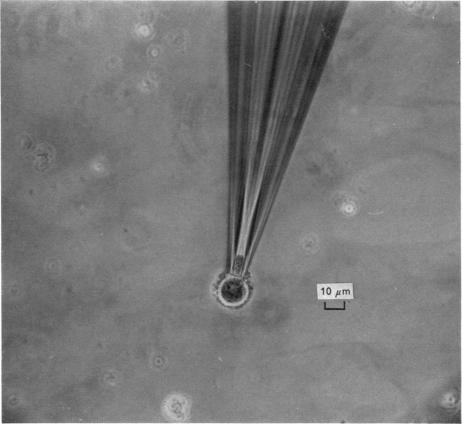
Electrophysiological properties of the rat chromaffin cell were studied using intracellular recording techniques. 2. The resting potential in the chromaffin cell was -49 +/- 6 mV (mean +/- S.D., n = 14) in standard saline containing 10 mM-Ca whereas that in Na-free saline was -63 +/- 9 mV (n = 17). At rest, the membrane has a substantial Na permeability. 3. Action potentials were evoked by passing current through the recording electrode. In standard saline the major fraction of the action potential disappeared either upon omission of external Na ions from standard saline or addition of 1 muM tetrodotoxin (TTX). We conclude that action potentials in the chromaffin cell are due mainly to an increase in the permeability of the membrane to Na ions. 4. Small but significant regenerative action potentials were observed in Na-free saline, and when Ca in Na-free saline was replaced by Ba, prolonged action potentials occurred. We conclude that action potentials in the chromaffin cell also have a Ca component. 5. Iontophoretic application of acetylcholine (ACh) produced a transient membrane depolarization in standard saline. 6. Spontaneous action potentials were recorded extracellularly by microsuction electrodes. They occurred at a rate of 0-05-0-1/sec in almost all cells. 7. When the perfusion fluid contained 3 x 10(-7) M to 10(-4) M ACh the spike frequency increased up to about 2/sec. This stimulatory effect of ACh was blocked by 10(-7) M atropine but not by 10(-3) M hexamethonium nor by 10(-5) M-d-tubocurarine. 8. The importance of Ca entry during action potentials for catecholamine secretion is discussed
摘要
运用细胞内记录技术研究了大鼠嗜铬细胞的电生理特性。2. 在含10 mM - Ca的标准盐溶液中,嗜铬细胞的静息电位为-49±6 mV(平均值±标准差,n = 14),而在无钠盐溶液中为-63±9 mV(n = 17)。静息时,细胞膜对钠有相当大的通透性。3. 通过记录电极通电流诱发动作电位。在标准盐溶液中,当从标准盐溶液中去除细胞外钠离子或加入1 μM河豚毒素(TTX)时,动作电位的主要部分消失。我们得出结论,嗜铬细胞中的动作电位主要是由于细胞膜对钠离子通透性的增加。4. 在无钠盐溶液中观察到小但显著的再生性动作电位,当无钠盐溶液中的钙被钡取代时,出现延长的动作电位。我们得出结论,嗜铬细胞中的动作电位也有钙成分。5. 在标准盐溶液中,离子电泳施加乙酰胆碱(ACh)会引起短暂的膜去极化。6. 用微吸电极在细胞外记录到自发动作电位。几乎在所有细胞中,它们的发生率为0.05 - 0.1/秒。7. 当灌注液含有3×10⁻⁷ M至10⁻⁴ M ACh时,峰频率增加至约2/秒。ACh的这种刺激作用被10⁻⁷ M阿托品阻断,但不被10⁻³ M六甲铵或10⁻⁵ M - d -筒箭毒碱阻断。8. 讨论了动作电位期间钙内流对儿茶酚胺分泌的重要性