Abt E, Suh H H, Allen G, Koutrakis P
National Research Council, Board on Environmental Studies and Toxicology, Washington, DC 20418, USA.
Environ Health Perspect. 2000 Jan;108(1):35-44. doi: 10.1289/ehp.0010835.
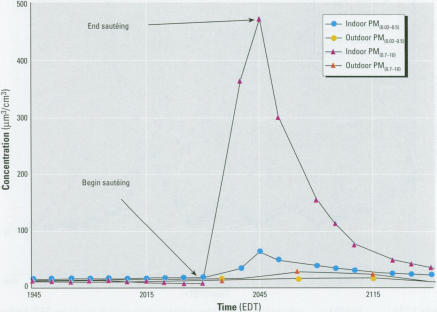
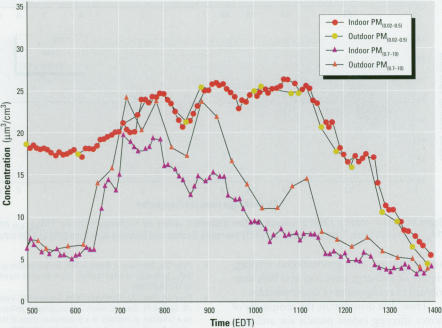
An intensive particle monitoring study was conducted in homes in the Boston, Massachusetts, area during the winter and summer of 1996 in an effort to characterize sources of indoor particles. As part of this study, continuous particle size and mass concentration data were collected in four single-family homes, with each home monitored for one or two 6-day periods. Additionally, housing activity and air exchange rate data were collected. Cooking, cleaning, and the movement of people were identified as the most important indoor particle sources in these homes. These sources contributed significantly both to indoor concentrations (indoor-outdoor ratios varied between 2 and 33) and to altered indoor particle size distributions. Cooking, including broiling/baking, toasting, and barbecuing contributed primarily to particulate matter with physical diameters between 0.02 and 0.5 microm [PM((0.02-0.5))], with volume median diameters of between 0.13 and 0.25 microm. Sources of particulate matter with aerodynamic diameters between 0.7 and 10 microm [PM((0.7-10))] included sautéing, cleaning (vacuuming, dusting, and sweeping), and movement of people, with volume median diameters of between 3 and 4.3 microm. Frying was associated with particles from both PM((0.02-0.5)) and PM((0.7-10)). Air exchange rates ranged between 0.12 and 24.3 exchanges/hr and had significant impact on indoor particle levels and size distributions. Low air exchange rates (< 1 exchange/hr) resulted in longer air residence times and more time for particle concentrations from indoor sources to increase. When air exchange rates were higher (> 1 exchange/hr), the impact of indoor sources was less pronounced, as indoor particle concentrations tracked outdoor levels more closely.
1996年冬夏两季,在马萨诸塞州波士顿地区的家庭中开展了一项密集的颗粒物监测研究,旨在确定室内颗粒物的来源。作为该研究的一部分,在四户单家庭住宅中收集了连续的粒径和质量浓度数据,每户监测一或两个为期6天的时间段。此外,还收集了房屋活动和空气交换率数据。烹饪、清洁和人员活动被确定为这些家庭中最重要的室内颗粒物来源。这些来源对室内浓度(室内外比率在2至33之间)以及室内颗粒物粒径分布的改变都有显著贡献。烹饪,包括炙烤/烘焙、烤面包和烧烤,主要产生物理直径在0.02至0.5微米之间的颗粒物[PM((0.02 - 0.5))],体积中值直径在0.13至0.25微米之间。空气动力学直径在0.7至10微米之间的颗粒物[PM((0.7 - 10))]来源包括炒菜、清洁(吸尘、掸灰和扫地)以及人员活动,体积中值直径在3至4.3微米之间。油炸与PM((0.02 - 0.5))和PM((0.7 - 10))的颗粒物都有关联。空气交换率在0.12至24.3次/小时之间,对室内颗粒物水平和粒径分布有显著影响。低空气交换率(<1次/小时)导致空气停留时间更长,室内源颗粒物浓度增加的时间更多。当空气交换率较高(>1次/小时)时,室内源的影响不太明显,因为室内颗粒物浓度更紧密地跟踪室外水平。