Serhan C N, Clish C B, Brannon J, Colgan S P, Chiang N, Gronert K
Center for Experimental Therapeutics and Reperfusion Injury, Department of Anesthesiology, Perioperative and Pain Medicine, Brigham and Women's Hospital and Harvard Medical School, Boston, Massachusetts 02115, USA.
J Exp Med. 2000 Oct 16;192(8):1197-204. doi: 10.1084/jem.192.8.1197.
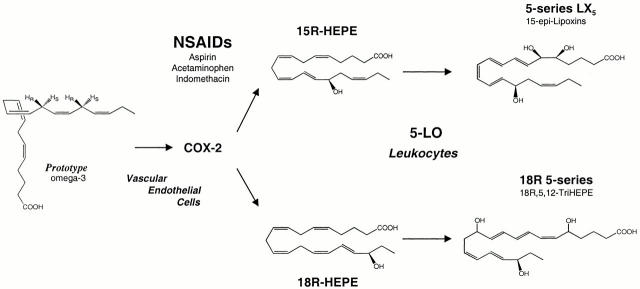
Aspirin therapy inhibits prostaglandin biosynthesis without directly acting on lipoxygenases, yet via acetylation of cyclooxygenase 2 (COX-2) it leads to bioactive lipoxins (LXs) epimeric at carbon 15 (15-epi-LX, also termed aspirin-triggered LX [ATL]). Here, we report that inflammatory exudates from mice treated with omega-3 polyunsaturated fatty acid and aspirin (ASA) generate a novel array of bioactive lipid signals. Human endothelial cells with upregulated COX-2 treated with ASA converted C20:5 omega-3 to 18R-hydroxyeicosapentaenoic acid (HEPE) and 15R-HEPE. Each was used by polymorphonuclear leukocytes to generate separate classes of novel trihydroxy-containing mediators, including 5-series 15R-LX(5) and 5,12,18R-triHEPE. These new compounds proved to be potent inhibitors of human polymorphonuclear leukocyte transendothelial migration and infiltration in vivo (ATL analogue > 5,12,18R-triHEPE > 18R-HEPE). Acetaminophen and indomethacin also permitted 18R-HEPE and 15R-HEPE generation with recombinant COX-2 as well as omega-5 and omega-9 oxygenations of other fatty acids that act on hematologic cells. These findings establish new transcellular routes for producing arrays of bioactive lipid mediators via COX-2-nonsteroidal antiinflammatory drug-dependent oxygenations and cell-cell interactions that impact microinflammation. The generation of these and related compounds provides a novel mechanism(s) for the therapeutic benefits of omega-3 dietary supplementation, which may be important in inflammation, neoplasia, and vascular diseases.
阿司匹林疗法可抑制前列腺素生物合成,而不直接作用于脂氧合酶,但通过环氧化酶2(COX-2)的乙酰化作用,它会生成在碳15处具有差向异构的生物活性脂氧素(LXs,15-表异构-LX,也称为阿司匹林触发的LX [ATL])。在此,我们报告,用ω-3多不饱和脂肪酸和阿司匹林(ASA)处理的小鼠的炎性渗出物会产生一系列新的生物活性脂质信号。用ASA处理的COX-2上调的人内皮细胞将C20:5 ω-3转化为18R-羟基二十碳五烯酸(HEPE)和15R-HEPE。多形核白细胞利用每一种来生成不同类别的新型含三羟基介质,包括5-系列15R-LX(5)和5,12,18R-三羟基二十碳五烯酸。这些新化合物被证明是体内人多形核白细胞跨内皮迁移和浸润的有效抑制剂(ATL类似物> 5,12,18R-三羟基二十碳五烯酸> 18R-HEPE)。对乙酰氨基酚和吲哚美辛也能通过重组COX-2以及作用于血细胞的其他脂肪酸的ω-5和ω-9氧化作用生成18R-HEPE和15R-HEPE。这些发现确立了通过COX-2非甾体抗炎药依赖性氧化作用和影响微炎症的细胞-细胞相互作用来产生生物活性脂质介质阵列的新的跨细胞途径。这些及相关化合物的生成提供了ω-3膳食补充剂治疗益处的新机制,这在炎症、肿瘤形成和血管疾病中可能很重要。