Ogura K, Maeda S, Nakao M, Watanabe T, Tada M, Kyutoku T, Yoshida H, Shiratori Y, Omata M
Department of Gastroenterology, Graduate School of Medicine, University of Tokyo, Tokyo 113-8655, Japan.
J Exp Med. 2000 Dec 4;192(11):1601-10. doi: 10.1084/jem.192.11.1601.
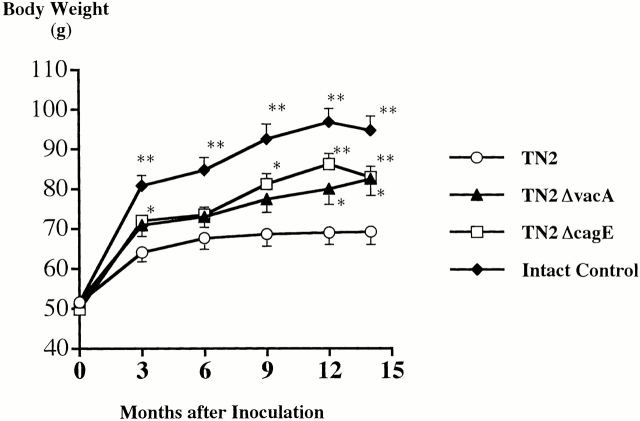
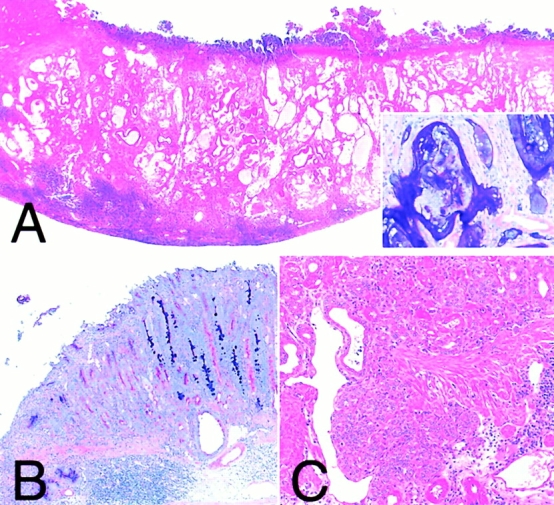
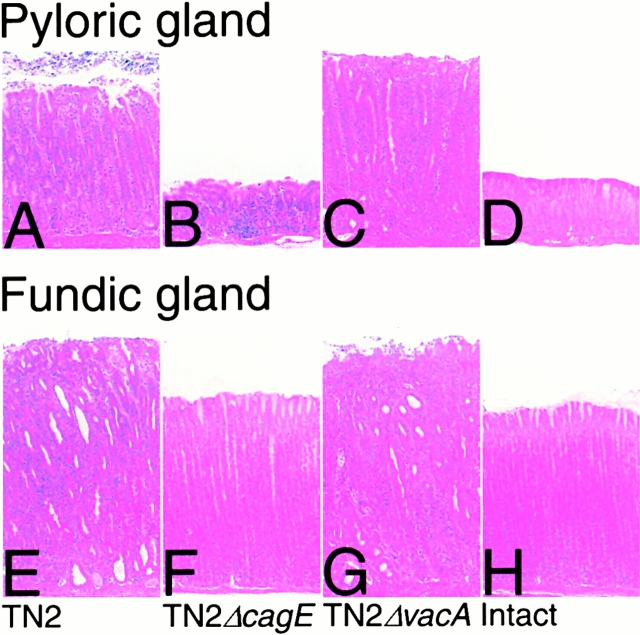
Helicobacter pylori infection induces various gastroduodenal diseases. We examined the role of two genes, vacA and cagE, in the gastric pathogenesis induced by H. pylori using a long-term (62 wk) animal model. Reportedly, both genes are associated with the virulence of H. pylori: vacA encodes vacuolating cytotoxin, and cagE, with other genes in the cag pathogenicity islands, encodes a type IV secretion system. Mongolian gerbils were challenged in this study by a wild-type TN2 strain and its isogenic mutants of cagE or vacA. The wild-type and vacA mutants induced severe gastritis, whereas cagE mutants induced far milder changes. Gastric ulcer was induced at the highest rate (22/23) by the wild-type TN2, followed by the vacA mutant (19/28). No ulcer was found in the gerbils infected with the cagE mutant (0/27) or in controls (0/27). Intestinal metaplasia was also found in the gerbils infected with the wild-type (14/23) or vacA mutant (15/28). Gastric cancer developed in one gerbil with wild-type infection and in one with vacA mutant infection. In conclusion, the knocking out of the cagE gene deprived wild-type H. pylori of the pathogenicity for gastritis and gastric ulcer, suggesting that the secretion system encoded by cag pathogenicity island genes plays an essential role.
幽门螺杆菌感染会引发各种胃十二指肠疾病。我们使用长期(62周)动物模型研究了vacA和cagE这两个基因在幽门螺杆菌诱发的胃部发病机制中的作用。据报道,这两个基因均与幽门螺杆菌的毒力相关:vacA编码空泡毒素,而cagE与cag致病岛中的其他基因一起编码IV型分泌系统。在本研究中,用野生型TN2菌株及其cagE或vacA同基因突变体对蒙古沙鼠进行攻击。野生型和vacA突变体诱发了严重的胃炎,而cagE突变体诱发的变化则要轻得多。野生型TN2诱发胃溃疡的比例最高(22/23),其次是vacA突变体(19/28)。感染cagE突变体的沙鼠(0/27)或对照组(0/27)均未发现溃疡。感染野生型(14/23)或vacA突变体(15/28)的沙鼠中也发现了肠化生。一只感染野生型菌株的沙鼠和一只感染vacA突变体的沙鼠发生了胃癌。总之,cagE基因的敲除使野生型幽门螺杆菌丧失了引发胃炎和胃溃疡的致病性,这表明cag致病岛基因编码的分泌系统起着至关重要的作用。