Lakowicz J R, Piszczek G, Kang J S
Center for Fluorescence Spectroscopy, Department of Biochemistry and Molecular Biology, University of Maryland at Baltimore, 725 West Lombard Street, Baltimore, Maryland 21201, USA.
Anal Biochem. 2001 Jan 1;288(1):62-75. doi: 10.1006/abio.2000.4860.
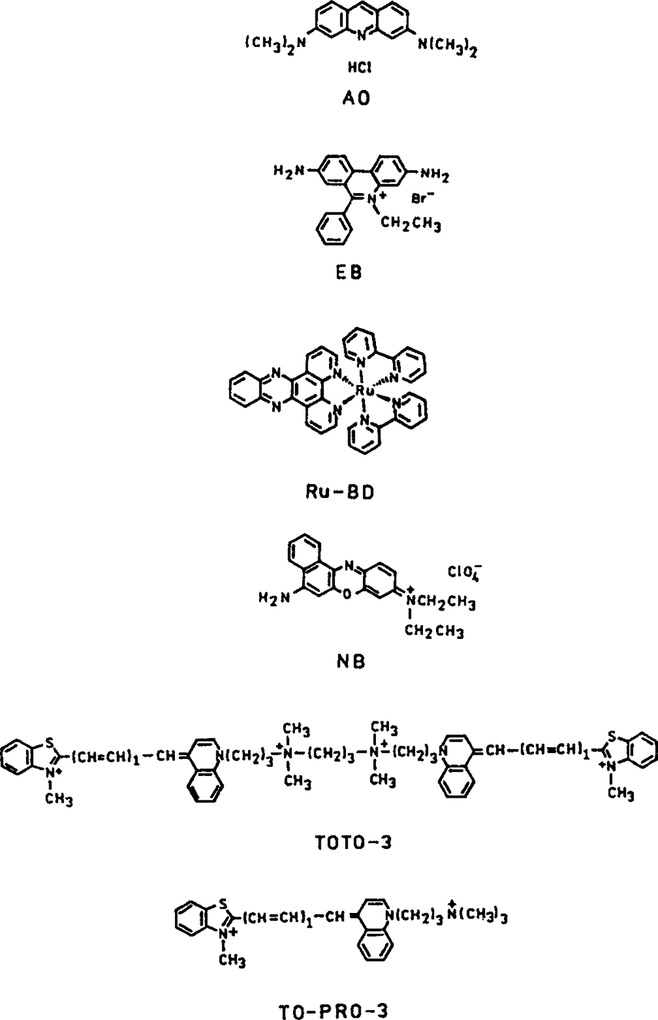
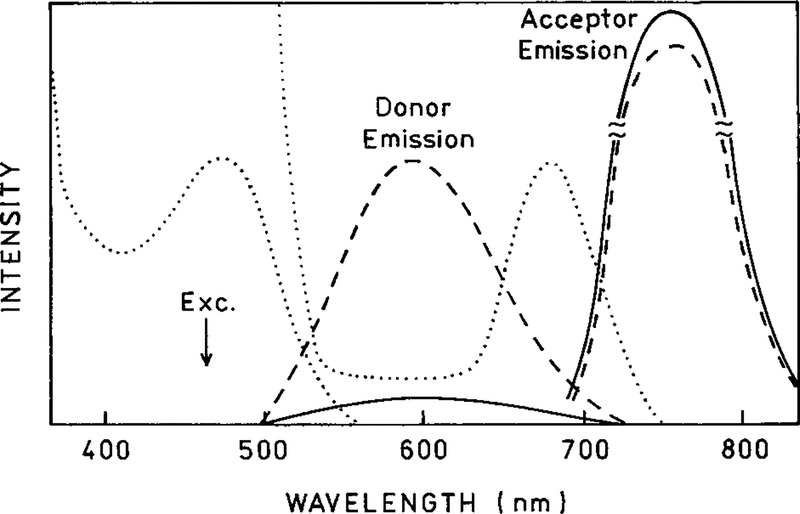
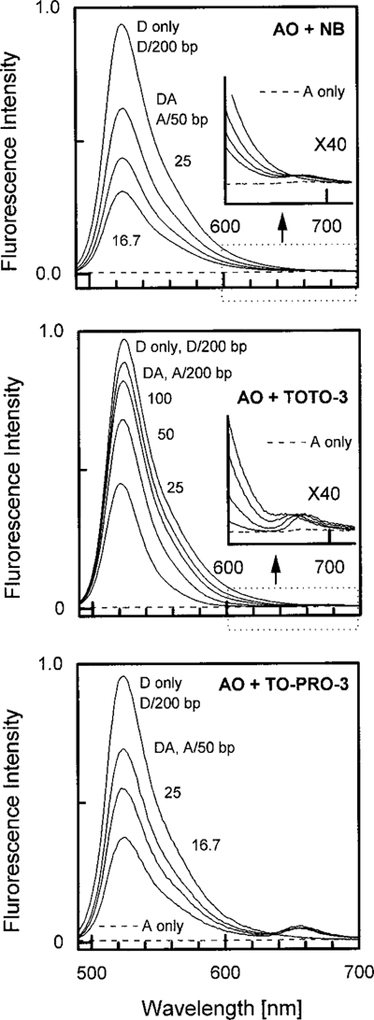
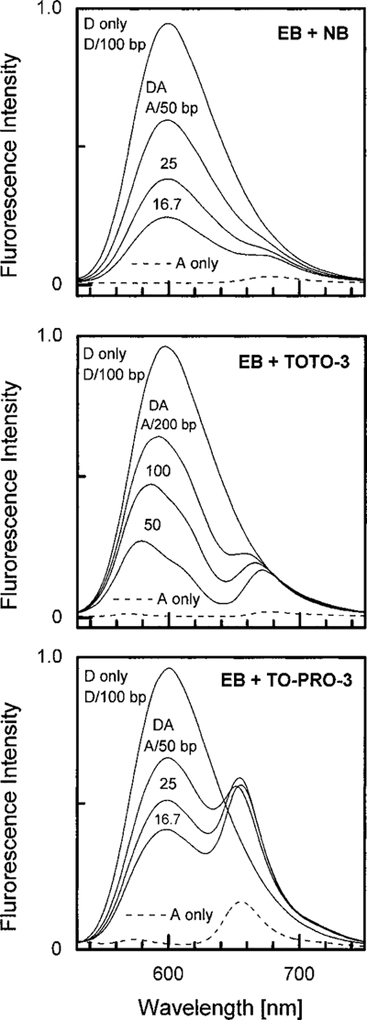
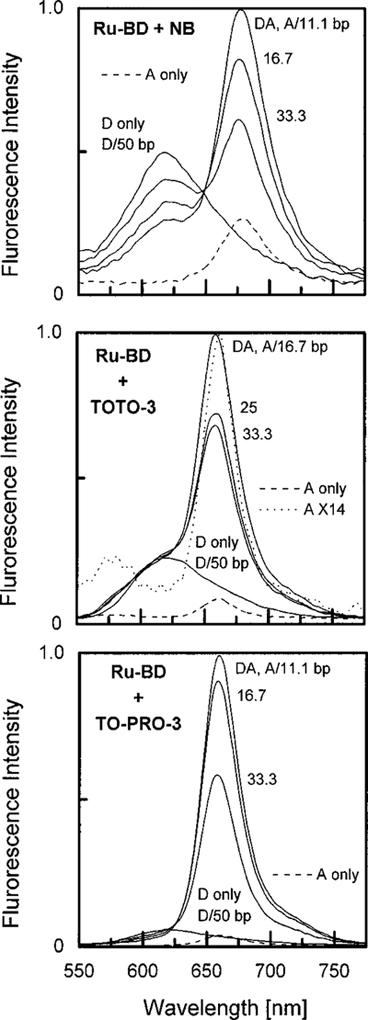
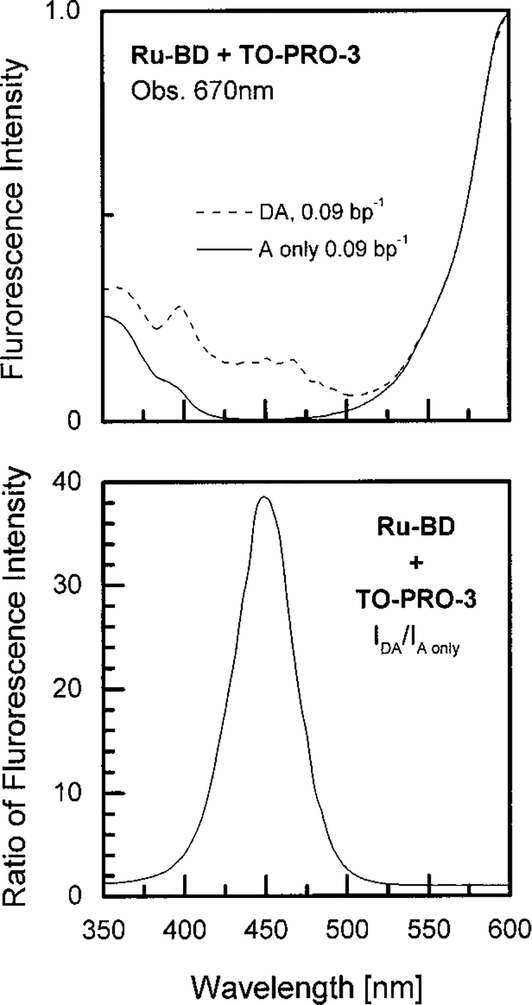
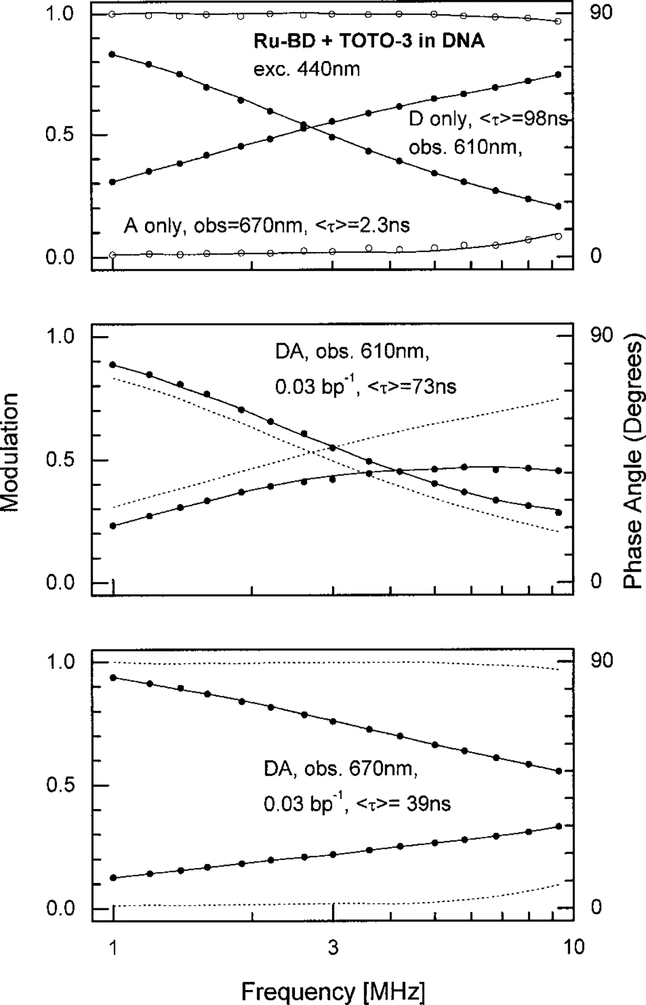
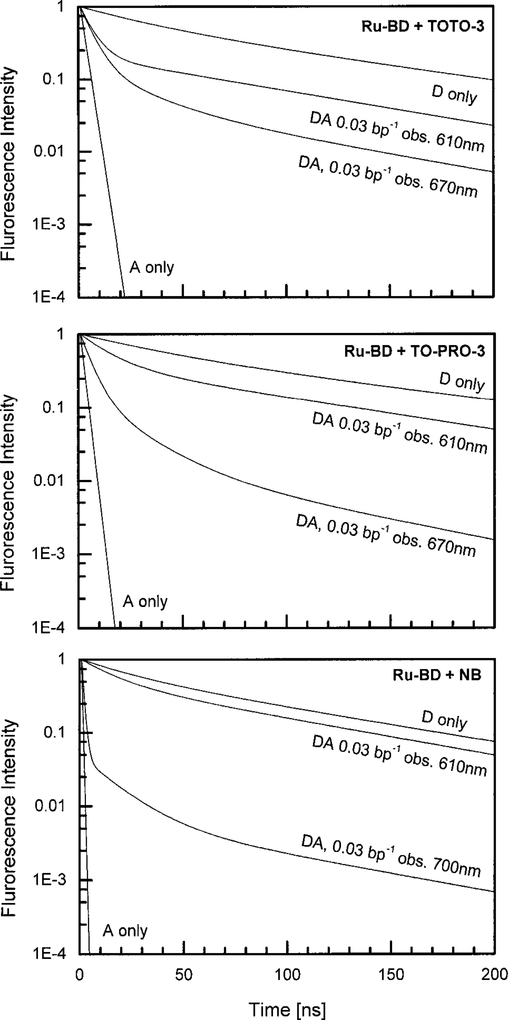
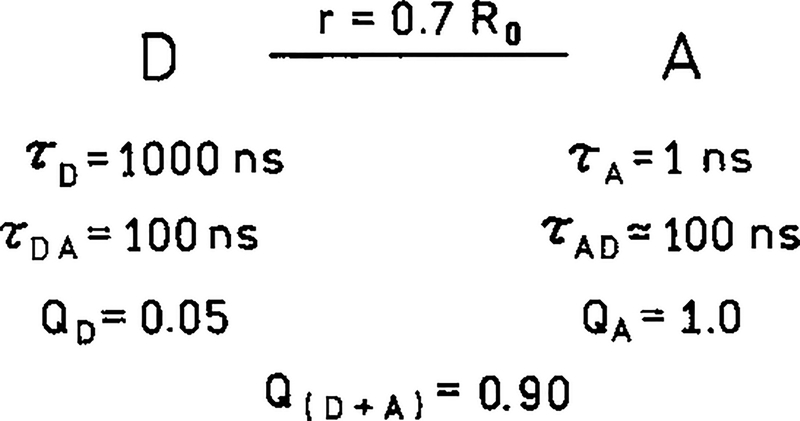
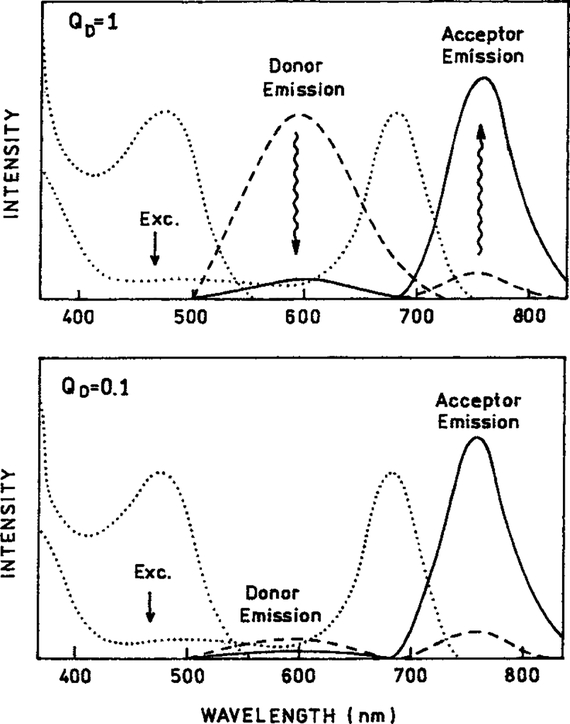
We describe an approach to creating a new class of luminophores which display both long wavelength emissions exceeding 600 nm and long lifetimes. These luminophores are based on resonance energy transfer (RET) from a long lifetime donor to a short lifetime but long wavelength acceptor. We demonstrated the possibility of obtaining these desirable spectral properties using donors and acceptors noncovalently bound to DNA. The donor was a ruthenium (Ru) metal-ligand complex in which one of the diimine ligands intercalated into double-helix DNA. The acceptors were either nile blue, TOTO-3, or TO-PRO-3. Upon binding of the acceptor to donor-labeled DNA, we found that the acceptor quantum yield was remarkably enhanced so that the wavelength-integrated intensities of the donor and acceptor bound to DNA were many-fold greater than the intensity of the donor and acceptor alone when separately bound to DNA. The origin of this effect is efficient energy transfer from the donor. Under these conditions the effective overall quantum yield approaches that of the acceptor. Importantly, the increased quantum yield can be obtained while maintaining usefully long apparent acceptor lifetimes of 30 to 80 ns. The effect of an increased quantum yield from a low quantum yield donor may find use in assays to detect macromolecular binding interactions. These results suggest the synthesis of covalently linked donor-acceptor pairs with the desirable spectral properties of long wavelength emission, high quantum yield, and moderately long lifetimes for gated detection.
我们描述了一种创建新型发光体的方法,这些发光体具有超过600 nm的长波长发射和长寿命。这些发光体基于从长寿命供体到短寿命但长波长受体的共振能量转移(RET)。我们证明了使用与DNA非共价结合的供体和受体获得这些理想光谱特性的可能性。供体是一种钌(Ru)金属-配体配合物,其中一个二亚胺配体插入双螺旋DNA中。受体是尼罗蓝、TOTO-3或TO-PRO-3。当受体与供体标记的DNA结合时,我们发现受体的量子产率显著提高,以至于与DNA结合的供体和受体的波长积分强度比单独与DNA结合时供体和受体的强度高出许多倍。这种效应的起源是供体的高效能量转移。在这些条件下,有效的总量子产率接近受体的量子产率。重要的是,在保持30至80 ns的有用长表观受体寿命的同时,可以获得增加的量子产率。低量子产率供体的量子产率增加的效应可用于检测大分子结合相互作用的分析中。这些结果表明合成具有长波长发射、高量子产率和适度长寿命用于门控检测的理想光谱特性的共价连接的供体-受体对。