Brotz T M, Gundelfinger E D, Borst A
Friedrich-Miescher-Laboratorium der Max-Planck-Gesellschaft Spemannstr, 37-39, D-72076 Tubingen, Germany.
BMC Neurosci. 2001;2:1. doi: 10.1186/1471-2202-2-1. Epub 2001 Feb 9.
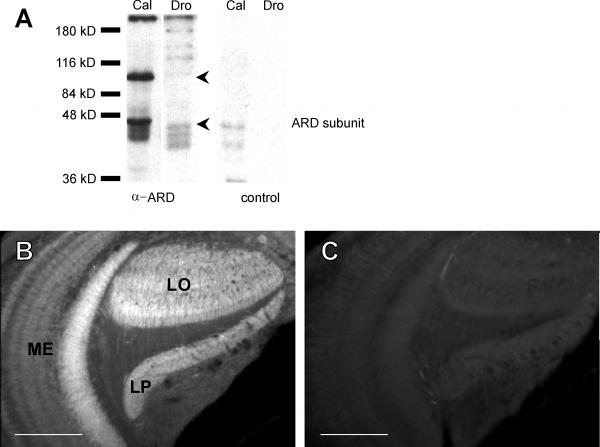
The fly visual system is a highly ordered brain structure with well-established physiological and behavioral functions. A large number of interneurons in the posterior part of the third visual neuropil, the lobula plate tangential cells (LPTCs), respond to visual motion stimuli. In these cells the mechanism of motion detection has been studied in great detail. Nevertheless, the cellular computations leading to their directionally selective responses are not yet fully understood. Earlier studies addressed the neuropharmacological basis of the motion response in lobula plate interneurons. In the present study we investigated the distribution of the respective neurotransmitter receptors in the fly visual system, namely nicotinic acetylcholine receptors (nAChRs) and GABA receptors (GABARs) demonstrated by antibody labeling.
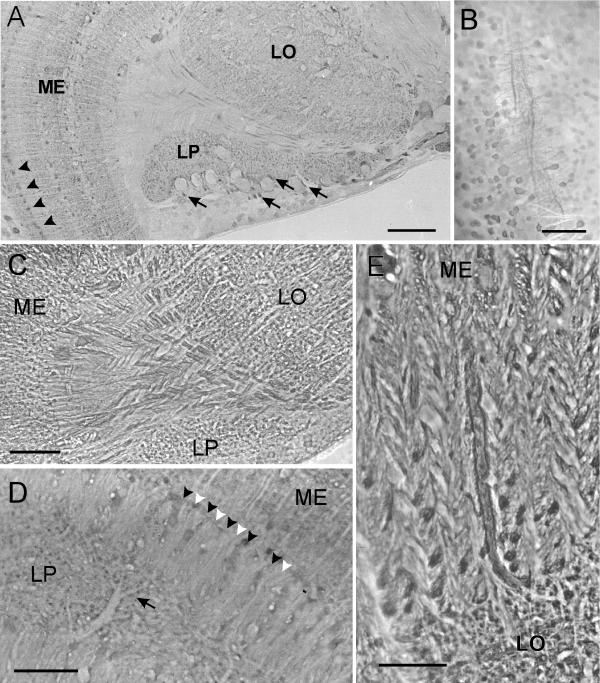
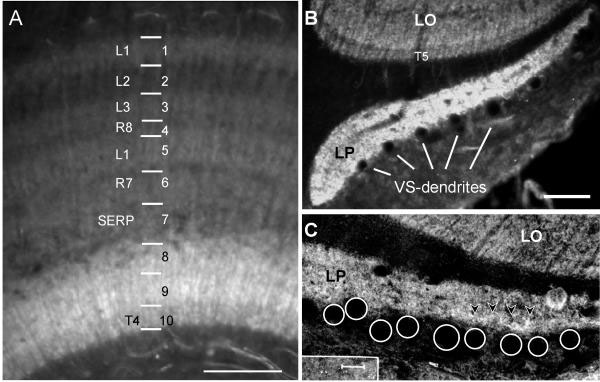
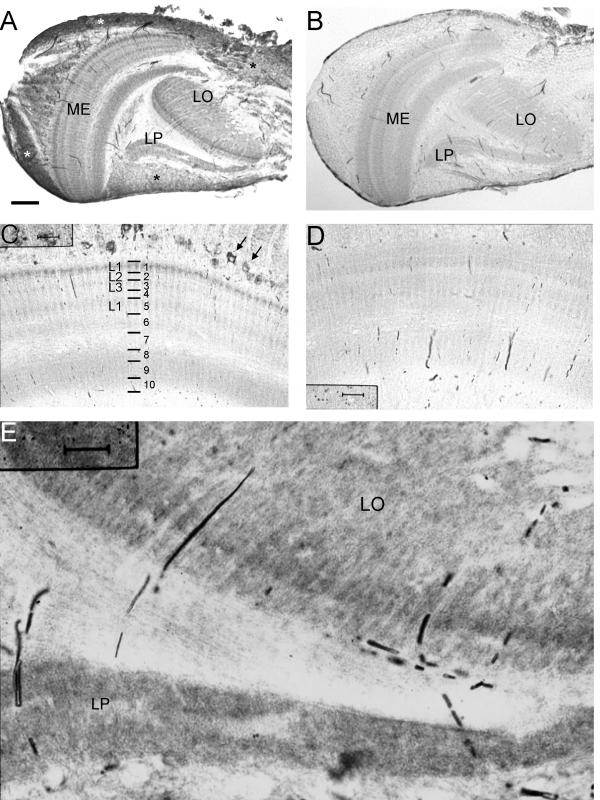
The medulla shows a laminar distribution of both nAChRs and GABARs. Both receptor types are present in layers that participate in motion processing. The lobula also shows a characteristic layering of immunoreactivity for either receptor in its posterior portion. Furthermore, immunostaining for nAChRs and GABARs can be observed in close vicinity of lobula plate tangential cells. Immunostaining of GABAergic fibers suggests that inhibitory inputs from the medulla are relayed through the lobula to the lobula plate rather than through direct connections between medulla and lobula plate.
The interaction of excitatory and inhibitory pathways is essential for the computation of visual motion responses and discussed in the context of the Reichardt model for motion detection.
果蝇视觉系统是一种高度有序的脑结构,具有完善的生理和行为功能。在第三视觉神经节的后部有大量中间神经元,即小叶板切向细胞(LPTCs),它们对视觉运动刺激做出反应。在这些细胞中,运动检测机制已经得到了详细研究。然而,导致其方向选择性反应的细胞计算过程尚未完全理解。早期研究探讨了小叶板中间神经元运动反应的神经药理学基础。在本研究中,我们通过抗体标记研究了果蝇视觉系统中相应神经递质受体,即烟碱型乙酰胆碱受体(nAChRs)和GABA受体(GABARs)的分布。
髓质显示出nAChRs和GABARs的分层分布。两种受体类型都存在于参与运动处理的层中。小叶在其后部也显示出两种受体免疫反应性的特征分层。此外,在小叶板切向细胞附近可以观察到nAChRs和GABARs的免疫染色。GABA能纤维的免疫染色表明,来自髓质的抑制性输入是通过小叶传递到小叶板,而不是通过髓质和小叶板之间的直接连接。
兴奋性和抑制性通路的相互作用对于视觉运动反应的计算至关重要,并在用于运动检测的赖夏特模型的背景下进行了讨论。