Takasugi Y, Furuya H, Moriya K, Okamoto Y
Department of Anesthesiology, Nippon Dental University, School of Dentistry at Tokyo, 2-3-16 Fujimi, Chiyoda-ku, Tokyo 102-8158, Japan.
Anesth Prog. 2000 Winter;47(4):125-9.
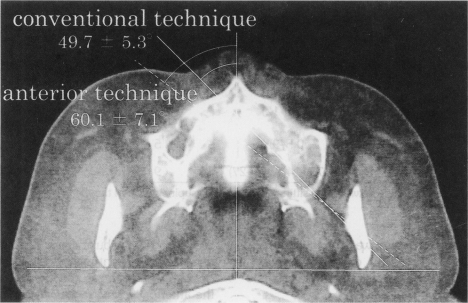
The conventional inferior alveolar nerve block (conventional technique) has potential risks of neural and vascular injuries. We studied a method of inferior alveolar nerve block by injecting a local anesthetic solution into the pterygomandibular space anterior to the mandibular foramen (anterior technique) with the purpose of avoiding such complications. The insertion angle of the anterior technique and the estimation of anesthesia in the anterior technique were examined. The predicted insertion angle measured on computed tomographic images was 60.1 +/- 7.1 degrees from the median, with the syringe end lying on the contralateral mandibular first molar, and the insertion depth was approximately 10 mm. We applied the anterior technique to 100 patients for mandibular molar extraction and assessed the anesthetic effects. A success rate of 74% was obtained. This is similar to that reported for the conventional technique but without the accompanying risks for inferior alveolar neural and vascular complications.
传统的下牙槽神经阻滞(传统技术)存在神经和血管损伤的潜在风险。我们研究了一种通过将局部麻醉溶液注射到下颌孔前方的翼下颌间隙(前方技术)来进行下牙槽神经阻滞的方法,目的是避免此类并发症。对前方技术的进针角度和前方技术中的麻醉效果评估进行了研究。在计算机断层扫描图像上测量的预测进针角度为距中线60.1±7.1度,注射器末端位于对侧下颌第一磨牙处,进针深度约为10毫米。我们将前方技术应用于100例下颌磨牙拔除患者,并评估了麻醉效果。获得了74%的成功率。这与传统技术报道的成功率相似,但没有下牙槽神经和血管并发症的相关风险。