Sopwith Will, Hart Tony, Garner Paul
International Health Division, Liverpool School of Tropical Medicine; now at the Communicable Disease Surveillance Centre North West, 57a Upper Northgate Street, Chester CH1 4EF, UK.
BMC Infect Dis. 2002 Mar 27;2:4. doi: 10.1186/1471-2334-2-4.
In 2000, the World Health Organization (WHO) had eight sets of conflicting recommendations for decontaminating medical equipment. We conducted a systematic review of observational studies to assist WHO in reconciling the various guidelines. This paper summarises the methods developed and illustrates the results for three procedures--alcohol, bleach and povidone iodine.
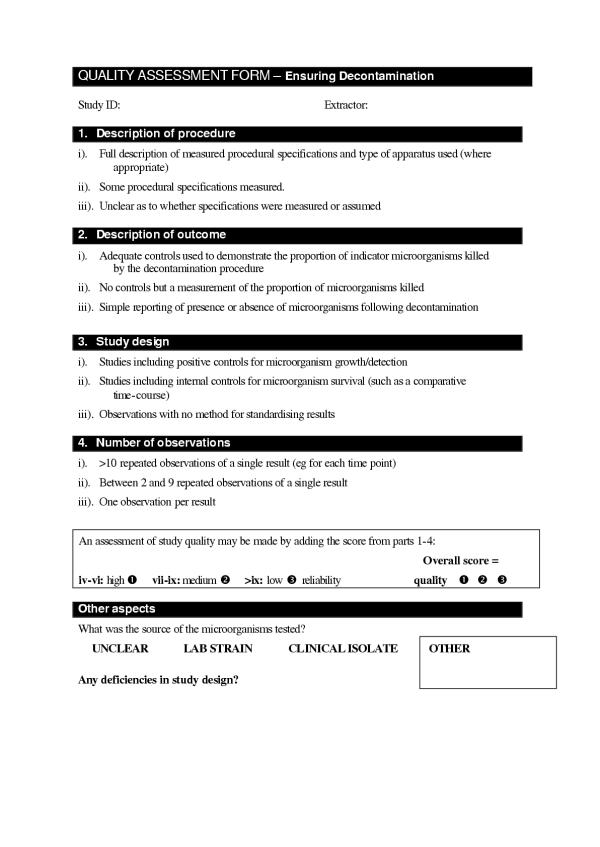
We developed a Medline search strategy and applied inclusion criteria specifying the decontamination procedures of interest and an outcome of microbial destruction for a set of marker organisms. We developed protocols to assess the quality of studies and categorised them according to the reliability of the methods used. Through an iterative process we identified best practice for the decontamination methods and key additional factors required to ensure their effectiveness. We identified 88 published papers for inclusion, describing 135 separate studies of decontamination.
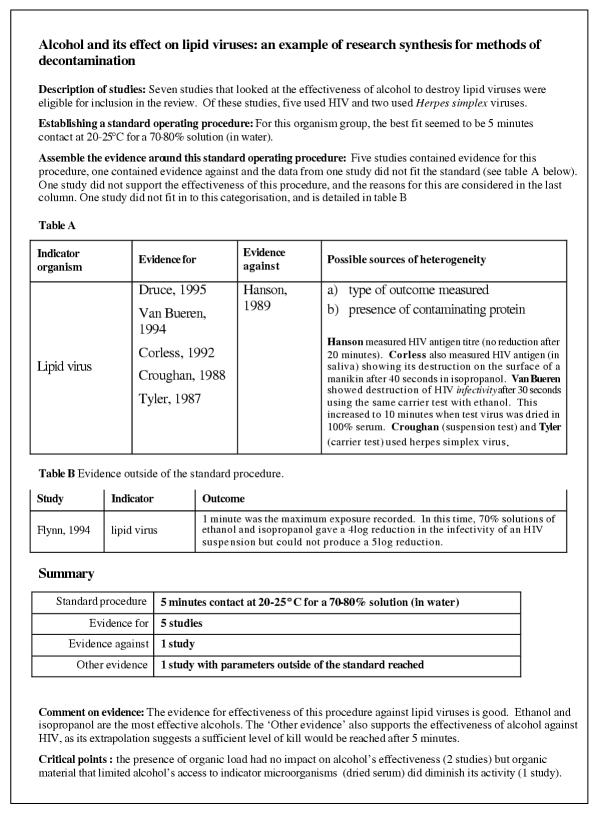
For disinfection with alcohol, best practice was identified from 23 studies as an exposure to 70-80% ethanol or isopropanol for at least 5 minutes. Bleach was effective for sterilization at a concentration of 5000 ppm for 5 minutes and for disinfection at 1000 ppm for 10 minutes (33 studies). Povidone iodine was only partially effective for disinfection at a concentration of 1% for 15 minutes (15 studies).
Our findings provide an evidence base for WHO guidelines on decontaminating medical equipment. The results support the recommended use of bleach and show that alcohol could be used more widely than current guidelines suggest, provided best practice is followed. The effectiveness of povidone iodine is uncertain.
2000年,世界卫生组织(WHO)针对医疗设备消毒给出了八套相互冲突的建议。我们对观察性研究进行了系统综述,以协助WHO协调各种指南。本文总结了所制定的方法,并阐述了三种消毒程序(酒精、漂白剂和聚维酮碘)的结果。
我们制定了一个Medline检索策略,并应用纳入标准,明确了感兴趣的消毒程序以及一组指示微生物的微生物杀灭结果。我们制定了评估研究质量的方案,并根据所使用方法的可靠性对研究进行分类。通过反复迭代的过程,我们确定了消毒方法的最佳实践以及确保其有效性所需的关键附加因素。我们确定了88篇纳入的已发表论文,描述了135项单独的消毒研究。
对于酒精消毒,从23项研究中确定的最佳实践是暴露于70 - 80%的乙醇或异丙醇中至少5分钟。漂白剂在浓度为5000 ppm时作用5分钟可有效灭菌,在浓度为1000 ppm时作用10分钟可有效消毒(33项研究)。聚维酮碘在浓度为1%时作用15分钟仅部分有效用于消毒(15项研究)。
我们的研究结果为WHO关于医疗设备消毒的指南提供了证据基础。结果支持推荐使用漂白剂,并表明如果遵循最佳实践,酒精的使用范围可比当前指南所建议的更广泛。聚维酮碘的有效性尚不确定。