Hislop Andrew D, Annels Nicola E, Gudgeon Nancy H, Leese Alison M, Rickinson Alan B
CRC Institute for Cancer Studies, University of Birmingham, Edgbaston, Birmingham B15 2TT, United Kingdom.
J Exp Med. 2002 Apr 1;195(7):893-905. doi: 10.1084/jem.20011692.
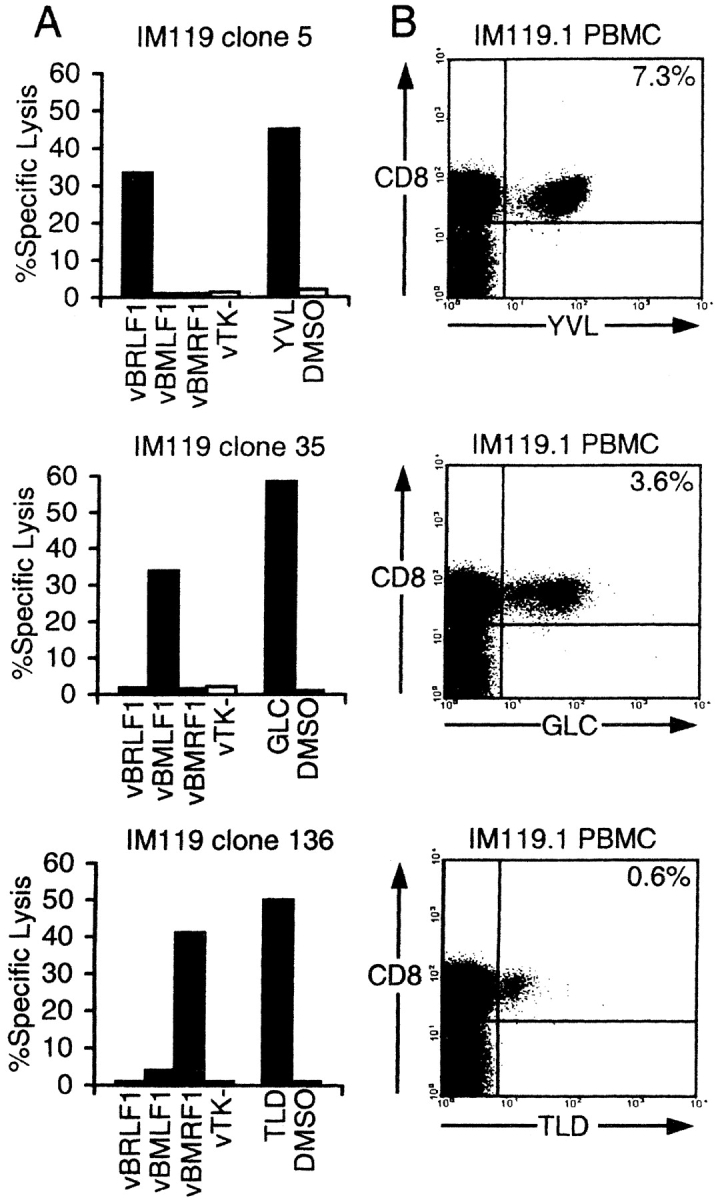
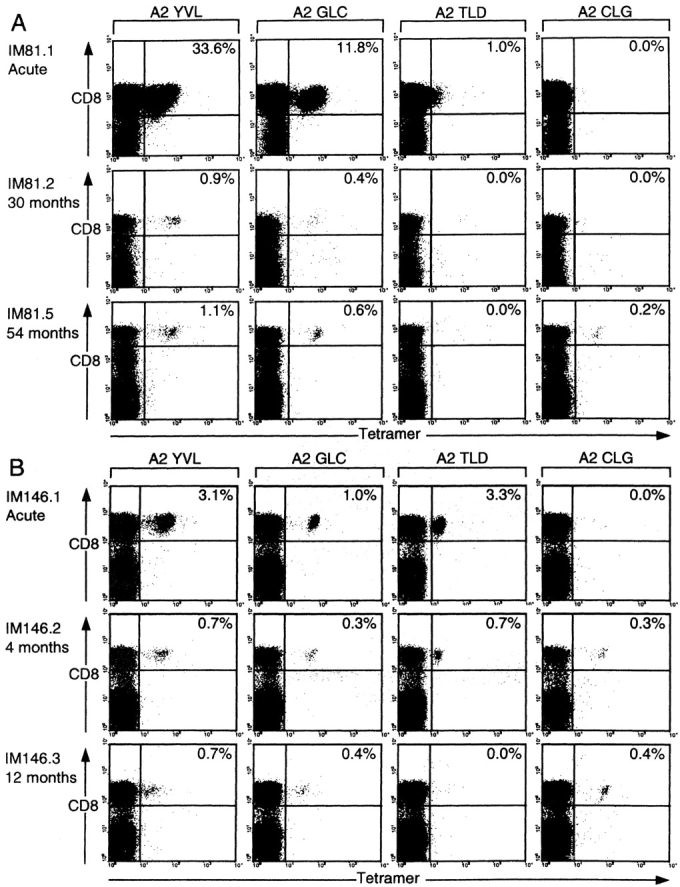
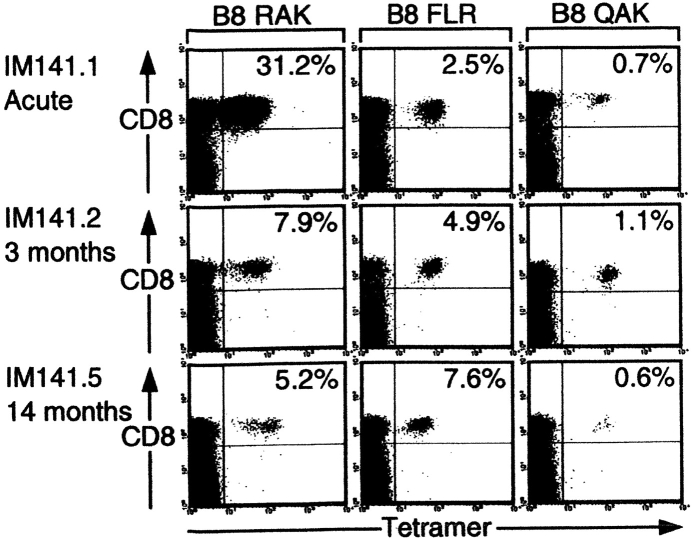
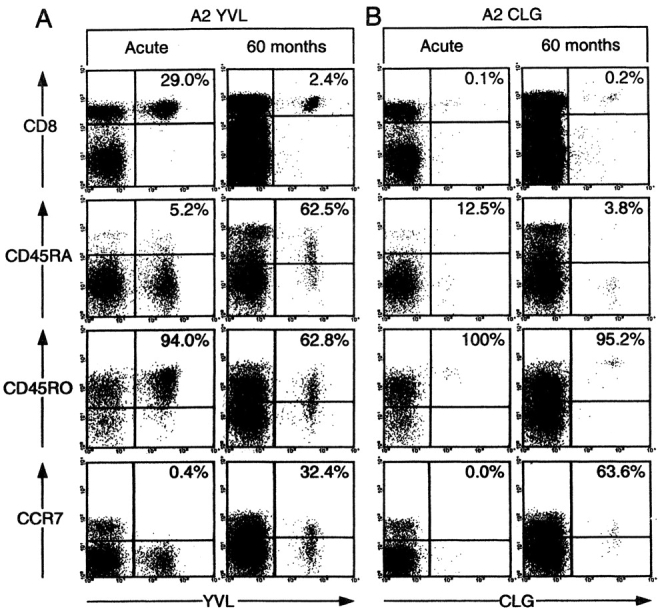
Primary virus infection often elicits a large CD8(+) T cell response which subsequently contracts to a smaller memory T cell pool; the relationship between these two virus-specific populations is not well understood. Here we follow the human CD8(+) T cell response to Epstein-Barr virus (EBV) from its primary phase in infectious mononucleosis (IM) through to the persistent carrier state. Using HLA-A2.1 or B8 tetramers specific for four lytic cycle and three latent cycle epitopes, we find marked differences in the epitope-specific composition of the T cell populations between the two phases of infection. The primary response is dominated by lytic epitope specificities which are severely culled (and in one case extinguished) with resolution of the acute infection; in contrast latent epitope specificities are less abundant, if present at all, in acute IM but often then increase their percentage representation in the CD8 pool. Even comparing epitopes of the same type, the relative size of responses seen in primary infection does not necessarily correlate with that seen in the longer term. We also follow the evolution of phenotypic change in these populations and show that, from a uniform CD45RA(-)RO(+)CCR7(-) phenotype in IM, lytic epitope responses show greater reversion to a CD45RA(+)RO(-) phenotype whereas latent epitope responses remain CD45RA(-)RO(+) with a greater tendency to acquire CCR7. Interestingly these phenotypic distinctions reflect the source of the epitope as lytic or latent, and not the extent to which the response has been amplified in vivo.
原发性病毒感染通常会引发强烈的CD8(+) T细胞反应,随后该反应会收缩为较小的记忆T细胞库;这两种病毒特异性群体之间的关系尚未得到充分理解。在这里,我们追踪人类CD8(+) T细胞对爱泼斯坦-巴尔病毒(EBV)的反应,从传染性单核细胞增多症(IM)的急性期到持续携带状态。使用针对四个裂解周期和三个潜伏周期表位的HLA-A2.1或B8四聚体,我们发现在感染的两个阶段之间,T细胞群体的表位特异性组成存在显著差异。急性期反应主要由裂解表位特异性主导,随着急性感染的消退,这些特异性会被大量清除(在一种情况下完全消失);相比之下,潜伏表位特异性在急性IM中即使存在也较少见,但随后在CD8库中的百分比往往会增加。即使比较同一类型的表位,原发性感染中观察到的反应相对大小也不一定与长期观察到的反应相关。我们还追踪了这些群体中表型变化的演变,并表明,在IM中从统一的CD45RA(-)RO(+)CCR7(-)表型开始,裂解表位反应显示出更大程度地逆转为CD45RA(+)RO(-)表型,而潜伏表位反应则保持CD45RA(-)RO(+),且获得CCR7的倾向更大。有趣的是,这些表型差异反映了表位的来源是裂解性还是潜伏性,而不是反应在体内扩增的程度。