Shekarriz Hodjat, Shekarriz Bijan, Upadhyay Jyoti, Comman Andreas, Markert Uwe, Bürk Conny G, Kujath Peter, Bruch Hans-Peter
Department of Surgery, University of Lübeck, Germany.
JSLS. 2002 Jan-Mar;6(1):53-8.
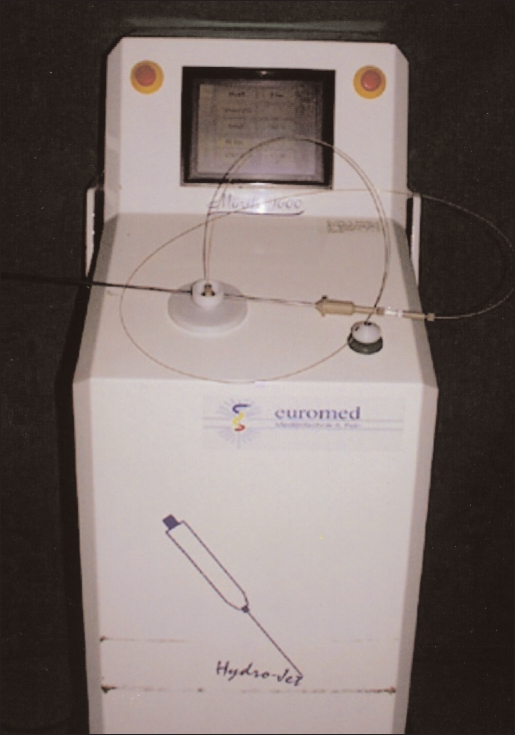
Hydro-Jet technology has long been used for cutting various materials like metal and wood in the industrial field. In the medical field, this technology has been applied successfully for selective cutting of the parenchyma of the liver. However, to our knowledge, no data exist on the use of the Hydro-Jet technique for laparoscopic cholecystectomy. The purpose of this study was to evaluate a new dissection technique using a high-pressure water stream (Hydro-Jet) and a new dissection probe for laparoscopic cholecystectomy.
Thirty pigs underwent laparoscopic cholecystectomy. Pigs were randomized to receive either the conventional or Hydro-Jet assisted dissection technique. The feasibility of this technique and the features of surgical dissection were evaluated and compared between the 2 groups.
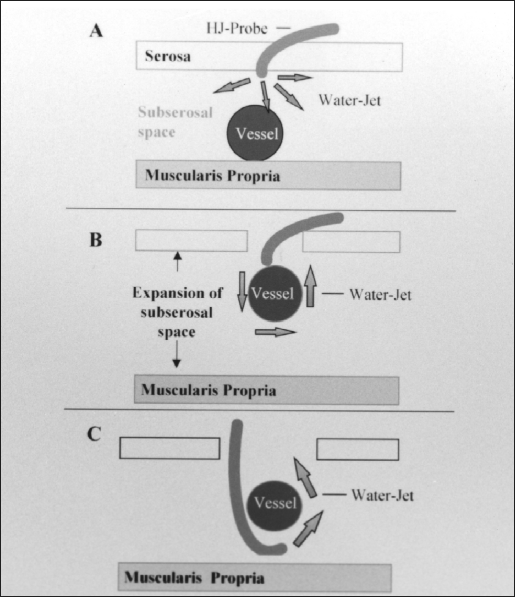
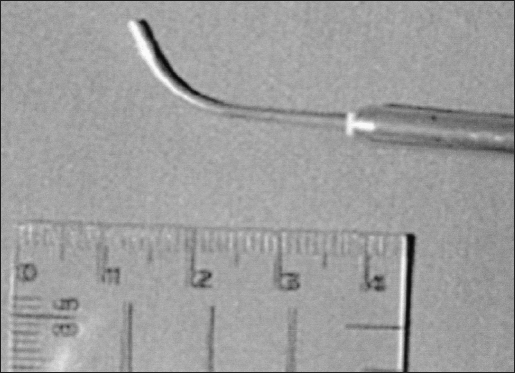
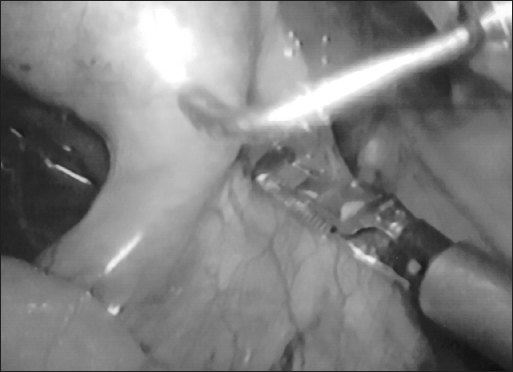
Laparoscopic cholecystectomy was successful in all animals with no need for conversion to open surgery. The mean operative time was 28 and 36 minutes for Hydro-Jet versus conventional dissection, respectively. Complications using the Hydro-Jet and conventional techniques included 6% and 20% gallbladder perforation and 6.5% and 13% liver laceration, respectively. The use of the Hydro-Jet for cholecystectomy had clear technical advantages over conventional dissection. The Hydro-Jet resulted in a selective dissection of fibrous and connective tissue preserving blood vessels for later ligation. Therefore, the dissection was performed in a relatively bloodless field. The ease of dissection using the new bent tipped dissector represents another advantage. Finally, the continuous water flow allowed a clear view for the operator.
This study shows that Hydro-jet dissection represents an excellent alternative to the conventional technique for laparoscopic cholecystectomy. The improved anatomical dissection combined with an almost bloodless operating field secondary to continuous water flow may decrease dissection-related complications.
水刀技术长期以来一直用于工业领域切割金属和木材等各种材料。在医学领域,该技术已成功应用于肝脏实质的选择性切割。然而,据我们所知,尚无关于水刀技术用于腹腔镜胆囊切除术的相关数据。本研究的目的是评估一种使用高压水流(水刀)的新型解剖技术以及一种用于腹腔镜胆囊切除术的新型解剖探头。
30头猪接受腹腔镜胆囊切除术。将猪随机分为接受传统或水刀辅助解剖技术两组。评估并比较两组该技术的可行性及手术解剖特点。
所有动物的腹腔镜胆囊切除术均成功,无需转为开放手术。水刀解剖组与传统解剖组的平均手术时间分别为28分钟和36分钟。水刀技术和传统技术的并发症分别包括6%和20%的胆囊穿孔以及6.5%和13%的肝撕裂伤。水刀用于胆囊切除术相比传统解剖具有明显的技术优势。水刀可选择性地解剖纤维和结缔组织,保留血管以便后续结扎。因此,解剖在相对无血的视野下进行。使用新型弯尖解剖器易于解剖是另一优势。最后,持续水流使术者视野清晰。
本研究表明,水刀解剖是腹腔镜胆囊切除术传统技术的一种极佳替代方法。解剖的改善以及持续水流导致的几乎无血的手术视野可能会减少与解剖相关的并发症。