Newkirk Marianna M, Goldbach-Mansky Raphaela, Lee Jennifer, Hoxworth Joseph, McCoy Angie, Yarboro Cheryl, Klippel John, El-Gabalawy Hani S
McGill University Health Centre, Montreal, Quebec, Canada.
Arthritis Res Ther. 2003;5(2):R82-90. doi: 10.1186/ar622. Epub 2003 Jan 6.
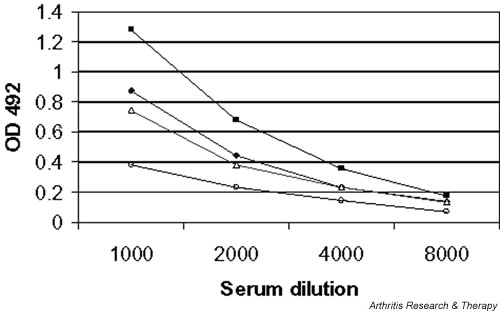
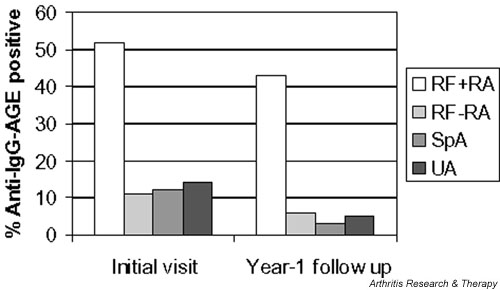
Advanced glycation end-product (AGE)-damaged IgG occurs as a result of hyperglycemia and/or oxidative stress. Autoantibodies to IgG-AGE were previously demonstrated in patients with severe, longstanding rheumatoid arthritis (RA). We investigated whether IgG-AGE and anti-IgG-AGE antibodies were present early in the course of RA and other inflammatory arthropathies. We prospectively followed a cohort of 238 patients with inflammatory arthritis of duration less than 1 year. Patients were evaluated clinically and serologically, and radiographs were obtained at initial and 1-year visits. Sera were assayed for IgG-AGE and anti-IgG-AGE antibodies by enzyme-linked immunosorbent assay (ELISA). Rheumatoid factor (RF) was determined by nephelometry and ELISA. Of all patients, 29% had RF-positive RA, 15% had RF-negative RA, 18% had spondyloarthropathy, and 38% had undifferentiated arthritis. IgG-AGE was present in 19% of patients, and was similar in amount and frequency in all groups. Patients with elevated IgG-AGE levels had significantly higher levels of the inflammatory markers C-reactive protein and erythrocyte sedimentation rate, but there was no correlation with blood glucose levels. Overall, 27% of the patients had IgM anti-IgG-AGE antibodies. These antibodies were highly significantly associated with RFs (P < 0.0001) and with swollen joint count (P < 0.01). In early onset arthritis, IgG damaged by AGE was detected in all patient groups. The ability to make IgM anti-IgG-AGE antibodies, however, was restricted to a subset of RF-positive RA patients with more active disease. The persistence of the anti-IgG-AGE response was more specific to RA, and was transient in the patients with spondyloarthropathy and with undifferentiated arthritis who were initially found to be positive for anti-IgG-AGE antibodies.
晚期糖基化终末产物(AGE)损伤的IgG是高血糖和/或氧化应激的结果。先前在患有严重、长期类风湿关节炎(RA)的患者中证实了针对IgG-AGE的自身抗体。我们调查了IgG-AGE和抗IgG-AGE抗体是否在RA和其他炎性关节病病程早期出现。我们前瞻性地随访了238例病程小于1年的炎性关节炎患者。对患者进行临床和血清学评估,并在初次就诊和1年随访时拍摄X光片。通过酶联免疫吸附测定(ELISA)检测血清中的IgG-AGE和抗IgG-AGE抗体。通过比浊法和ELISA测定类风湿因子(RF)。在所有患者中,29%患有RF阳性RA,15%患有RF阴性RA,18%患有脊柱关节病,38%患有未分化关节炎。19%的患者存在IgG-AGE,且在所有组中的含量和频率相似。IgG-AGE水平升高的患者炎症标志物C反应蛋白和红细胞沉降率水平显著更高,但与血糖水平无关。总体而言,27%的患者有IgM抗IgG-AGE抗体。这些抗体与RFs高度显著相关(P < 0.0001),与肿胀关节计数也显著相关(P < 0.01)。在早期关节炎中,所有患者组均检测到AGE损伤的IgG。然而,产生IgM抗IgG-AGE抗体的能力仅限于疾病更活跃的RF阳性RA患者亚组。抗IgG-AGE反应的持续存在对RA更具特异性,在最初抗IgG-AGE抗体呈阳性的脊柱关节病和未分化关节炎患者中是短暂的。