Bardos Tamas, Czipri Matyas, Vermes Csaba, Finnegan Alison, Mikecz Katalin, Zhang Jian
Section of Biochemistry and Molecular Biology, Department of Orthopedic Surgery, Rush University at Rush-Presbyterian-St, Luke's Medical Center, Chicago, Illinois, USA.
Arthritis Res Ther. 2003;5(2):R106-13. doi: 10.1186/ar624. Epub 2003 Jan 20.
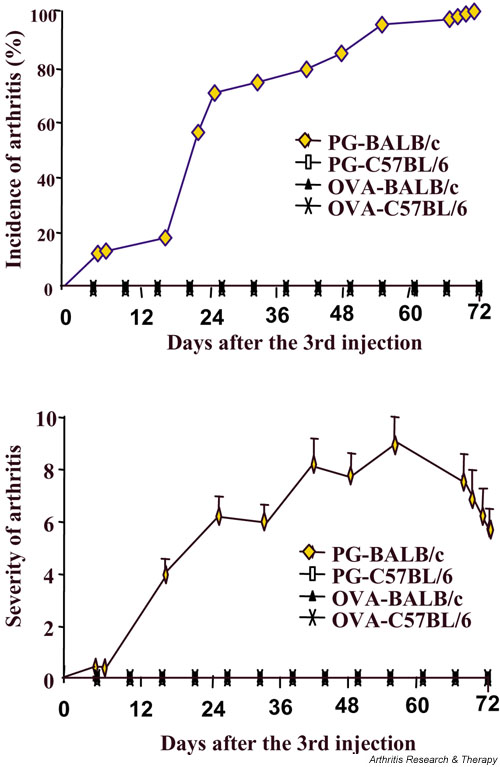
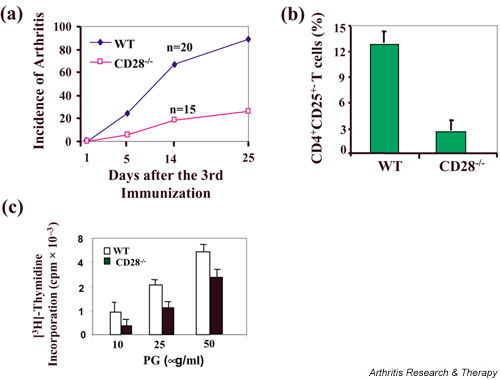
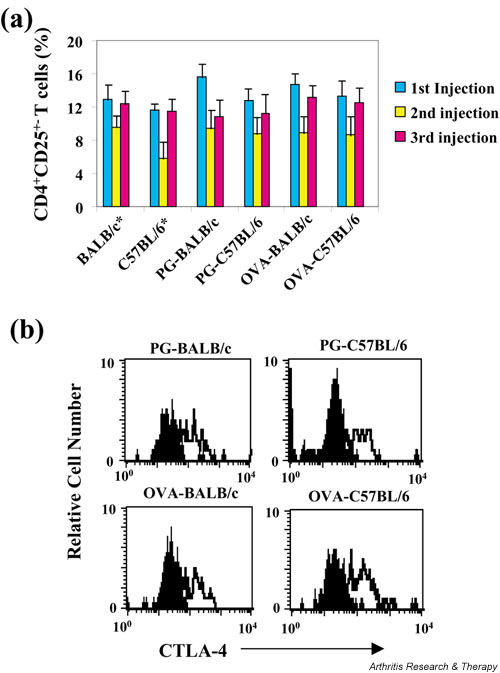
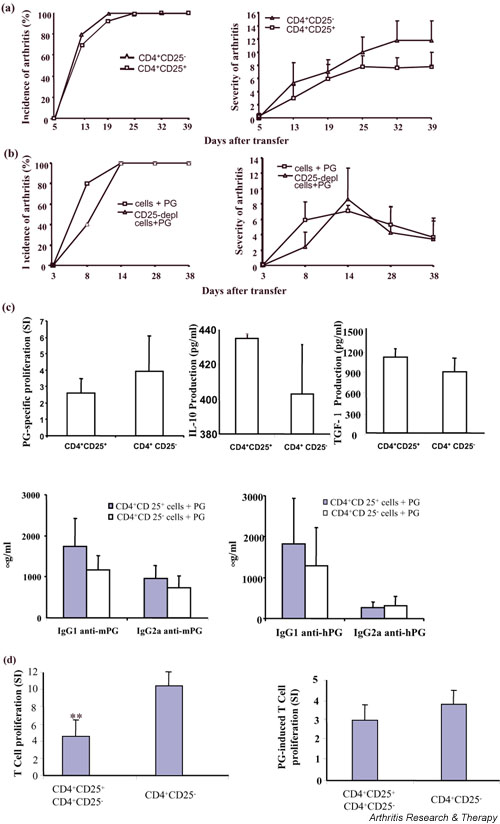
Accumulating evidence suggests that regulatory T cells play a crucial role in preventing autoimmunity. Recently, a naturally occurring CD4+CD25+ T-cell subset that is anergic and also suppressive has been shown to suppress autoimmunity in several animal models. We used proteoglycan-induced arthritis (PGIA) as a study model to investigate the role of the CD4+CD25+ regulatory T cells in autoimmune arthritis. There was no significant change in the percentage of CD4+CD25+ T cells during the immunization period when proteoglycan- or ovalbumin-immunized BALB/c and C57BL/6 mice were compared. An adoptive transfer study showed that the CD4+CD25+ T cells did not protect severe combined immunodeficient mice from arthritis when they were cotransferred with splenocytes from arthritic animals. Similarly, depletion of the CD4+CD25+ T cells did not enhance the onset of the disease or disease severity in severe combined immunodeficient mice. Moreover, CD28-deficient mice, which have very few CD4+CD25+ T cells, were highly resistant to PGIA. These findings indicate that the CD4+CD25+ regulatory T cells may not play a critical role in controlling PGIA.
越来越多的证据表明,调节性T细胞在预防自身免疫中起着关键作用。最近,一种天然存在的、无反应性且具有抑制作用的CD4+CD25+T细胞亚群已被证明在几种动物模型中可抑制自身免疫。我们使用蛋白聚糖诱导的关节炎(PGIA)作为研究模型,来研究CD4+CD25+调节性T细胞在自身免疫性关节炎中的作用。当比较用蛋白聚糖或卵清蛋白免疫的BALB/c和C57BL/6小鼠时,在免疫期间CD4+CD25+T细胞的百分比没有显著变化。一项过继转移研究表明,当CD4+CD25+T细胞与来自关节炎动物的脾细胞共同转移时,它们并不能保护严重联合免疫缺陷小鼠免于患关节炎。同样,在严重联合免疫缺陷小鼠中,CD4+CD25+T细胞的耗竭并没有增强疾病的发作或疾病严重程度。此外,CD28缺陷小鼠(其CD4+CD25+T细胞极少)对PGIA具有高度抗性。这些发现表明,CD4+CD25+调节性T细胞可能在控制PGIA中不发挥关键作用。