Lyne Rachel, Burns Gavin, Mata Juan, Penkett Chris J, Rustici Gabriella, Chen Dongrong, Langford Cordelia, Vetrie David, Bähler Jürg
The Wellcome Trust Sanger Institute, Hinxton, Cambridge CB10 1SA, UK.
BMC Genomics. 2003 Jul 10;4(1):27. doi: 10.1186/1471-2164-4-27.
The genome of the fission yeast Schizosaccharomyces pombe has recently been sequenced, setting the stage for the post-genomic era of this increasingly popular model organism. We have built fission yeast microarrays, optimised protocols to improve array performance, and carried out experiments to assess various characteristics of microarrays.
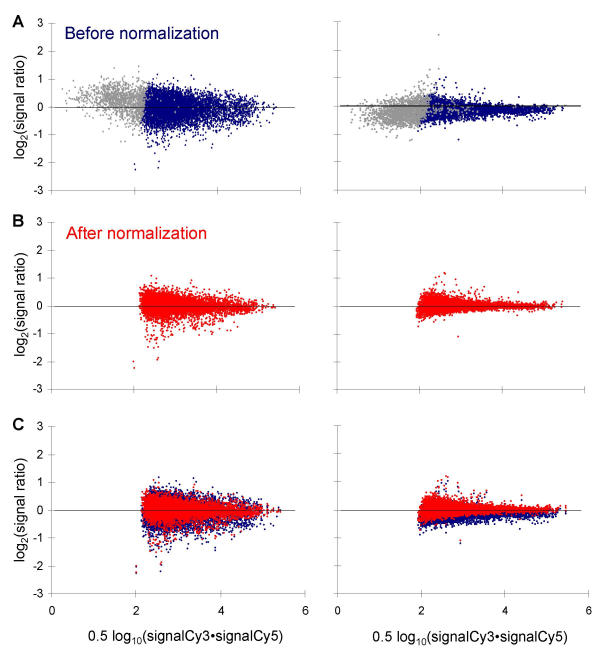
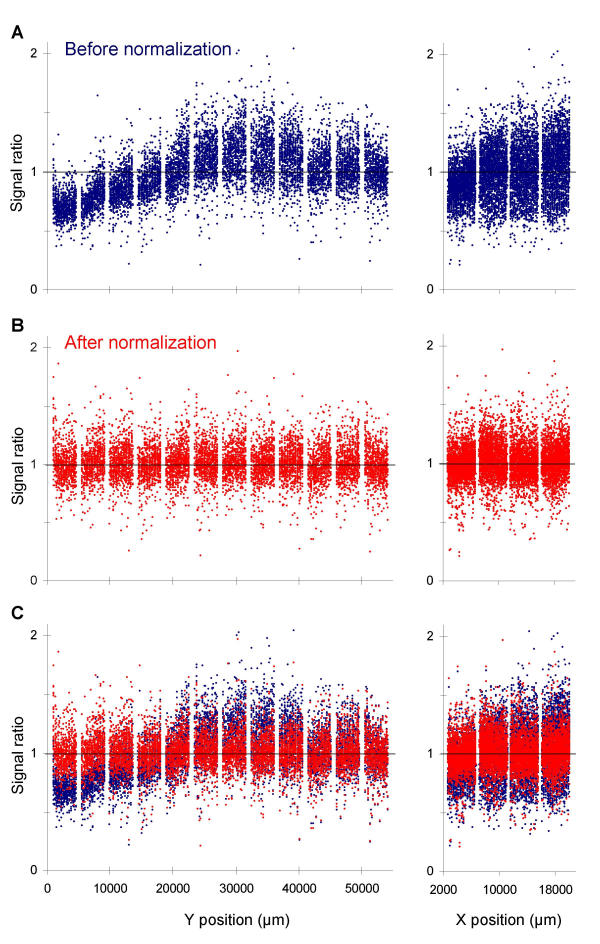
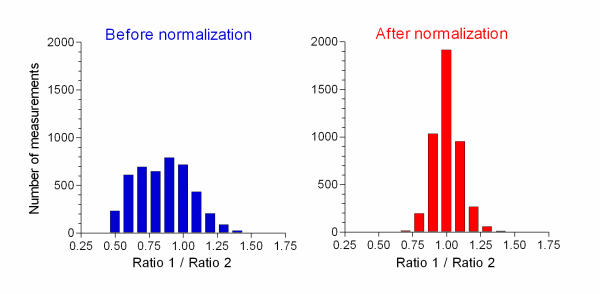
We designed PCR primers to amplify specific probes (180-500 bp) for all known and predicted fission yeast genes, which are printed in duplicate onto separate regions of glass slides together with control elements (approximately 13,000 spots/slide). Fluorescence signal intensities depended on the size and intragenic position of the array elements, whereas the signal ratios were largely independent of element properties. Only the coding strand is covalently linked to the slides, and our array elements can discriminate transcriptional direction. The microarrays can distinguish sequences with up to 70% identity, above which cross-hybridisation contributes to the signal intensity. We tested the accuracy of signal ratios and measured the reproducibility of array data caused by biological and technical factors. Because the technical variability is lower, it is best to use samples prepared from independent biological experiments to obtain repeated measurements with swapping of fluorochromes to prevent dye bias. We also developed a script that discards unreliable data and performs a normalization to correct spatial artefacts.
This paper provides data for several microarray properties that are rarely measured. The results define critical parameters for microarray design and experiments and provide a framework to optimise and interpret array data. Our arrays give reproducible and accurate expression ratios with high sensitivity. The scripts for primer design and initial data processing as well as primer sequences and detailed protocols are available from our website.
裂殖酵母粟酒裂殖酵母的基因组最近已被测序,为这种越来越受欢迎的模式生物的后基因组时代奠定了基础。我们构建了裂殖酵母微阵列,优化了提高阵列性能的方案,并进行了实验以评估微阵列的各种特性。
我们设计了PCR引物,用于扩增所有已知和预测的裂殖酵母基因的特异性探针(180 - 500 bp),这些探针以一式两份打印在载玻片的不同区域,同时还有对照元件(每张载玻片约13,000个点)。荧光信号强度取决于阵列元件的大小和基因内位置,而信号比率在很大程度上与元件特性无关。只有编码链与载玻片共价连接,并且我们的阵列元件可以区分转录方向。微阵列能够区分同一性高达70%的序列,超过这个比例交叉杂交会影响信号强度。我们测试了信号比率的准确性,并测量了由生物学和技术因素导致的阵列数据的可重复性。由于技术变异性较低,最好使用从独立生物学实验制备的样本进行重复测量,并交换荧光染料以防止染料偏差。我们还开发了一个脚本,用于丢弃不可靠数据并进行归一化以校正空间假象。
本文提供了一些很少测量的微阵列特性的数据。结果定义了微阵列设计和实验的关键参数,并提供了一个优化和解释阵列数据的框架。我们的阵列具有高灵敏度,能给出可重复且准确的表达比率。引物设计和初始数据处理的脚本以及引物序列和详细方案可从我们的网站获取。