Briones Carlos, Domingo Esteban, Molina-París Carmen
Centro de Astrobiología (CSIC-INTA), Carretera de Ajalvir, Km 4, Torrejón de Ardoz, 28850 Madrid, Spain.
J Mol Biol. 2003 Aug 1;331(1):213-29. doi: 10.1016/s0022-2836(03)00661-2.
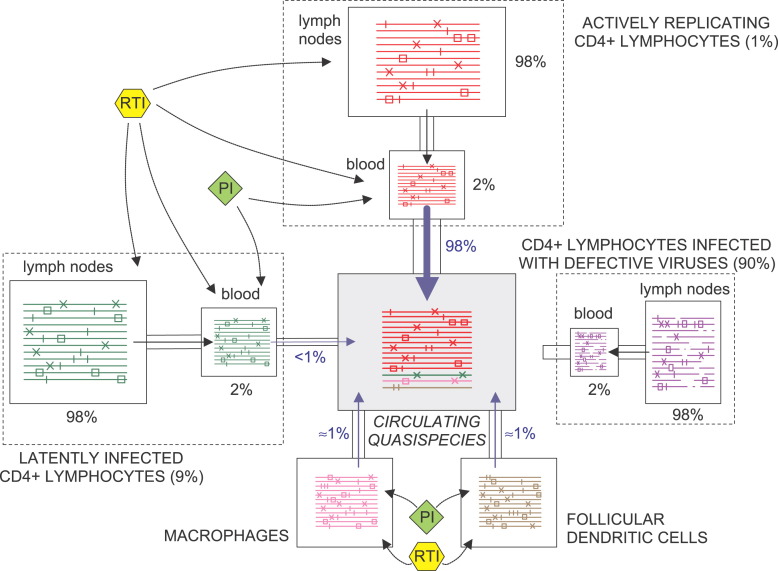
Viral quasispecies may possess a molecular memory of their past evolutionary history, imprinted on minority components of the mutant spectrum. Here we report experimental evidence and a theoretical model for memory in retroviral quasispecies in vivo. Apart from replicative memory associated with quasispecies dynamics, retroviruses may harbour a "cellular" or "anatomical" memory derived from their integrative cycle and the presence of viral reservoirs in body compartments. Three independent sets of data exemplify the two kinds of memory in human immunodeficiency virus type 1 (HIV-1). The data provide evidence of re-emergence of sequences that were hidden in cellular or anatomical compartments for extended periods of infection, and recovery of a quasispecies from pre-existing genomes. We develop a three-component model that incorporates the essential features of the quasispecies dynamics of retroviruses exposed to selective pressures. Significantly, a numerical study based on this model is in agreement with the experimental data, further supporting the existence of both replicative and reservoir memory in retroviral quasispecies.
病毒准种可能拥有其过去进化历史的分子记忆,这种记忆印刻在突变谱的少数组分上。在此,我们报告了体内逆转录病毒准种记忆的实验证据和理论模型。除了与准种动态相关的复制记忆外,逆转录病毒可能还拥有一种源自其整合周期以及身体各部位病毒储存库存在的“细胞”或“解剖学”记忆。三组独立的数据例证了1型人类免疫缺陷病毒(HIV-1)中的这两种记忆。这些数据证明了在长时间感染过程中隐藏于细胞或解剖学部位的序列再次出现,以及从先前存在的基因组中恢复准种。我们开发了一个包含暴露于选择压力下的逆转录病毒准种动态基本特征的三组分模型。重要的是,基于该模型的数值研究与实验数据一致,进一步支持了逆转录病毒准种中复制记忆和储存库记忆的存在。