Riordan James F
Center for Biochemical and Biophysical Sciences and Medicine, Harvard Medical School, One Kendall Square, Cambridge, MA 02139, USA.
Genome Biol. 2003;4(8):225. doi: 10.1186/gb-2003-4-8-225. Epub 2003 Jul 25.
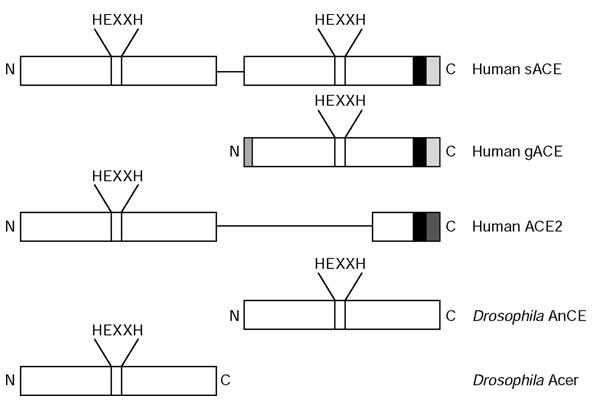
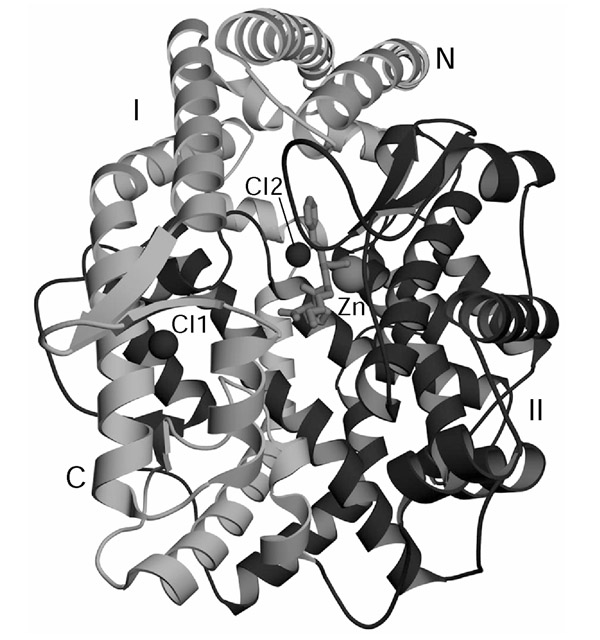
Angiotensin-I-converting enzyme (ACE) is a monomeric, membrane-bound, zinc- and chloride-dependent peptidyl dipeptidase that catalyzes the conversion of the decapeptide angiotensin I to the octapeptide angiotensin II, by removing a carboxy-terminal dipeptide. ACE has long been known to be a key part of the renin angiotensin system that regulates blood pressure, and ACE inhibitors are important for the treatment of hypertension. There are two forms of the enzyme in humans, the ubiquitous somatic ACE and the sperm-specific germinal ACE, both encoded by the same gene through transcription from alternative promoters. Somatic ACE has two tandem active sites with distinct catalytic properties, whereas germinal ACE, the function of which is largely unknown, has just a single active site. Recently, an ACE homolog, ACE2, has been identified in humans that differs from ACE in being a carboxypeptidase that preferentially removes carboxy-terminal hydrophobic or basic amino acids; it appears to be important in cardiac function. ACE homologs (also known as members of the M2 gluzincin family) have been found in a wide variety of species, even in those that neither have a cardiovascular system nor synthesize angiotensin. X-ray structures of a truncated, deglycosylated form of germinal ACE and a related enzyme from Drosophila have been reported, and these show that the active site is deep within a central cavity. Structure-based drug design targeting the individual active sites of somatic ACE may lead to a new generation of ACE inhibitors, with fewer side-effects than currently available inhibitors.
血管紧张素转换酶(ACE)是一种单体、膜结合、依赖锌和氯的肽基二肽酶,它通过去除羧基末端二肽,催化十肽血管紧张素I转化为八肽血管紧张素II。长期以来,人们一直认为ACE是调节血压的肾素血管紧张素系统的关键组成部分,ACE抑制剂对高血压治疗很重要。人类体内有两种形式的这种酶,即普遍存在的体细胞ACE和精子特异性的生殖细胞ACE,二者由同一基因通过不同启动子转录编码。体细胞ACE有两个串联的活性位点,具有不同的催化特性,而功能 largely未知的生殖细胞ACE只有一个活性位点。最近,在人类中发现了一种ACE同系物ACE2,它与ACE不同,是一种羧肽酶,优先去除羧基末端的疏水或碱性氨基酸;它似乎在心脏功能中很重要。ACE同系物(也称为M2谷锌肽酶家族成员)已在多种物种中发现,甚至在那些既没有心血管系统也不合成血管紧张素的物种中也有发现。已报道了截短的、去糖基化形式的生殖细胞ACE和来自果蝇的相关酶的X射线结构,这些结构表明活性位点位于中央腔的深处。针对体细胞ACE各个活性位点的基于结构的药物设计可能会导致新一代的ACE抑制剂,其副作用比目前可用的抑制剂更少。