Fu Y K, Arkins S, Fuh G, Cunningham B C, Wells J A, Fong S, Cronin M J, Dantzer R, Kelley K W
Department of Animal Sciences, University of Illinois, Urbana 61801.
J Clin Invest. 1992 Feb;89(2):451-7. doi: 10.1172/JCI115605.
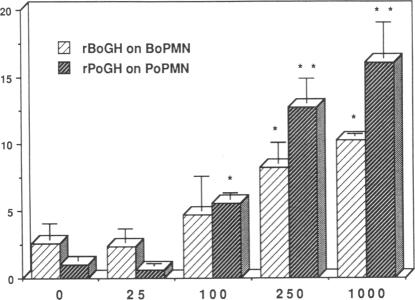
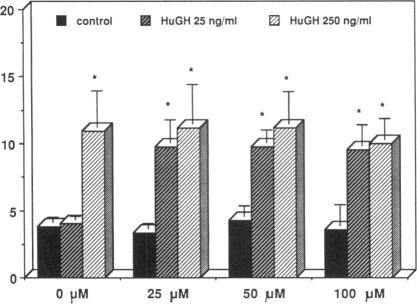
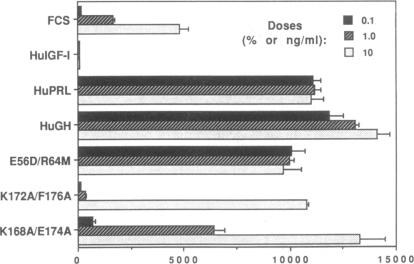
Recombinant human growth hormone (HuGH) and human prolactin (HuPRL), but not GH of bovine or porcine origin, prime human neutrophils for enhanced superoxide anion (O2-) secretion. Since HuGH, but not GH of other species, effectively binds to the HuPRL receptor (HuPRL-R), we used a group of HuGH variants created by site-directed mutagenesis to identify the receptor on human neutrophils responsible for HuGH priming. A monoclonal antibody (MAb) directed against the HuPRL-R completely abrogated O2- secretion by neutrophils incubated with either HuGH or HuPRL, whereas a MAb to the HuGH-R had no effect. The HuGH variant K172A/F176A, which has reduced affinity for both the HuGH-binding protein (BP) and the HuPRL-BP, was unable to prime human neutrophils. This indicates that priming is initiated by a ligand-receptor interaction, the affinity of which is near that defined for receptors for PRL and GH. Another HuGH variant, K168A/E174A, which has relatively low affinity for the HuPRL-BP but slightly increased affinity for the HuGH-BP, had much reduced ability to prime neutrophils. In contrast, HuGH variant E56D/R64M, which has a similar affinity as wild-type HuGH for the HuPRL-BP but a lower affinity for the HuGH-BP, primed neutrophils as effectively as the wild-type HuGH. Finally, binding of HuGH to the HuPRL-BP but not to the HuGH-BP has been shown to be zinc dependent, and priming of neutrophils by HuGH was also responsive to zinc. Collectively, these data directly couple the binding of HuGH to the HuPRL-R with one aspect of functional activation of human target cells.
重组人生长激素(HuGH)和人催乳素(HuPRL)可使人类中性粒细胞致敏,以增强超氧阴离子(O2-)的分泌,但牛或猪来源的生长激素则无此作用。由于HuGH而非其他物种的生长激素能有效结合人催乳素受体(HuPRL-R),我们使用了一组通过定点诱变产生的HuGH变体,以确定人类中性粒细胞上负责HuGH致敏的受体。一种针对HuPRL-R的单克隆抗体(MAb)完全消除了与HuGH或HuPRL一起孵育的中性粒细胞的O2-分泌,而针对HuGH-R的MAb则没有效果。HuGH变体K172A/F176A对HuGH结合蛋白(BP)和HuPRL-BP的亲和力均降低,无法使人类中性粒细胞致敏。这表明致敏是由配体-受体相互作用引发的,其亲和力接近催乳素和生长激素受体所定义的亲和力。另一种HuGH变体K168A/E174A对HuPRL-BP的亲和力相对较低,但对HuGH-BP的亲和力略有增加,其使中性粒细胞致敏的能力大大降低。相比之下,HuGH变体E56D/R64M对HuPRL-BP的亲和力与野生型HuGH相似,但对HuGH-BP的亲和力较低,其致敏中性粒细胞的效果与野生型HuGH一样有效。最后,已证明HuGH与HuPRL-BP而非HuGH-BP的结合是锌依赖性的,并且HuGH对中性粒细胞的致敏也对锌有反应。总体而言,这些数据直接将HuGH与HuPRL-R的结合与人类靶细胞功能激活的一个方面联系起来。