
一种由胰岛素样生长因子IB前激素的E肽结构域编码的促有丝分裂肽酰胺。
A mitogenic peptide amide encoded within the E peptide domain of the insulin-like growth factor IB prohormone.
作者信息
Siegfried J M, Kasprzyk P G, Treston A M, Mulshine J L, Quinn K A, Cuttitta F
机构信息
Department of Pharmacology, University of Pittsburgh, PA 15261.
出版信息
Proc Natl Acad Sci U S A. 1992 Sep 1;89(17):8107-11. doi: 10.1073/pnas.89.17.8107.
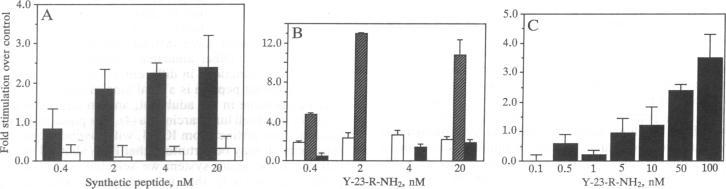
We have identified an amino acid sequence within the E peptide of the insulin-like growth factor IB (IGF-IB) precursor that is biologically active and designated this peptide insulin-like growth factor IB-(103-124) E1 amide (IBE1). Its existence was predicted by a flanking Gly-Lys-Lys-Lys, a signal sequence for sequential proteolytic cleavage and peptidyl C-terminal amidation. A synthetic analog of the predicted IBE1 peptide, designated Y-23-R-NH2, was generated with tyrosine added at position 0. This peptide at 2-20 nM had growth-promoting effects on both normal and malignant human bronchial epithelial cells. Y-23-R-NH2 bound to specific high-affinity receptors (Kd = 2.8 +/- 1.4 x 10(-11) M) present at 1-2 x 10(4) binding sites per cell. Ligand binding was not inhibited by recombinant insulin or recombinant IGF-I. Furthermore, a monoclonal antibody antagonist to the IGF-I receptor (alpha IR3) did not suppress the proliferative response induced by Y-23-R-NH2. In addition, C-terminal amidation was shown to be important in receptor recognition since the free-acid analog of IBE1 (Y-23-R-OH) did not effectively compete for binding and was not a potent agonist of proliferation. Immunoblot analysis of human lung tumor cell line extracts using an antibody raised against Y-23-R-NH2 detected a low molecular mass band of approximately 5 kDa, implying that a protein product is produced that has immunological similarity to IBE1. Extracts of human, mammalian, and avian livers analyzed on an immunoblot with the anti-Y-23-R-NH2 antibody contained proteins of approximately 21 kDa that were specifically recognized by the antiserum and presumably represent an IGF-I precursor molecule. This implies that in species where an IGF-I mRNA with homology to the human IGF-IB E domain has not yet been described, an alternate mRNA must be produced that contains a sequence similar to that of the midportion of the human IGF-IB E domain. Our findings demonstrate that IBE1 is a growth factor that mediates its effect through a specific high-affinity receptor and is most likely conserved in many species.
我们已在胰岛素样生长因子IB(IGF-IB)前体的E肽内鉴定出一段具有生物活性的氨基酸序列,并将该肽命名为胰岛素样生长因子IB-(103-124) E1酰胺(IBE1)。其存在是由侧翼的甘氨酸-赖氨酸-赖氨酸-赖氨酸预测的,这是一个用于顺序蛋白水解切割和肽基C末端酰胺化的信号序列。生成了预测的IBE1肽的合成类似物,命名为Y-23-R-NH2,在第0位添加了酪氨酸。该肽在2-20 nM浓度下对正常和恶性人支气管上皮细胞均有促生长作用。Y-23-R-NH2与每个细胞中存在1-2×10⁴个结合位点的特异性高亲和力受体结合(Kd = 2.8±1.4×10⁻¹¹ M)。重组胰岛素或重组IGF-I不抑制配体结合。此外,IGF-I受体的单克隆抗体拮抗剂(αIR3)不抑制Y-23-R-NH2诱导的增殖反应。另外,C末端酰胺化在受体识别中很重要,因为IBE1的游离酸类似物(Y-23-R-OH)不能有效竞争结合,且不是增殖的有效激动剂。使用针对Y-23-R-NH2产生的抗体对人肺肿瘤细胞系提取物进行免疫印迹分析,检测到一条约5 kDa的低分子量条带,这意味着产生了一种与IBE1具有免疫相似性的蛋白质产物。用人、哺乳动物和禽类肝脏提取物进行抗Y-23-R-NH2抗体免疫印迹分析,含有约21 kDa的蛋白质,该蛋白质被抗血清特异性识别,可能代表一种IGF-I前体分子。这意味着在尚未描述与人IGF-IB E结构域具有同源性的IGF-I mRNA的物种中,必须产生一种包含与人IGF-IB E结构域中部序列相似的替代mRNA。我们的研究结果表明,IBE1是一种生长因子,它通过特异性高亲和力受体介导其作用,并且很可能在许多物种中保守。


 Zotero 插件