Seki T, Yamashita K, Nishitani H, Takagi T, Russell P, Nishimoto T
Department of Molecular Biology, Graduate School of Medical Science, Kyushu University, Fukuoka, Japan.
Mol Biol Cell. 1992 Dec;3(12):1373-88. doi: 10.1091/mbc.3.12.1373.
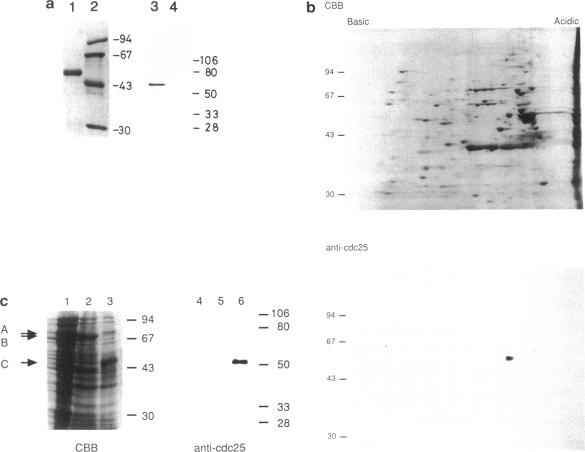
We cloned the hamster cdc25C cDNA by using the human cdc25C cDNA as a probe and prepared an antibody to Escherichia coli-produced hamster cdc25C protein that is specific to the human cdc25C protein. The microinjected antibody inhibited a chromosome condensation induced by tsBN2 mutation, indicating that the cdc25C protein is required for an activation of p34cdc2 kinase caused by loss of RCC1 function. The hamster cdc25C protein located in the cytoplasm, prominently in a periphery of the nuclei of cells arrested with hydroxyurea, and seemed to move into the nuclei by loss of RCC1 function. Also, we found a molecular shift of the cdc25C protein in cells showing premature chromosome condensation (PCC), in addition to normal mitotic cells. This molecular-shift appeared depending on an activation of p34cdc2 kinase.
我们以人cdc25C cDNA为探针克隆了仓鼠cdc25C cDNA,并制备了针对大肠杆菌产生的仓鼠cdc25C蛋白的抗体,该抗体对人cdc25C蛋白具有特异性。显微注射的抗体抑制了tsBN2突变诱导的染色体浓缩,表明cdc25C蛋白是RCC1功能丧失导致的p34cdc2激酶激活所必需的。仓鼠cdc25C蛋白位于细胞质中,在羟基脲阻滞的细胞的细胞核周边尤为明显,并且似乎通过RCC1功能丧失而进入细胞核。此外,除了正常有丝分裂细胞外,我们还在显示早熟染色体浓缩(PCC)的细胞中发现了cdc25C蛋白的分子迁移。这种分子迁移似乎取决于p34cdc2激酶的激活。