Smith K A, Stark M B, Gorman P A, Stark G R
Imperial Cancer Research Fund, London, United Kingdom.
Proc Natl Acad Sci U S A. 1992 Jun 15;89(12):5427-31. doi: 10.1073/pnas.89.12.5427.
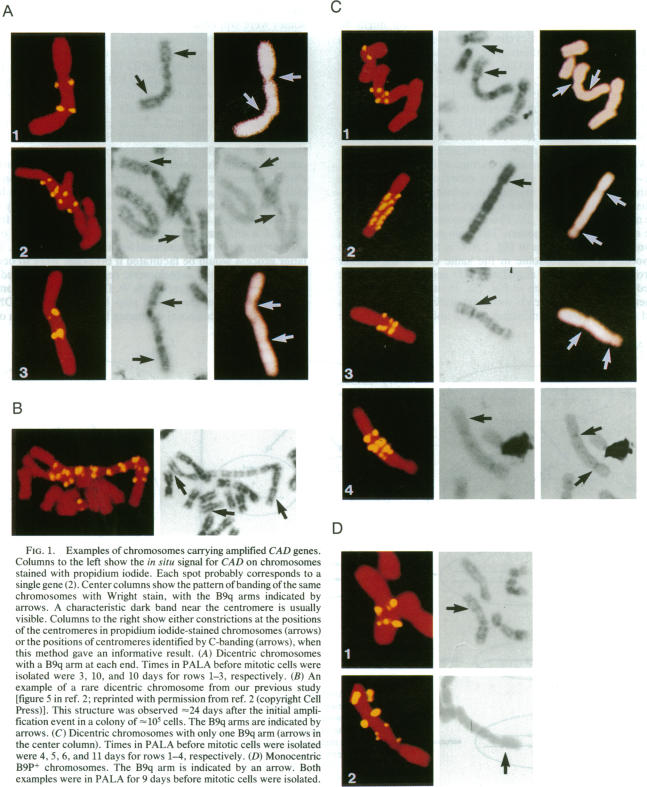
Previous analyses by fluorescence in situ hybridization of structures present 20-30 cell generations after the primary events of mammalian gene amplification have shown that tens of megabases of DNA separate each copy of the selected gene in chromosomal arrays that contain up to 15 copies. Since these structures are very unstable, it is necessary to study amplified DNA as soon as possible after it has been formed to relate the structures observed to the primary mechanisms that generated them. Previously, new amplifications of the CAD gene were analyzed in colonies of 10(5) N-(phosphonoacetyl)-L-aspartate-resistant Syrian hamster BHK cells. CAD is on the p arm of chromosome B9 and the amplified genes were usually found in large extensions of B9p, with one copy in its normal position. We now report that dividing drug-resistant cells have been physically separated from static drug-sensitive cells, to allow the amplified structures to be observed only a few cell generations after they have been formed. The most informative results are that about one-third of the newly formed chromosomes carrying amplified CAD genes are dicentric and that about half of these carry two B9q arms. These observations reveal that recombination between the p telomeric regions of two B9 sister chromatids is an important primary event of amplification in this system. The resulting dicentric chromosomes can then enter bridge-breakage-fusion cycles that provide the means to increase the number of CAD genes per cell in successive generations by an asymmetric distribution at each cell division.
先前通过荧光原位杂交对哺乳动物基因扩增主要事件发生20 - 30个细胞世代后所呈现结构的分析表明,在包含多达15个拷贝的染色体阵列中,选定基因的每个拷贝之间相隔数十兆碱基的DNA。由于这些结构非常不稳定,有必要在扩增的DNA形成后尽快对其进行研究,以便将观察到的结构与产生它们的主要机制联系起来。此前,在10⁵个对N -(膦酰基乙酰基)- L -天冬氨酸耐药的叙利亚仓鼠BHK细胞集落中分析了CAD基因的新扩增情况。CAD位于B9染色体的p臂上,扩增基因通常在B9p的大片段延伸区域中发现,其中一个拷贝位于其正常位置。我们现在报告,已将正在分裂的耐药细胞与静止的药物敏感细胞进行了物理分离,以便在扩增结构形成仅几个细胞世代后就能观察到它们。最具信息量的结果是,携带扩增CAD基因的新形成染色体中约三分之一是双着丝粒的,并且其中约一半携带两条B9q臂。这些观察结果表明,两条B9姐妹染色单体的p端粒区域之间的重组是该系统中扩增的一个重要主要事件。由此产生的双着丝粒染色体随后可进入桥 - 断裂 - 融合循环,该循环通过每次细胞分裂时的不对称分布提供了在连续世代中增加每个细胞CAD基因数量的方式。