Drewes G, Lichtenberg-Kraag B, Döring F, Mandelkow E M, Biernat J, Goris J, Dorée M, Mandelkow E
Max-Planck-Unit for Structural Molecular Biology, Hamburg, Germany.
EMBO J. 1992 Jun;11(6):2131-8. doi: 10.1002/j.1460-2075.1992.tb05272.x.
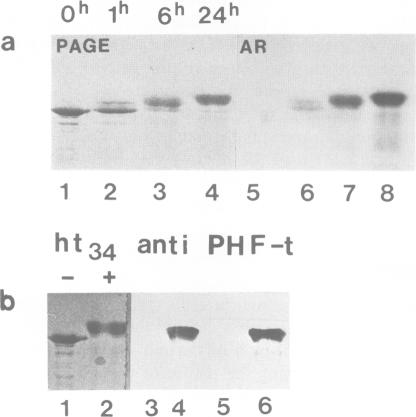
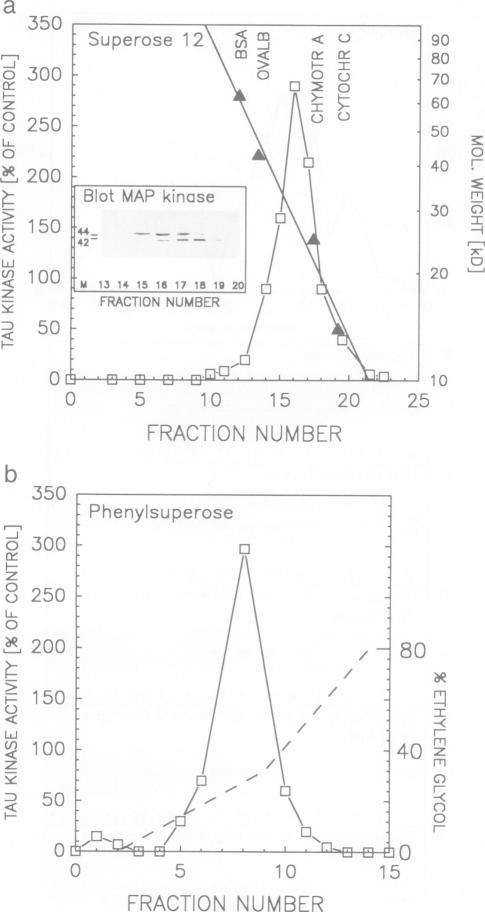
The microtubule-associated protein tau is a major component of the paired helical filaments (PHFs) observed in Alzheimer's disease brains. The pathological tau is distinguished from normal tau by its state of phosphorylation, higher apparent M(r) and reaction with certain antibodies. However, the protein kinase(s) have not been characterized so far. Here we describe a protein kinase from brain which specifically induces the Alzheimer-like state in tau protein. The 42 kDa protein belongs to the family of mitogen activated protein kinases (MAPKs) and is activated by tyrosine phosphorylation. It is capable of phosphorylating Ser-Pro and Thr-Pro motifs in tau protein (approximately 14-16 P1 per tau molecule). By contrast, other proline directed Ser/Thr kinases such as p34(cdc2) combined with cyclin A or B have only minor effects on tau phosphorylation. We propose that MAP kinase is abnormally active in Alzheimer brain tissue, or that the corresponding phosphatases are abnormally passive, due to a breakdown of the normal regulatory mechanisms.
微管相关蛋白tau是在阿尔茨海默病大脑中观察到的双螺旋丝(PHF)的主要成分。病理性tau与正常tau的区别在于其磷酸化状态、更高的表观分子量(M(r))以及与某些抗体的反应。然而,迄今为止尚未鉴定出相关的蛋白激酶。在此我们描述一种来自大脑的蛋白激酶,它能特异性地诱导tau蛋白呈现阿尔茨海默病样状态。这种42 kDa的蛋白属于丝裂原活化蛋白激酶(MAPK)家族,通过酪氨酸磷酸化被激活。它能够磷酸化tau蛋白中的Ser-Pro和Thr-Pro基序(每个tau分子约14 - 16个P1)。相比之下,其他脯氨酸导向的Ser/Thr激酶,如与细胞周期蛋白A或B结合的p34(cdc2),对tau磷酸化的影响较小。我们推测,由于正常调节机制的破坏,MAP激酶在阿尔茨海默病脑组织中异常活跃,或者相应的磷酸酶异常失活。