Petricoin E F, Hackett R H, Akai H, Igarashi K, Finbloom D S, Larner A C
Division of Cytokine Biology, Center for Biologics Evaluation and Research, Bethesda, Maryland 20892.
Mol Cell Biol. 1992 Oct;12(10):4486-95. doi: 10.1128/mcb.12.10.4486-4495.1992.
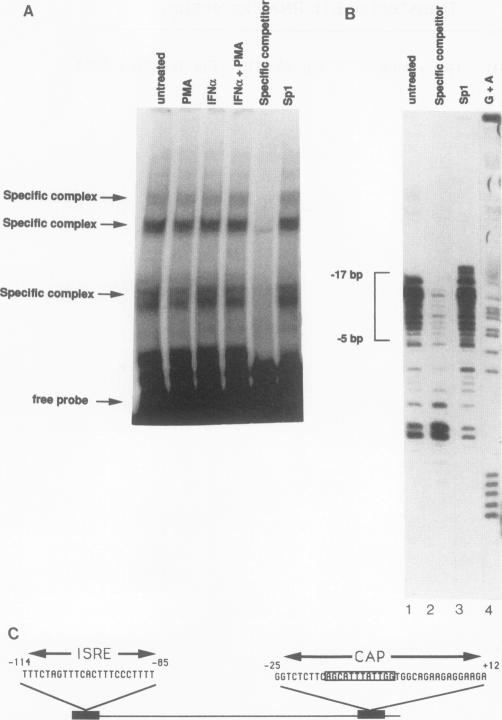
Phorbol esters activate the expression of a variety of early-response genes through protein kinase C-dependent pathways. In addition, phorbol esters may promote cell growth by the inhibition of expression of cellular gene products regulated by antiproliferative agents such as interferons (IFN)s. In human diploid fibroblasts, phorbol 12-myristate 13-acetate (PMA) selectively inhibits the IFN-alpha-induced cellular gene ISG54. Using transient transfection assays, we have delineated two elements in the promoter of this gene that are necessary for the inhibitory actions of PMA. These elements include (i) the IFN-stimulated response element (ISRE) which is necessary for IFN-alpha-induced cellular gene expression, and (ii) an element located near the site of transcription initiation. IFN-alpha treatment resulted in the rapid induction of ISGF3, a multisubunit transcription factor which binds to the ISRE. PMA caused a substantial reduction in IFN alpha-induced ISGF3 in both nuclear and cytoplasmic extracts, as determined by electrophoretic mobility shift assays with the ISRE as a probe. In vitro reconstitution experiments revealed that IFN-alpha activation of the ISGF3 alpha component of ISGF3 was not affected by PMA. Further experiments were consistent with the possibility that PMA regulated the activity of a cellular factor which competed with ISGF3 gamma for binding of the activated ISGF3 alpha polypeptides. Electrophoretic mobility shift assays using the cap site of ISG54 as a probe demonstrated the formation of a specific complex whose DNA binding activity was not affected by treatment of cells with PMA or IFN-alpha. Competitive inhibition studies were consistent with the DNA-protein complex at the cap site of ISG54 containing proteins with DNA binding sites in common with those which also interact with the ISRE. These data suggest a unique regulatory mechanism by which phorbol esters can modulate IFN signaling.
佛波酯通过蛋白激酶C依赖性途径激活多种早期反应基因的表达。此外,佛波酯可能通过抑制由抗增殖剂如干扰素(IFN)调节的细胞基因产物的表达来促进细胞生长。在人二倍体成纤维细胞中,佛波醇12-肉豆蔻酸酯13-乙酸酯(PMA)选择性抑制IFN-α诱导的细胞基因ISG54。使用瞬时转染分析,我们已经确定了该基因启动子中的两个元件,它们是PMA抑制作用所必需的。这些元件包括:(i)IFN刺激反应元件(ISRE),它是IFN-α诱导的细胞基因表达所必需的;(ii)位于转录起始位点附近的一个元件。IFN-α处理导致ISGF3的快速诱导,ISGF3是一种与ISRE结合的多亚基转录因子。通过以ISRE为探针的电泳迁移率变动分析确定,PMA导致核提取物和细胞质提取物中IFN-α诱导的ISGF3大幅减少。体外重组实验表明,PMA不影响ISGF3的ISGF3α组分的IFN-α激活。进一步的实验与以下可能性一致,即PMA调节一种细胞因子的活性,该细胞因子与ISGF3γ竞争结合活化的ISGF3α多肽。使用ISG54的帽位点作为探针的电泳迁移率变动分析证明形成了一种特异性复合物,其DNA结合活性不受PMA或IFN-α处理细胞的影响。竞争性抑制研究与ISG54帽位点处的DNA-蛋白质复合物一致,该复合物含有与那些也与ISRE相互作用的蛋白质具有共同DNA结合位点的蛋白质。这些数据表明佛波酯调节IFN信号传导的独特调节机制。