Williams R O, Feldmann M, Maini R N
Kennedy Institute of Rheumatology, Charing Cross Sunley Research Centre, London, United Kingdom.
Proc Natl Acad Sci U S A. 1992 Oct 15;89(20):9784-8. doi: 10.1073/pnas.89.20.9784.
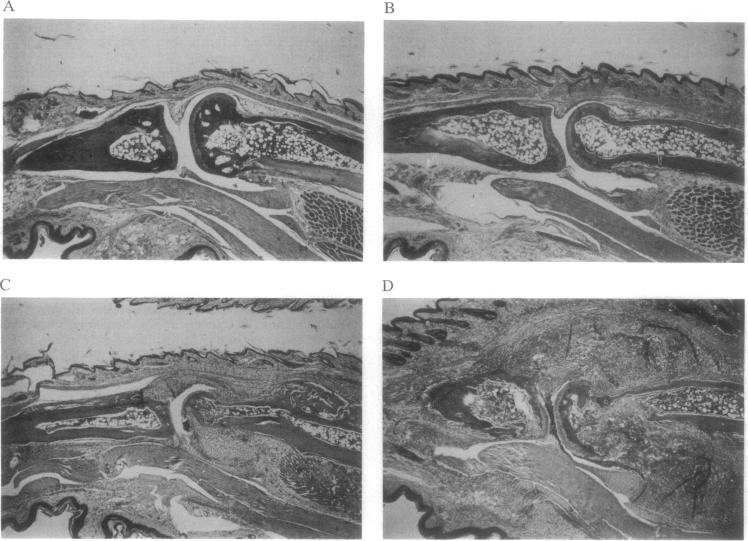
There is considerable evidence implicating tumor necrosis factor alpha (TNF-alpha) in the pathogenesis of rheumatoid arthritis. This evidence is based not only on the universal presence of TNF-alpha in arthritic joints accompanied by the upregulation of TNF-alpha receptors but also on the effects of neutralizing TNF-alpha in joint cell cultures. Thus, neutralization of TNF-alpha in vitro results in inhibition of the production of interleukin 1, which like TNF-alpha, is believed to contribute to joint inflammation and erosion. To determine the validity of this concept in vivo, the effect of administering TNF-neutralizing antibodies to mice with collagen-induced arthritis has been studied. This disease model was chosen because of its many immunological and pathological similarities to human rheumatoid arthritis. TN3-19.12, a hamster IgG1 monoclonal antibody to murine TNF-alpha/beta, was injected i.p. into mice either before the onset of arthritis or after the establishment of clinical disease. Anti-TNF administered prior to disease onset significantly reduced paw swelling and histological severity of arthritis without reducing the incidence of arthritis or the level of circulating anti-type II collagen IgG. More relevant to human disease was the capacity of the antibody to reduce the clinical score, paw swelling, and the histological severity of disease even when injected after the onset of clinical arthritis. These results have implications for possible modes of therapy of human arthritis.
有大量证据表明肿瘤坏死因子α(TNF-α)与类风湿性关节炎的发病机制有关。这一证据不仅基于TNF-α在关节炎关节中的普遍存在以及TNF-α受体的上调,还基于在关节细胞培养中中和TNF-α的作用。因此,在体外中和TNF-α会导致白细胞介素1的产生受到抑制,白细胞介素1与TNF-α一样,被认为会导致关节炎症和侵蚀。为了确定这一概念在体内的有效性,研究了给患有胶原诱导性关节炎的小鼠注射TNF中和抗体的效果。选择这种疾病模型是因为它在许多免疫学和病理学方面与人类类风湿性关节炎相似。TN3-19.12是一种针对小鼠TNF-α/β的仓鼠IgG1单克隆抗体,在关节炎发作前或临床疾病确立后经腹腔注射到小鼠体内。在疾病发作前给予抗TNF抗体可显著减轻爪部肿胀和关节炎的组织学严重程度,而不会降低关节炎的发病率或循环抗II型胶原IgG的水平。与人类疾病更相关的是,即使在临床关节炎发作后注射该抗体,它也有降低临床评分、爪部肿胀和疾病组织学严重程度的能力。这些结果对人类关节炎可能的治疗方式具有启示意义。