Guerra Marta A, Curns Aaron T, Rupprecht Charles E, Hanlon Cathleen A, Krebs John W, Childs James E
Division of Quarantine and Global Migration, National Center for Infectious Diseases, Centers for Disease Control and Prevention, Atlanta, Georgia 30333, USA.
Emerg Infect Dis. 2003 Sep;9(9):1143-50. doi: 10.3201/eid0909.020608.
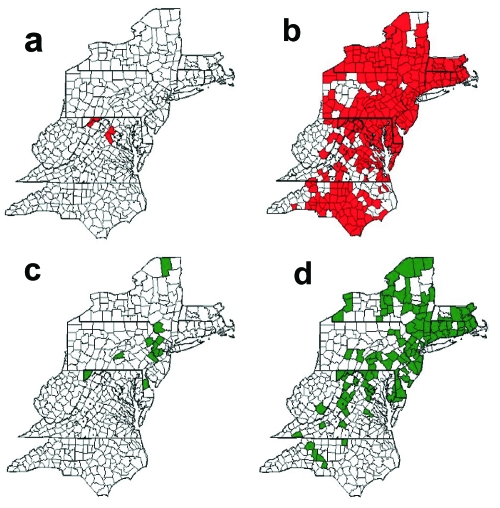
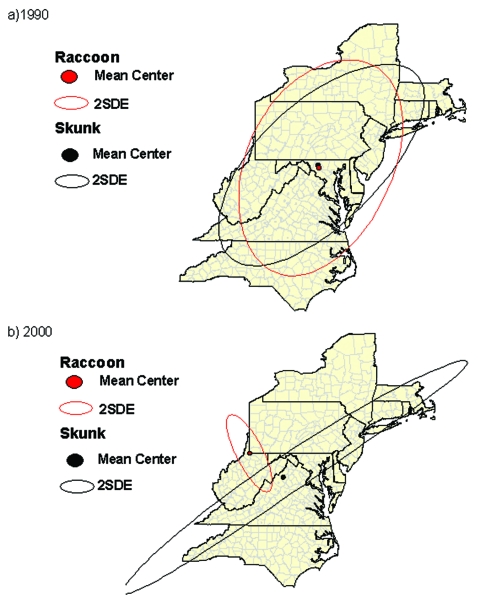
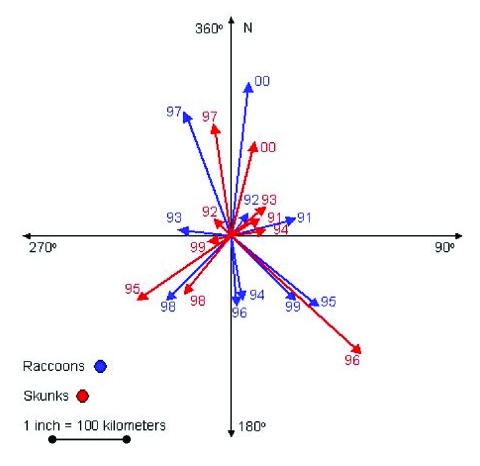
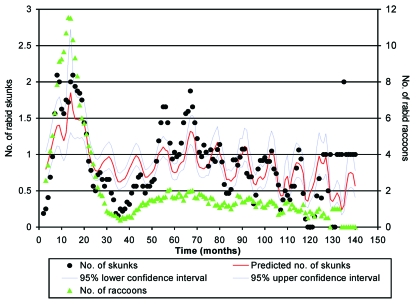
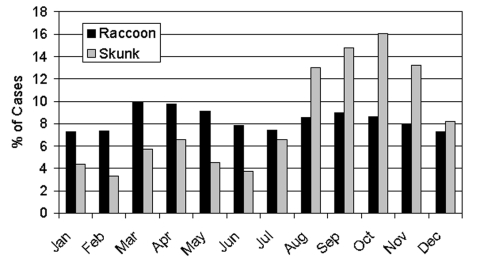
Since 1981, an epizootic of raccoon rabies has spread throughout the eastern United States. A concomitant increase in reported rabies cases in skunks has raised concerns that an independent maintenance cycle of rabies virus in skunks could become established, affecting current strategies of wildlife rabies control programs. Rabies surveillance data from 1981 through 2000 obtained from the health departments of 11 eastern states were used to analyze temporal and spatial characteristics of rabies epizootics in each species. Spatial analysis indicated that epizootics in raccoons and skunks moved in a similar direction from 1990 to 2000. Temporal regression analysis showed that the number of rabid raccoons predicted the number of rabid skunks through time, with a 1-month lag. In areas where the raccoon rabies virus variant is enzootic, spatio-temporal analysis does not provide evidence that this rabies virus variant is currently cycling independently among skunks.
自1981年以来,浣熊狂犬病 epizootic 已蔓延至美国东部各地。臭鼬报告的狂犬病病例随之增加,这引发了人们的担忧,即狂犬病病毒可能在臭鼬中建立独立的维持循环,从而影响当前野生动物狂犬病控制计划的策略。利用从东部11个州的卫生部门获得的1981年至2000年的狂犬病监测数据,分析了每个物种中狂犬病 epizootic 的时间和空间特征。空间分析表明,1990年至2000年,浣熊和臭鼬的 epizootic 朝着相似的方向发展。时间回归分析表明,患狂犬病浣熊的数量随时间推移可预测患狂犬病臭鼬的数量,滞后1个月。在浣熊狂犬病病毒变种呈地方流行的地区,时空分析并未提供证据表明这种狂犬病病毒变种目前正在臭鼬之间独立循环。