Xie Lu, Law Brian K, Aakre Mary E, Edgerton Mary, Shyr Yu, Bhowmick Neil A, Moses Harold L
Department of Cancer Biology, Vanderbilt University, Nashville, Tennessee, USA.
Breast Cancer Res. 2003;5(6):R187-98. doi: 10.1186/bcr640. Epub 2003 Aug 20.
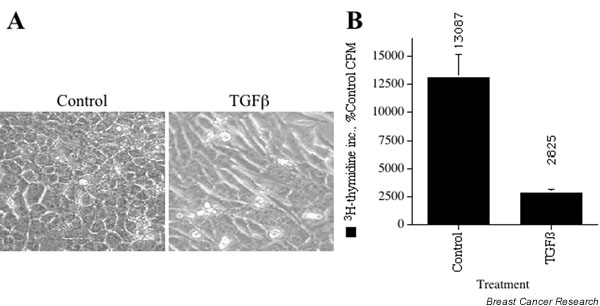
Transforming growth factor beta (TGF-beta) plays an essential role in a wide array of cellular processes. The most well studied TGF-beta response in normal epithelial cells is growth inhibition. In some cell types, TGF-beta induces an epithelial to mesenchymal transition (EMT). NMuMG is a nontransformed mouse mammary gland epithelial cell line that exhibits both a growth inhibitory response and an EMT response to TGF-beta, rendering NMuMG cells a good model system for studying these TGF-beta effects.
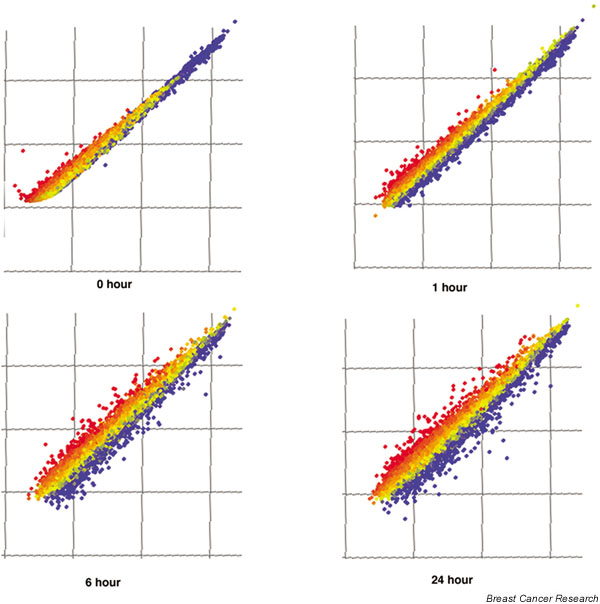
A National Institutes of Aging mouse 15,000 cDNA microarray was used to profile the gene expression of NMuMG cells treated with TGF-beta1 for 1, 6, or 24 hours. Data analyses were performed using GenePixPro and GeneSpring software. Selected microarray results were verified by northern analyses.
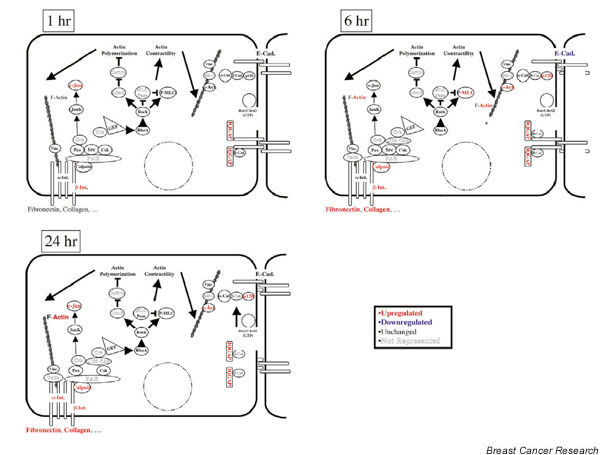
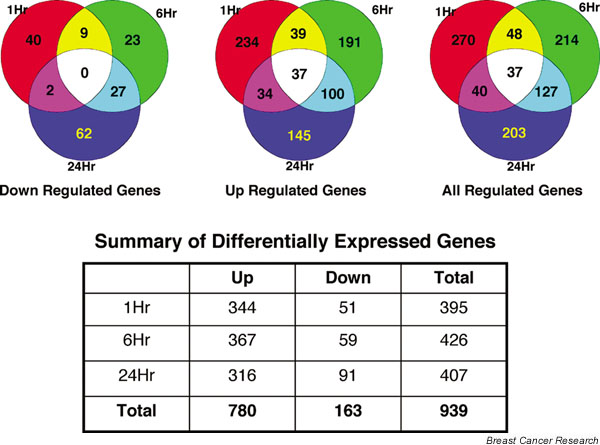
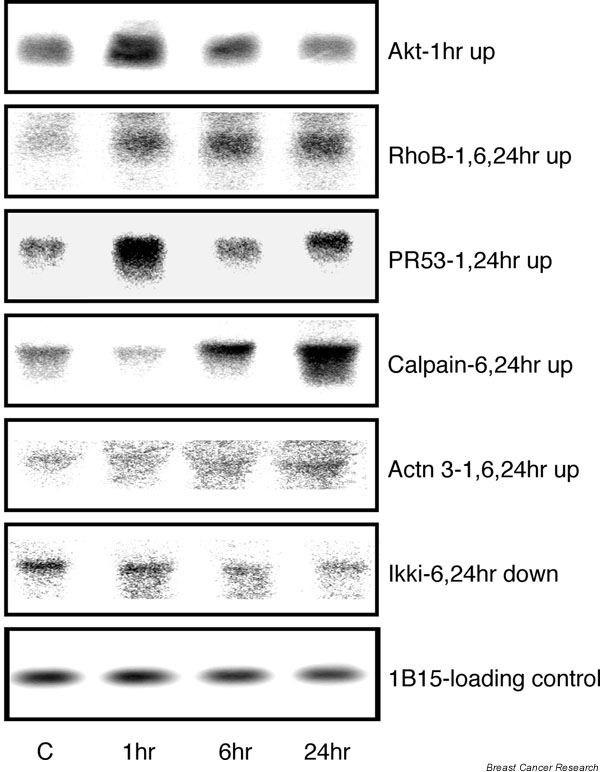
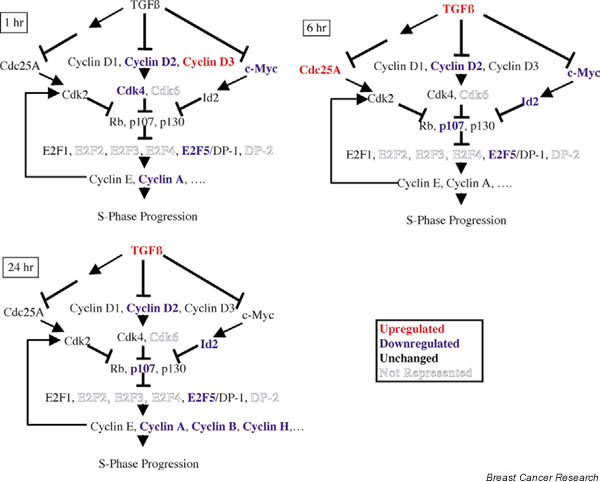
Of the 15,000 genes examined by microarray, 939 were upregulated or downregulated by TGF-beta. This represents approximately 10% of the genes examined, minus redundancy. Seven genes previously not known to be regulated by TGF-beta at the transcriptional level (Akt and RhoB) or not at all (IQGAP1, mCalpain, actinin alpha3, Ikki, PP2A-PR53), were identified and their regulation by TGF-beta verified by northern blotting. Cell cycle pathway examination demonstrated downregulation of cyclin D2, c-myc, Id2, p107, E2F5, cyclin A, cyclin B, and cyclin H. Examination of cell adhesion-related genes revealed upregulation of c-Jun, alpha-actinin, actin, myosin light chain, p120cas catenin (Catns), alpha-integrin, integrin beta5, fibronectin, IQGAP1, and mCalpain.
Using a cDNA microarray to examine TGF-beta-regulated gene expression in NMuMG cells, we have shown regulation of multiple genes that play important roles in cell cycle control and EMT. In addition, we have identified several novel TGF-beta-regulated genes that may mediate previously unknown TGF-beta functions.
转化生长因子β(TGF-β)在多种细胞过程中发挥着重要作用。正常上皮细胞中研究最充分的TGF-β反应是生长抑制。在某些细胞类型中,TGF-β可诱导上皮-间质转化(EMT)。NMuMG是一种未转化的小鼠乳腺上皮细胞系,对TGF-β表现出生长抑制反应和EMT反应,使NMuMG细胞成为研究这些TGF-β效应的良好模型系统。
使用美国国立衰老研究所的小鼠15000 cDNA微阵列对用TGF-β1处理1、6或24小时的NMuMG细胞的基因表达进行分析。使用GenePixPro和GeneSpring软件进行数据分析。选定的微阵列结果通过Northern分析进行验证。
在通过微阵列检测的15000个基因中,有939个基因被TGF-β上调或下调。这约占检测基因的10%,减去冗余部分。鉴定出7个以前未知在转录水平受TGF-β调控(Akt和RhoB)或根本不受调控(IQGAP1、mCalpain、肌动蛋白α3、Ikki、PP2A-PR53)的基因,并通过Northern印迹验证了它们受TGF-β的调控。细胞周期途径检查显示细胞周期蛋白D2、c-myc、Id2、p107、E2F5、细胞周期蛋白A、细胞周期蛋白B和细胞周期蛋白H下调。对细胞黏附相关基因的检查显示c-Jun、α-辅肌动蛋白、肌动蛋白、肌球蛋白轻链、p120连环蛋白(Catns)、α-整合素、整合素β5、纤连蛋白、IQGAP1和mCalpain上调。
通过cDNA微阵列检测NMuMG细胞中TGF-β调控的基因表达,我们发现了多个在细胞周期控制和EMT中起重要作用的基因的调控情况。此外,我们还鉴定出了几个新的TGF-β调控基因,它们可能介导以前未知的TGF-β功能。