Watabe K, Ishikawa T, Mukohara Y, Nakamura H
Odawara Research Center, Nippon Soda Co., Ltd., Kanagawa, Japan.
J Bacteriol. 1992 Dec;174(24):7989-95. doi: 10.1128/jb.174.24.7989-7995.1992.
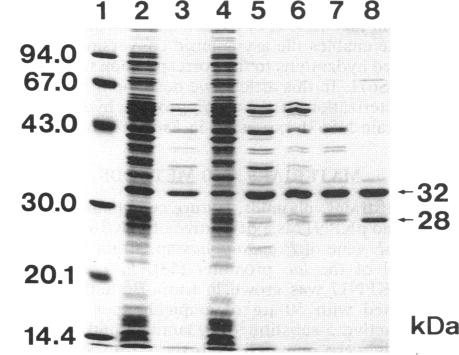
The hydantoin racemase gene of Pseudomonas sp. strain NS671 had been cloned and expressed in Escherichia coli. Hydantoin racemase was purified from the cell extract of the E. coli strain by phenyl-Sepharose, DEAE-Sephacel, and Sephadex G-200 chromatographies. The purified enzyme had an apparent molecular mass of 32 kDa as determined by sodium dodecyl sulfate-polyacrylamide gel electrophoresis. By gel filtration, a molecular mass of about 190 kDa was found, suggesting that the native enzyme is a hexamer. The optimal conditions for hydantoin racemase activity were pH 9.5 and a temperature of 45 degrees C. The enzyme activity was slightly stimulated by the addition of not only Mn2+ or Co2+ but also metal-chelating agents, indicating that the enzyme is not a metalloenzyme. On the other hand, Cu2+ and Zn2+ strongly inhibited the enzyme activity. Kinetic studies showed substrate inhibition, and the Vmax values for D- and L-5-(2-methylthioethyl)hydantoin were 35.2 and 79.0 mumol/min/mg of protein, respectively. The purified enzyme did not racemize 5-isopropylhydantoin, whereas the cells of E. coli expressing the enzyme are capable of racemizing it. After incubation of the purified enzyme with 5-isopropylhydantoin, the enzyme no longer showed 5-(2-methylthioethyl)hydantoin-racemizing activity. However, in the presence of 5-(2-methylthioethyl)hydantoin, the purified enzyme racemized 5-isopropylhydantoin completely, suggesting that 5-(2-methylthioethyl)hydantoin protects the enzyme from inactivation by 5-isopropylhydratoin. Thus, we examined the protective effect of various compounds and found that divalent-sulfur-containing compounds (R-S-R' and R-SH) have this protective effect.
假单胞菌属NS671菌株的乙内酰脲消旋酶基因已被克隆并在大肠杆菌中表达。通过苯基琼脂糖凝胶、二乙氨基乙基琼脂糖凝胶和葡聚糖G - 200柱层析从大肠杆菌菌株的细胞提取物中纯化乙内酰脲消旋酶。经十二烷基硫酸钠 - 聚丙烯酰胺凝胶电泳测定,纯化后的酶表观分子量为32 kDa。通过凝胶过滤法测得分子量约为190 kDa,表明天然酶是六聚体。乙内酰脲消旋酶活性的最佳条件是pH 9.5和温度45℃。不仅添加Mn2 +或Co2 +,而且添加金属螯合剂都会对酶活性有轻微的促进作用,这表明该酶不是金属酶。另一方面,Cu2 +和Zn2 +强烈抑制酶活性。动力学研究表明存在底物抑制作用,D - 和L - 5 -(2 - 甲硫基乙基)乙内酰脲的Vmax值分别为35.2和79.0 μmol/(min·mg蛋白质)。纯化后的酶不能使5 - 异丙基乙内酰脲消旋,而表达该酶的大肠杆菌细胞能够使其消旋。纯化后的酶与5 - 异丙基乙内酰脲孵育后,该酶不再表现出5 -(2 - 甲硫基乙基)乙内酰脲消旋活性。然而,在5 -(2 - 甲硫基乙基)乙内酰脲存在的情况下,纯化后的酶能使5 - 异丙基乙内酰脲完全消旋,这表明5 -(2 - 甲硫基乙基)乙内酰脲可保护该酶不被5 - 异丙基乙内酰脲灭活。因此,我们研究了各种化合物的保护作用,发现含二价硫的化合物(R - S - R'和R - SH)具有这种保护作用。