Department of Obstetrics and Gynaecology, Birmingham Clinical Trials Unit and Department of Public Health and Epidemiology, University of Birmingham B15 2TT, UK
BMC Womens Health. 2003 Dec 8;3(1):6. doi: 10.1186/1472-6874-3-6.
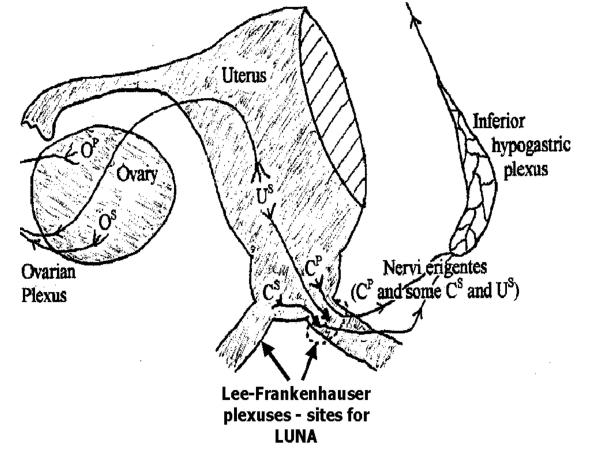
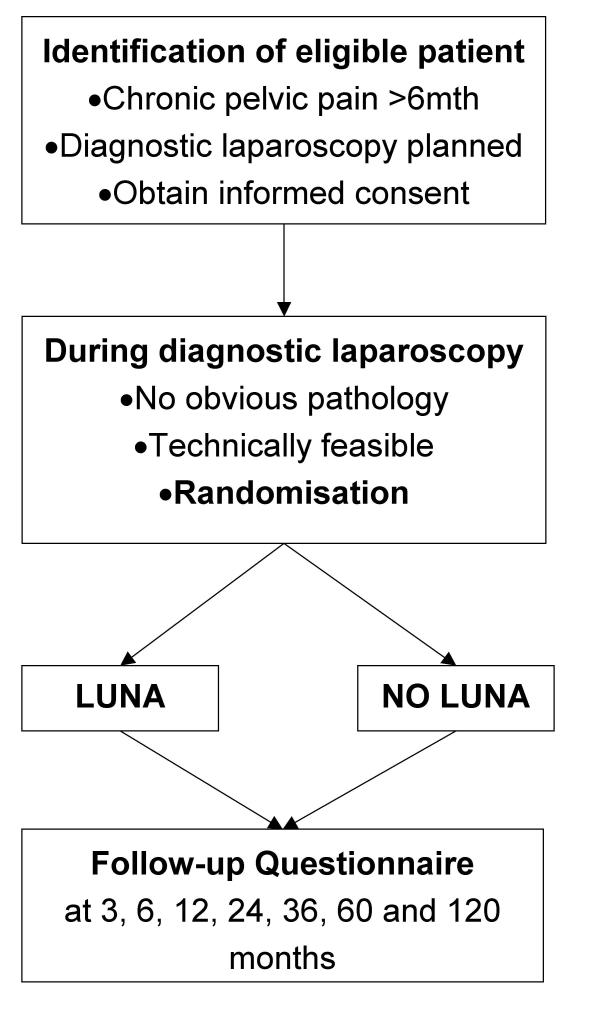
Chronic pelvic pain is a common condition with a major impact on health-related quality of life, work productivity and health care utilisation. The cause of the pain is not always obvious as no pathology is seen in 40-60% of the cases. In the absence of pathology there is no established treatment. The Lee-Frankenhauser sensory nerve plexuses and parasympathetic ganglia in the uterosacral ligaments carry pain from the uterus, cervix and other pelvic structures. Interruption of these nerve trunks by laparoscopic uterosacral nerve ablation (LUNA) may alleviate pain. However, the balance of benefits and risks of this intervention have not been reliably assessed. LUNA has, nevertheless, been introduced into practice, although there remains controversy regarding indications for LUNA. Hence, there is an urgent need for a randomised controlled trial to confirm, or refute, any worthwhile effectiveness. The principal hypothesis is that, in women with chronic pelvic pain in whom diagnostic laparoscopy reveals either no pathology or mild endometriosis (AFS score </= 5) LUNA alleviates pain and improves life quality at 12 months. METHODS/DESIGN: The principal objective is to test the hypothesis that in women with chronic pelvic pain in whom diagnostic laparoscopy reveals either no pathology or mild endometriosis (AFS score </= 5) LUNA alleviates pain and improves life quality at 12 months. A multi-centre, prospective, randomised-controlled-trial will be carried out with blind assessment of outcomes in eligible consenting patients randomised at diagnostic laparoscopy to LUNA (experimental group) or to no pelvic denervation (control group). Postal questionnaires including visual analogue scale for pain (primary outcome), an index of sexual satisfaction and the EuroQoL 5D-EQ instrument (secondary outcomes) will be administered at 3, 6 and 12 months. The primary assessment of the effectiveness of LUNA will be from comparison of outcomes at the one-year follow-up, although the medium-term and longer-term risks and benefits of LUNA will also be evaluated.The sample size for this trial has been estimated as 420 patients in total using the hypothesis that LUNA will alleviate pain symptoms (i.e. reduce pain scores on a VAS) more than no intervention at one-year following diagnostic laparoscopy and taking into consideration 20% loss to follow-up. The intention to treat analysis to address the principal research questions will be conducted using the one-year follow-up data.
慢性盆腔疼痛是一种常见病症,对健康相关生活质量、工作效率和医疗保健利用有着重大影响。疼痛原因并不总是显而易见,因为40%-60%的病例未发现病理改变。在没有病理改变的情况下,尚无既定的治疗方法。子宫骶韧带中的Lee-Frankenhauser感觉神经丛和副交感神经节传导来自子宫、宫颈和其他盆腔结构的疼痛。通过腹腔镜子宫骶神经切除术(LUNA)切断这些神经干可能会缓解疼痛。然而,这种干预措施的利弊尚未得到可靠评估。尽管如此,LUNA已被应用于临床实践,尽管关于LUNA的适应证仍存在争议。因此,迫切需要进行一项随机对照试验来证实或反驳其任何实际疗效。主要假设是,对于诊断性腹腔镜检查未发现病理改变或轻度子宫内膜异位症(美国生殖医学学会[AFS]评分≤5分)的慢性盆腔疼痛女性,LUNA在12个月时可缓解疼痛并改善生活质量。
方法/设计:主要目的是检验以下假设:对于诊断性腹腔镜检查未发现病理改变或轻度子宫内膜异位症(AFS评分≤5分)的慢性盆腔疼痛女性,LUNA在12个月时可缓解疼痛并改善生活质量。将开展一项多中心、前瞻性、随机对照试验,对符合条件且同意参与的患者进行结局的盲法评估,这些患者在诊断性腹腔镜检查时被随机分为LUNA组(试验组)或未进行盆腔去神经支配组(对照组)。将在3个月、6个月和12个月时发放邮政问卷,包括疼痛视觉模拟量表(主要结局)、性满意度指数和欧洲五维健康量表(次要结局)。LUNA有效性的主要评估将基于一年随访时结局的比较,尽管也将评估LUNA的中期和长期风险及益处。本试验的样本量估计为总共420例患者,假设LUNA在诊断性腹腔镜检查后一年比不进行干预更能缓解疼痛症状(即降低VAS疼痛评分),并考虑到20%的失访率。将使用一年随访数据进行意向性分析以解决主要研究问题。