El-Din Shawki Hossam
Obstetrics and Gynecology Department, Faculty of Medicine, El Minia University, El Minia, Egypt.
Gynecol Surg. 2011 Feb;8(1):31-39. doi: 10.1007/s10397-010-0612-1. Epub 2010 Aug 7.
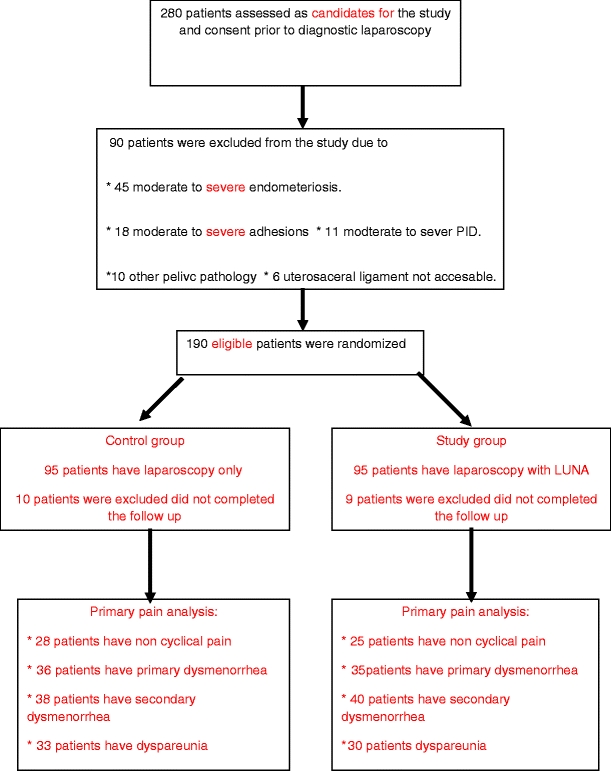
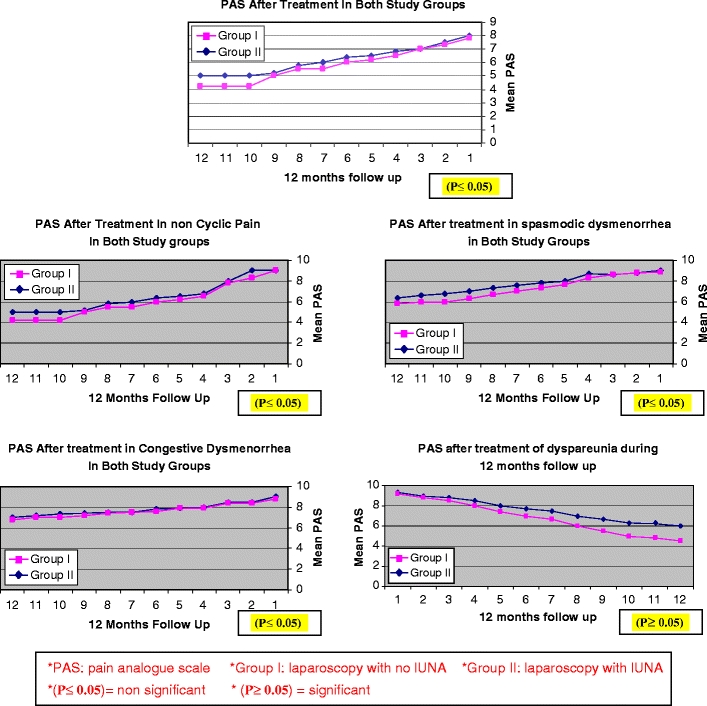
The aim of this work is to explore the efficacy , safety, and patients' satisfaction of laparoscopic uterosacral nerve ablation (LUNA) in relief of pain in women with chronic pelvic pain in whom diagnostic laparoscopy reveals either no pathology or mild endometriosis (AFS score ≤5). The study was a prospective, single-blind, randomized trial with 12 months follow-up. It was conducted at the endoscopy unit of the Gynecology Department of El Minia University Hospital, Egypt. One hundred ninety Egyptian women consented to participate in the study. These eligible patients were randomized using computer-generated tables and were divided into two equal groups, including the control group (diagnostic laparoscopy with no pelvic denervation) and the study group (diagnostic laparoscopy plus LUNA). Diagnostic laparoscopy with or without laparoscopic uterosacral nerve ablation was done. There were no statistically significant difference between both groups regarding the efficacy and the overall success rate (between group I and group II, it was 77.64%, 76.47%, and 74.11% versus 79.06%, 75.58%, and 73.25% at 3, 6, and 12 months, respectively) and the cumulative patients' satisfaction rate (it was 74.11%, 74.11%, and 71.76% versus 75.58%, 75.58%, and 72.09% at 3, 6, and 12 months between group I and group II, respectively; P ≤ 0.05). There was no statistically significant difference between both groups as regards the effectiveness of LUNA in the treatment of primary (spasmodic) and secondary (congestive) dysmenorrhea (P ≤ 0.05), while there was a statistically significant difference between both groups in the treatment of dyspareunia (P ≥ 0.05). LUNA can be a last alternative option in well-selected patients for control of chronic pelvic pain without endometriosis; however, its effectiveness may not extend to other indications. Also, preliminary experience in the treatment of primary deep dyspareunia presents a promising perspective on the management of deep dyspareunia, especially if it will involve a team of social, psychological, and gynecological specialists.
这项研究的目的是探讨腹腔镜子宫骶骨神经切断术(LUNA)在缓解慢性盆腔疼痛女性疼痛方面的疗效、安全性及患者满意度,这些女性经诊断性腹腔镜检查未发现病变或仅有轻度子宫内膜异位症(AFS评分≤5)。该研究是一项前瞻性、单盲、随机试验,随访期为12个月。研究在埃及明亚大学医院妇科内镜科进行。190名埃及女性同意参与该研究。这些符合条件的患者通过计算机生成的表格进行随机分组,分为两组,即对照组(仅进行诊断性腹腔镜检查,不进行盆腔去神经手术)和研究组(诊断性腹腔镜检查加LUNA)。进行了有或无腹腔镜子宫骶骨神经切断术的诊断性腹腔镜检查。两组在疗效和总体成功率方面(I组和II组在3、6和12个月时分别为77.64%、76.47%和74.11%,以及79.06%、75.58%和73.25%)以及累积患者满意度方面(I组和II组在3、6和12个月时分别为74.11%、74.11%和71.76%,以及75.58%、75.58%和72.09%;P≤0.05)均无统计学显著差异。两组在LUNA治疗原发性(痉挛性)和继发性(充血性)痛经的有效性方面无统计学显著差异(P≤0.05),而在治疗性交困难方面两组有统计学显著差异(P≥0.05)。对于精心挑选的无子宫内膜异位症的慢性盆腔疼痛患者,LUNA可以作为控制疼痛的最后一种选择;然而,其有效性可能不适用于其他适应症。此外,在治疗原发性深部性交困难方面的初步经验为深部性交困难的管理提供了一个有前景的视角,特别是如果有社会、心理和妇科专家团队参与。