Jézéquel P, Campion L, Joalland M-P, Millour M, Dravet F, Classe J-M, Delecroix V, Deporte R, Fumoleau P, Ricolleau G
Département de Biologie Oncologique, Centre Régional de Lutte Contre le Cancer, René Gauducheau, boulevard Jacques Monod, 44805 Saint Herblain, France.
Br J Cancer. 2004 Jan 12;90(1):189-93. doi: 10.1038/sj.bjc.6601450.
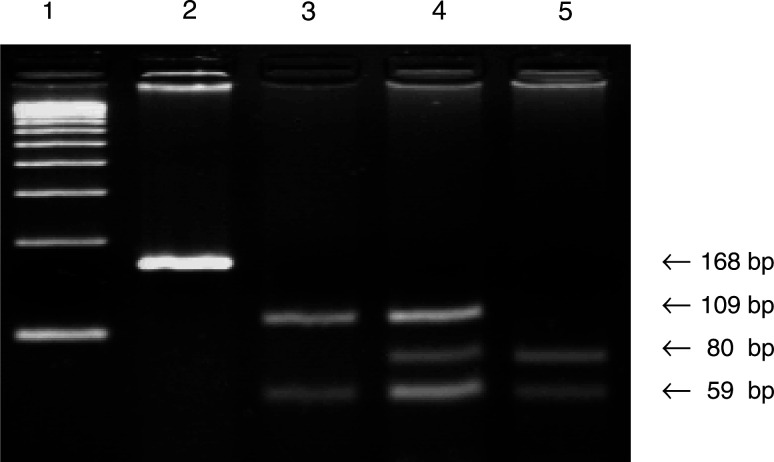
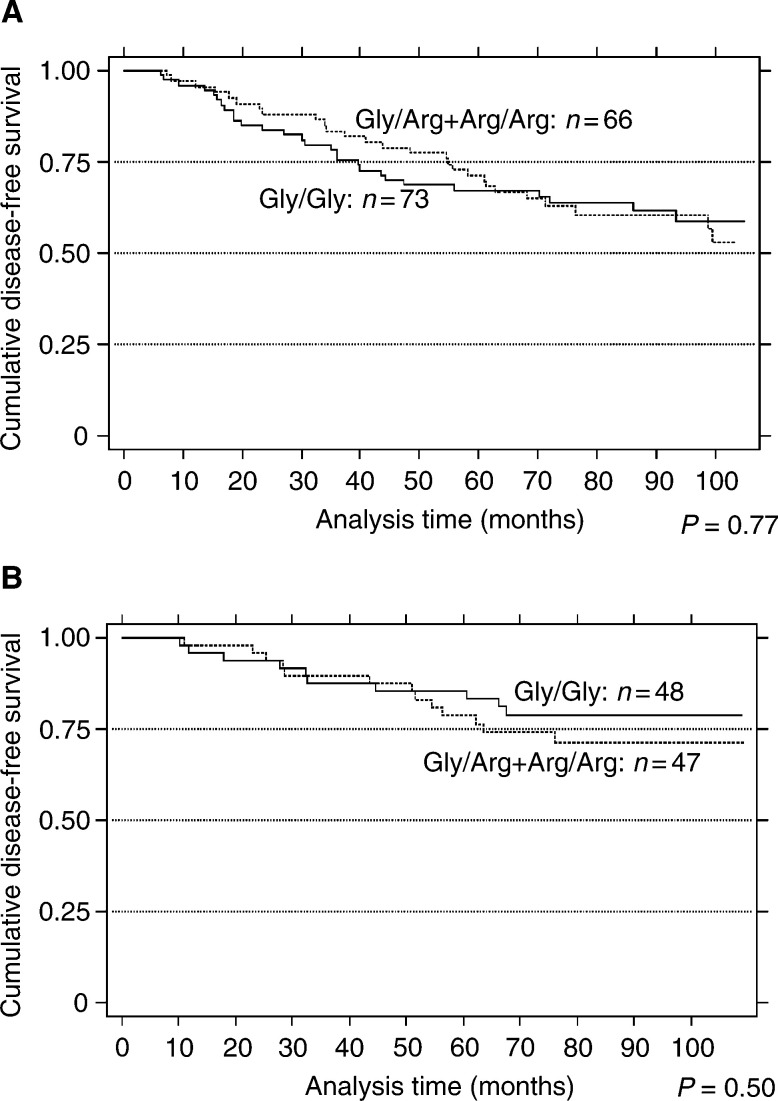
This study screened large cohorts of node-positive and node-negative breast cancer patients to determine whether the G388R mutation of the FGFR4 gene is a useful prognostic marker for breast cancer as reported by Bange et al in 2002. Node-positive (n=139) and node-negative (n=95) breast cancer cohorts selected for mutation screening were followed up for median periods of 89 and 87 months, respectively. PCR - RFLP analysis was modified to facilitate molecular screening. Curves for disease-free survival were plotted according to the Kaplan - Meier method, and a log-rank test was used for comparisons between groups. Three other nonparametric linear rank-tests particularly suitable for investigating possible relations between G388R mutation and early cancer progression were also used. Kaplan - Meier analysis based on any of the four nonparametric linear rank tests performed for node-positive and node-negative patients was not indicative of disease-free survival time. G388R mutation of the FGFR4 gene is not relevant for breast cancer prognosis.
本研究对大量淋巴结阳性和阴性乳腺癌患者队列进行了筛查,以确定FGFR4基因的G388R突变是否如2002年班格等人报道的那样,是乳腺癌有用的预后标志物。为进行突变筛查而选取的淋巴结阳性(n = 139)和淋巴结阴性(n = 95)乳腺癌队列,分别随访了89个月和87个月的中位数时间。对聚合酶链反应-限制性片段长度多态性分析进行了改进,以利于分子筛查。根据Kaplan-Meier方法绘制无病生存曲线,并使用对数秩检验进行组间比较。还使用了另外三种特别适合研究G388R突变与早期癌症进展之间可能关系的非参数线性秩检验。基于对淋巴结阳性和阴性患者进行的四种非参数线性秩检验中的任何一种进行的Kaplan-Meier分析,均未显示无病生存时间。FGFR4基因的G388R突变与乳腺癌预后无关。