Granell Susana, Bulbena Oriol, Genesca Meritxell, Sabater Luis, Sastre Juan, Gelpi Emilio, Closa Daniel
Dept, of Experimental Pathology, Institut d'Investigacions Biomèdiques de Barcelona-Consejo Superior de Investigaciones Científicas (IIBB-CSIC), Institut d'Investigacions Biomèdiques August Pi i Sunyer (IDIBAPS), Barcelona, Spain.
BMC Gastroenterol. 2004 Jan 19;4:1. doi: 10.1186/1471-230X-4-1.
Xanthine oxidoreductase has been proposed to play a role in the development of local and systemic effects of acute pancreatitis. Under physiologic conditions, the enzyme exists mainly as xanthine dehydrogenase (XDH) but can be converted by proteolytic cleavage to its superoxide-generating form xanthine oxidase (XOD). In addition to its intracellular location XDH/XOD is also associated to the polysaccharide chains of proteoglycans on the external endothelial cell membrane. In the early stages of acute pancreatitis, this enzyme seems to be arising from its mobilization from the gastrointestinal endothelial cell surface. Taking into account the ability of alpha-amylase to hydrolyze the internal alpha-1,4 linkages of polysaccharides, we wanted to elucidate the involvement of alpha-amylase in XDH/XOD mobilization from the gastrointestinal endothelial cell surface and the relevance of the ascitic fluid (AF) as the source of alpha-amylase in experimental acute pancreatitis.
Acute pancreatitis was induced in male Wistar rats by intraductal administration of 5% sodium taurocholate. In another experimental group 3000 U/Kg alpha-amylase was i.v. administered. The concentrations of XDH, XOD and alpha-amylase in plasma and AF and myeloperoxidase (MPO) in lung have been evaluated. In additional experiments, the effect of peritoneal lavage and the absorption of alpha-amylase present in the AF by an isolated intestine have been determined.
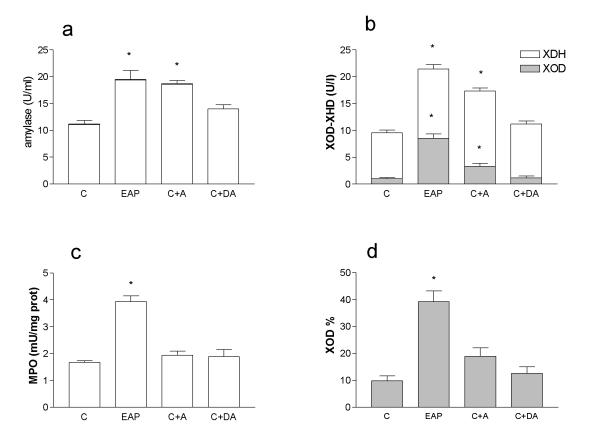
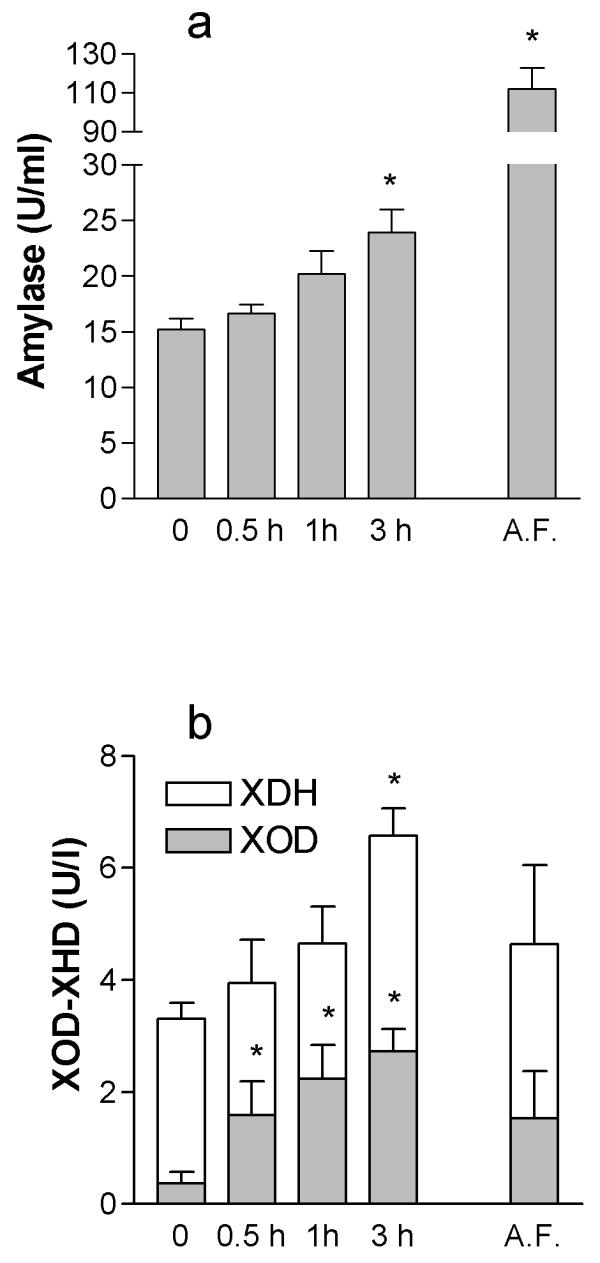
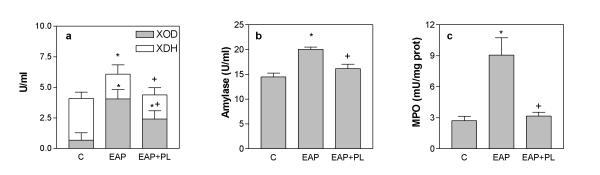
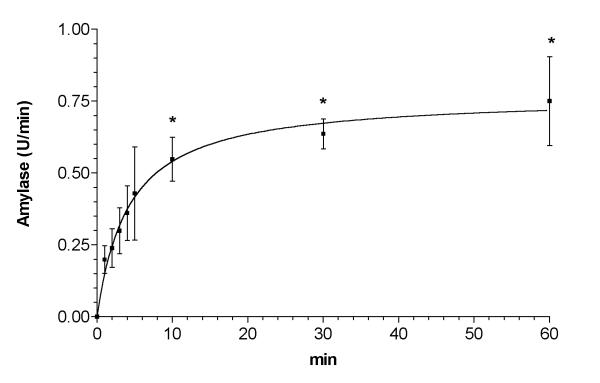
Similar increase in XDH+XOD activity in plasma was observed after induction of acute pancreatitis and after i.v. administration of alpha-amylase. Nevertheless, the conversion from XDH to XOD was only observed in the pancreatitis group. Lung inflammation measured as MPO activity was observed only in the pancreatitis group. In addition peritoneal lavage prevented the increase in alpha-amylase and XDH+XOD in plasma after induction of pancreatitis. Finally, it was observed that alpha-amylase is absorbed from the AF by the intestine.
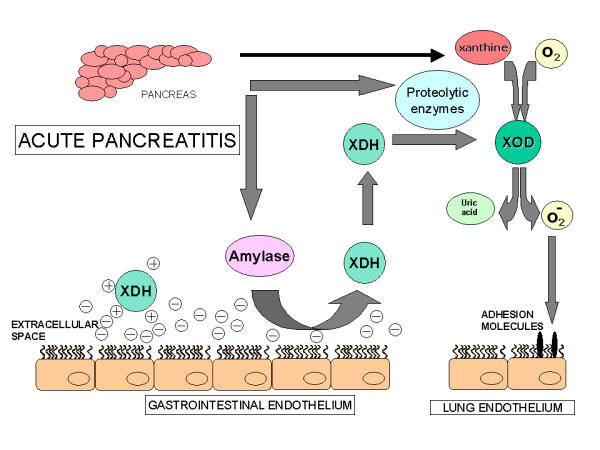
During the early stages of acute pancreatitis, alpha-amylase absorbed from AF through the gastrointestinal tract could interfere with the binding of XDH/XOD attached to glycoproteins of the endothelial cells. Proteolytic enzymes convert XDH into its oxidase form promoting an increase in circulating XOD that has been reported to be one of the mechanisms involved in the triggering of the systemic inflammatory process.
黄嘌呤氧化还原酶被认为在急性胰腺炎局部和全身效应的发展中起作用。在生理条件下,该酶主要以黄嘌呤脱氢酶(XDH)的形式存在,但可通过蛋白水解裂解转化为其产生超氧化物的形式黄嘌呤氧化酶(XOD)。除了其细胞内定位外,XDH/XOD还与内皮细胞膜外蛋白聚糖的多糖链相关。在急性胰腺炎的早期阶段,这种酶似乎是从胃肠道内皮细胞表面动员而来的。考虑到α-淀粉酶能够水解多糖的内部α-1,4键,我们想要阐明α-淀粉酶在XDH/XOD从胃肠道内皮细胞表面的动员中的作用,以及腹水(AF)作为实验性急性胰腺炎中α-淀粉酶来源的相关性。
通过胰管内注射5%牛磺胆酸钠诱导雄性Wistar大鼠发生急性胰腺炎。在另一个实验组中,静脉注射3000 U/Kgα-淀粉酶。评估了血浆和AF中XDH、XOD和α-淀粉酶的浓度以及肺中的髓过氧化物酶(MPO)。在额外的实验中,测定了腹腔灌洗的效果以及分离的肠道对AF中存在的α-淀粉酶的吸收情况。
在诱导急性胰腺炎后和静脉注射α-淀粉酶后,血浆中XDH+XOD活性出现了类似的增加。然而,仅在胰腺炎组中观察到了从XDH到XOD的转化。仅在胰腺炎组中观察到以MPO活性衡量的肺部炎症。此外,腹腔灌洗可防止诱导胰腺炎后血浆中α-淀粉酶和XDH+XOD的增加。最后,观察到肠道可从AF中吸收α-淀粉酶。
在急性胰腺炎的早期阶段,通过胃肠道从AF中吸收的α-淀粉酶可能会干扰附着在内皮细胞糖蛋白上的XDH/XOD的结合。蛋白水解酶将XDH转化为其氧化酶形式,促进循环XOD的增加,据报道这是引发全身炎症过程的机制之一。