Gabriela Diaz de Barboza, Solange Guizzardi, Luciana Moine, Nori Tolosa de Talamoni, Laboratorio "Dr. Fernando Cañas", Cátedra de Bioquímica y Biología Molecular, Facultad de Ciencias Médicas, INICSA (CONICET-Universidad Nacional de Córdoba), Pabellón Argentina, Ciudad Universitaria, Córdoba 5000, Argentina.
World J Gastroenterol. 2017 Apr 28;23(16):2841-2853. doi: 10.3748/wjg.v23.i16.2841.
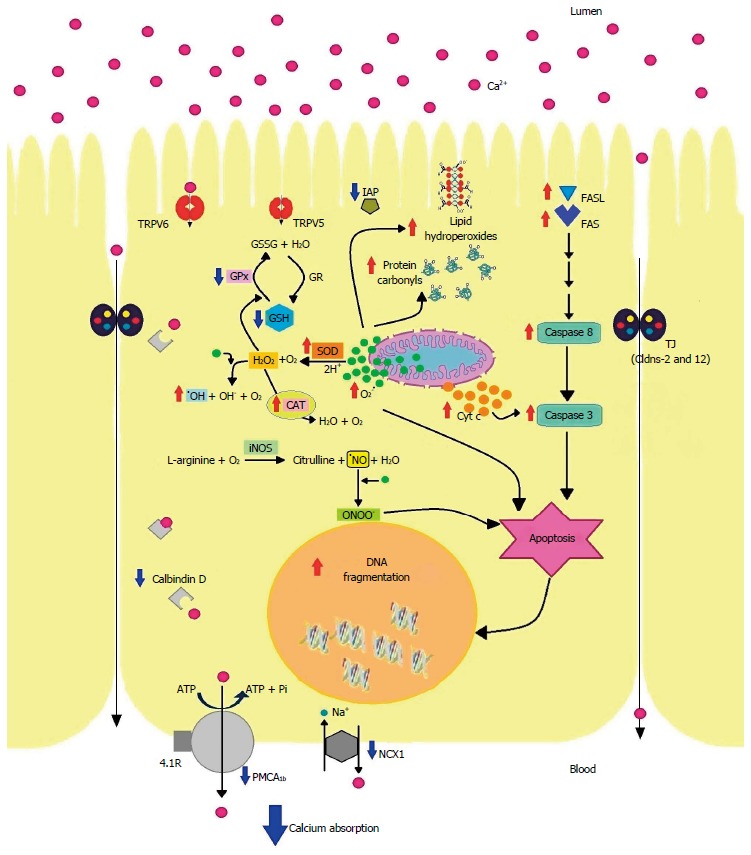
The disequilibrium between the production of reactive oxygen (ROS) and nitrogen (RNS) species and their elimination by protective mechanisms leads to oxidative stress. Mitochondria are the main source of ROS as by-products of electron transport chain. Most of the time the intestine responds adequately against the oxidative stress, but with aging or under conditions that exacerbate the ROS and/or RNS production, the defenses are not enough and contribute to developing intestinal pathologies. The endogenous antioxidant defense system in gut includes glutathione (GSH) and GSH-dependent enzymes as major components. When the ROS and/or RNS production is exacerbated, oxidative stress occurs and the intestinal Ca absorption is inhibited. GSH depleting drugs such as DL-buthionine-S,R-sulfoximine, menadione and sodium deoxycholate inhibit the Ca transport from lumen to blood by alteration in the protein expression and/or activity of molecules involved in the Ca transcellular and paracellular pathways through mechanisms of oxidative stress, apoptosis and/or autophagy. Quercetin, melatonin, lithocholic and ursodeoxycholic acids block the effect of those drugs in experimental animals by their antioxidant, anti-apoptotic and/or anti-autophagic properties. Therefore, they may become drugs of choice for treatment of deteriorated intestinal Ca absorption under oxidant conditions such as aging, diabetes, gut inflammation and other intestinal disorders.
活性氧(ROS)和活性氮(RNS)物质的产生与通过保护机制消除它们之间的失衡会导致氧化应激。线粒体是 ROS 的主要来源,是电子传递链的副产品。大多数时候,肠道会对氧化应激做出适当的反应,但随着年龄的增长或在加剧 ROS 和/或 RNS 产生的情况下,防御机制不足,导致肠道病理发生。肠道内源性抗氧化防御系统包括谷胱甘肽 (GSH) 和 GSH 依赖性酶作为主要成分。当 ROS 和/或 RNS 的产生加剧时,就会发生氧化应激,肠道钙吸收受到抑制。谷胱甘肽耗竭药物,如 DL-丁硫氨酸-S,R-亚砜亚胺、甲萘醌和脱氧胆酸钠,通过氧化应激、细胞凋亡和/或自噬机制,改变参与钙细胞内和细胞旁途径的分子的蛋白表达和/或活性,从而抑制钙从腔内向血液的转运。槲皮素、褪黑素、胆酸和熊去氧胆酸通过抗氧化、抗细胞凋亡和/或抗自噬特性,阻断这些药物在实验动物中的作用。因此,它们可能成为在氧化剂条件下(如衰老、糖尿病、肠道炎症和其他肠道疾病)治疗恶化的肠道钙吸收的首选药物。