Ribeiro Sidarta, Gervasoni Damien, Soares Ernesto S, Zhou Yi, Lin Shih-Chieh, Pantoja Janaina, Lavine Michael, Nicolelis Miguel A L
Department of Neurobiology, Duke University Medical Center, Durham, North Carolina, USA.
PLoS Biol. 2004 Jan;2(1):E24. doi: 10.1371/journal.pbio.0020024. Epub 2004 Jan 20.
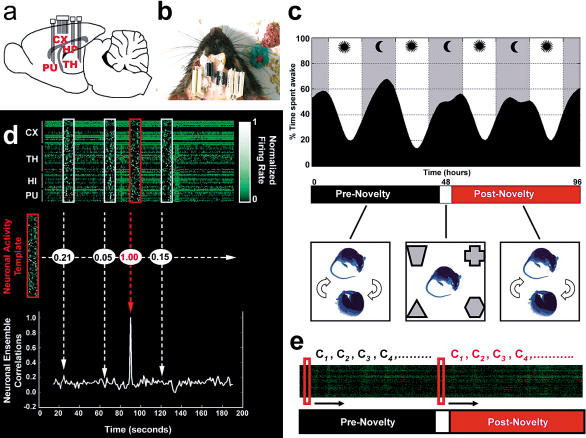
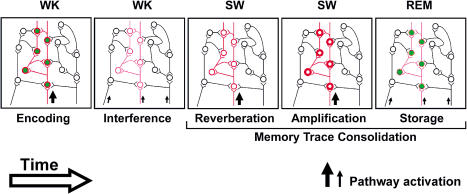
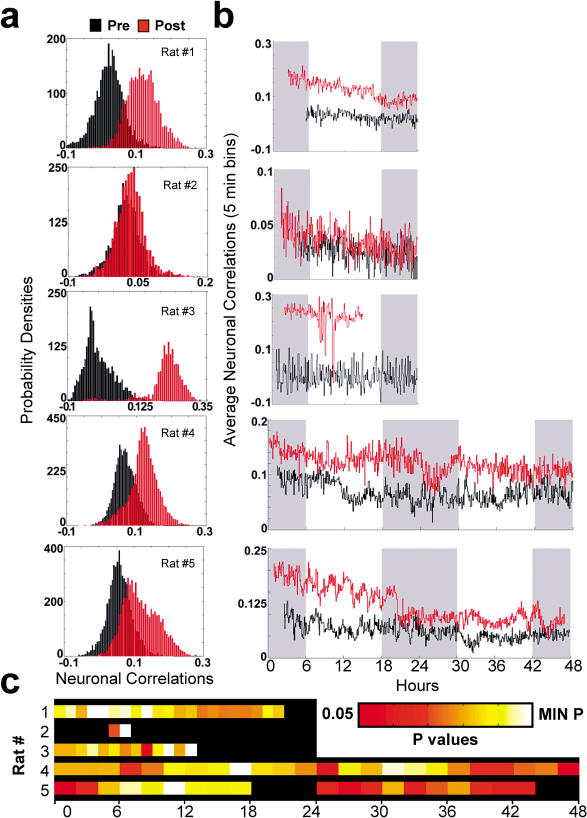
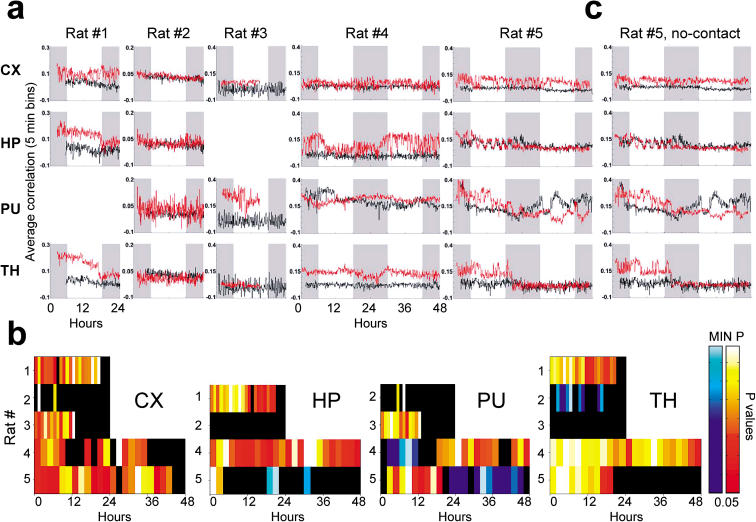
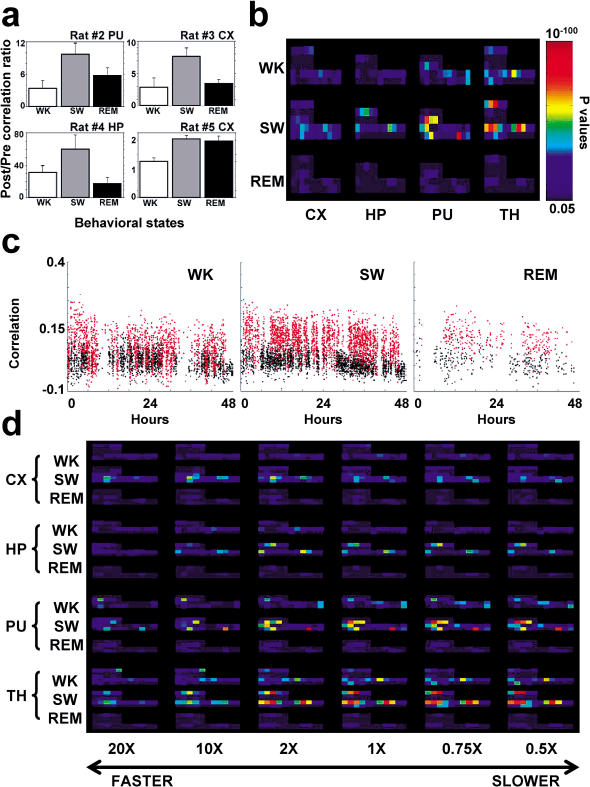
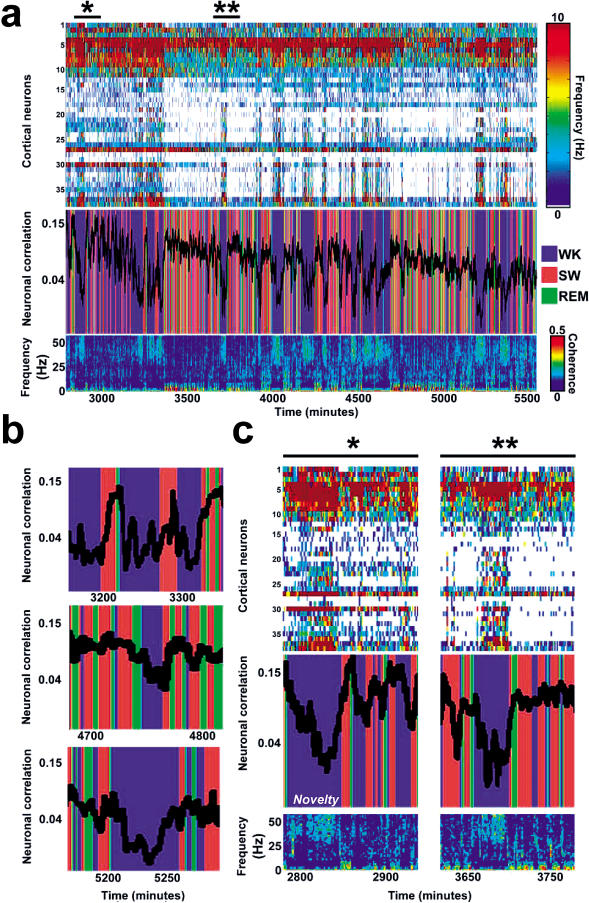
The discovery of experience-dependent brain reactivation during both slow-wave (SW) and rapid eye-movement (REM) sleep led to the notion that the consolidation of recently acquired memory traces requires neural replay during sleep. To date, however, several observations continue to undermine this hypothesis. To address some of these objections, we investigated the effects of a transient novel experience on the long-term evolution of ongoing neuronal activity in the rat forebrain. We observed that spatiotemporal patterns of neuronal ensemble activity originally produced by the tactile exploration of novel objects recurred for up to 48 h in the cerebral cortex, hippocampus, putamen, and thalamus. This novelty-induced recurrence was characterized by low but significant correlations values. Nearly identical results were found for neuronal activity sampled when animals were moving between objects without touching them. In contrast, negligible recurrence was observed for neuronal patterns obtained when animals explored a familiar environment. While the reverberation of past patterns of neuronal activity was strongest during SW sleep, waking was correlated with a decrease of neuronal reverberation. REM sleep showed more variable results across animals. In contrast with data from hippocampal place cells, we found no evidence of time compression or expansion of neuronal reverberation in any of the sampled forebrain areas. Our results indicate that persistent experience-dependent neuronal reverberation is a general property of multiple forebrain structures. It does not consist of an exact replay of previous activity, but instead it defines a mild and consistent bias towards salient neural ensemble firing patterns. These results are compatible with a slow and progressive process of memory consolidation, reflecting novelty-related neuronal ensemble relationships that seem to be context- rather than stimulus-specific. Based on our current and previous results, we propose that the two major phases of sleep play distinct and complementary roles in memory consolidation: pretranscriptional recall during SW sleep and transcriptional storage during REM sleep.
在慢波睡眠(SW)和快速眼动睡眠(REM)期间发现与经验相关的大脑重新激活,这引发了一种观点,即最近获得的记忆痕迹的巩固需要在睡眠期间进行神经重演。然而,迄今为止,一些观察结果仍在削弱这一假设。为了解决其中一些异议,我们研究了短暂的新异经历对大鼠前脑持续神经元活动长期演变的影响。我们观察到,最初由对新异物体的触觉探索产生的神经元群体活动的时空模式,在大脑皮层、海马体、壳核和丘脑重复出现长达48小时。这种由新异性诱导的重复以低但显著的相关值为特征。当动物在物体之间移动而不接触它们时采样的神经元活动也得到了几乎相同的结果。相比之下,当动物探索熟悉的环境时获得的神经元模式几乎没有重复。虽然过去神经元活动模式的回响在慢波睡眠期间最强,但清醒与神经元回响的减少相关。快速眼动睡眠在不同动物中显示出更具变化的结果。与海马体位置细胞的数据不同,我们在任何采样的前脑区域都没有发现神经元回响的时间压缩或扩展的证据。我们的结果表明,持续的与经验相关的神经元回响是多个前脑结构的普遍特性。它不是由先前活动的精确重演组成,而是定义了对显著神经元群体放电模式的轻微且一致的偏向。这些结果与记忆巩固的缓慢渐进过程相一致,反映了似乎是情境而非刺激特异性的与新异性相关的神经元群体关系。基于我们目前和以前的结果,我们提出睡眠的两个主要阶段在记忆巩固中发挥着不同且互补的作用:慢波睡眠期间的转录前回忆和快速眼动睡眠期间的转录存储。