Chrysohoou Christina, Panagiotakos Demosthenes B, Pitsavos Christos, Kosma Konstantina, Barbetseas John, Karagiorga Markisia, Ladis Ioannis, Stefanadis Christodoulos
First Cardiology Clinic, School of Medicine, University of Athens, Greece.
Lipids Health Dis. 2004 Mar 15;3:3. doi: 10.1186/1476-511X-3-3.
Beta-thalassaemia major (b-TM) has been defined as a combination of chronic hemolytic anemia, iron storage disease and myocarditis, and it has been associated with premature death especially due to heart failure. To the best of our knowledge the status of blood lipids in these patients has rarely been investigated. Thus, we assessed the levels of lipids and lipoproteins in a sample of cardiovascular disease free adult men and women with b-TM.
During 2003 we enrolled 192 consecutive patients with b-TM that visited our Institution for routine examinations. The Institution is considered the major reference center for b-TM in Greece. Of the 192 patients, 88 were men (25 +/- 6 years old) and 104 women (26 +/- 6 years old). Fasting blood lipid levels were measured in all participants.
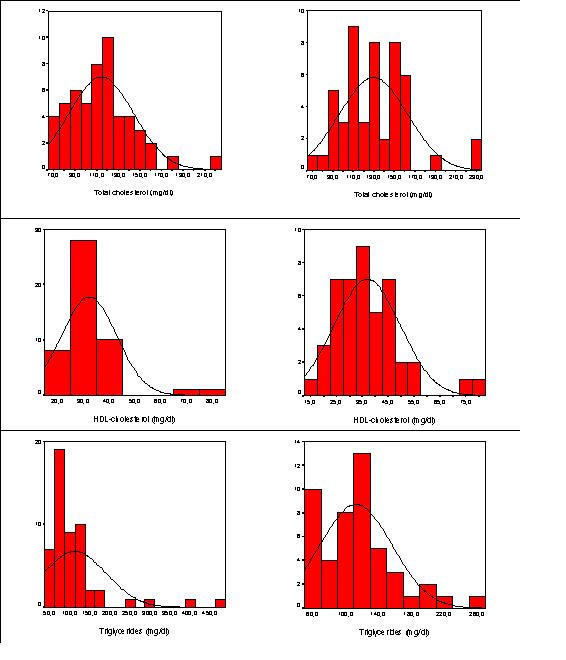
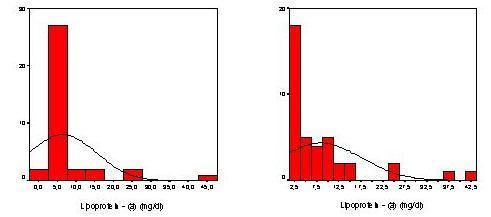
Data analysis revealed that 4% of men and 2% of women had total serum cholesterol levels > 200 mg/dl, and 11% of men and 17% of women had triglyceride levels > 150 mg/dl. In addition, mean HDL cholesterol levels were 32 +/- 11 mg/dl in men and 38 +/- 10 mg/dl in women, lipoprotein-a levels were 8.3 +/- 9 mg/dl in men and 8.8 +/- 9 mg/dl in women, apolipoprotein-A1 levels were 111 +/- 17 mg/dl in men and 123 +/- 29 mg/dl in women, and apolipoprotein-B levels were 60 +/- 20 mg/dl in men and 59 +/- 14 mg/dl in women. Total-to-HDL cholesterol ratios were 3.7 +/- 1.2 and 3.8 +/- 1.5 in men and women, respectively.
The majority of the patients had blood lipid levels (by the exception of HDL-cholesterol) within the normal range, and consequently the prevalence of lipid and lipoprotein abnormalities was much lower as compared to the general population of the same age. Interestingly, is that the total-to HDL cholesterol ratio was high in our patients, and may underline the importance of this index for the prognosis of future cardiac events in these patients.
重型β地中海贫血(b-TM)被定义为慢性溶血性贫血、铁储存疾病和心肌炎的组合,并且与过早死亡相关,尤其是由于心力衰竭。据我们所知,这些患者的血脂状况很少被研究。因此,我们评估了一组无心血管疾病的成年男性和女性b-TM患者的脂质和脂蛋白水平。
2003年期间,我们连续纳入了192例因常规检查前来我院就诊的b-TM患者。我院是希腊b-TM的主要参考中心。在这192例患者中,88例为男性(25±6岁),104例为女性(26±6岁)。对所有参与者测量空腹血脂水平。
数据分析显示,4%的男性和2%的女性血清总胆固醇水平>200mg/dl,11%的男性和17%的女性甘油三酯水平>150mg/dl。此外,男性的平均高密度脂蛋白胆固醇水平为32±11mg/dl,女性为38±10mg/dl;脂蛋白-a水平男性为8.3±9mg/dl,女性为8.8±9mg/dl;载脂蛋白-A1水平男性为111±17mg/dl,女性为123±29mg/dl;载脂蛋白-B水平男性为60±20mg/dl,女性为59±14mg/dl。男性和女性的总胆固醇与高密度脂蛋白胆固醇比值分别为3.7±1.2和3.8±1.5。
大多数患者的血脂水平(高密度脂蛋白胆固醇除外)在正常范围内,因此与同年龄的普通人群相比,脂质和脂蛋白异常的患病率要低得多。有趣的是,我们的患者总胆固醇与高密度脂蛋白胆固醇比值较高,这可能强调了该指标对这些患者未来心脏事件预后的重要性。