Loeb Mark, McGeer Allison, Henry Bonnie, Ofner Marianna, Rose David, Hlywka Tammy, Levie Joanne, McQueen Jane, Smith Stephanie, Moss Lorraine, Smith Andrew, Green Karen, Walter Stephen D
Department of Pathology and Molecualr Medicine, McMaster University, Hamilton, Ontario, Canada.
Emerg Infect Dis. 2004 Feb;10(2):251-5. doi: 10.3201/eid1002.030838.
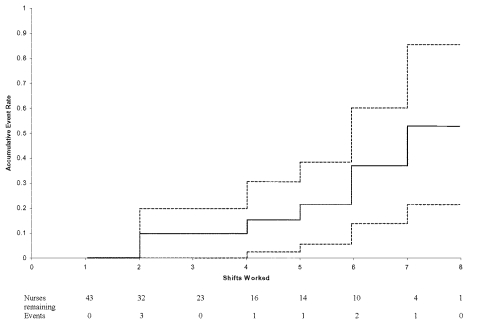
To determine factors that predispose or protect healthcare workers from severe acute respiratory syndrome (SARS), we conducted a retrospective cohort study among 43 nurses who worked in two Toronto critical care units with SARS patients. Eight of 32 nurses who entered a SARS patient's room were infected. The probability of SARS infection was 6% per shift worked. Assisting during intubation, suctioning before intubation, and manipulating the oxygen mask were high-risk activities. Consistently wearing a mask (either surgical or particulate respirator type N95) while caring for a SARS patient was protective for the nurses, and consistent use of the N95 mask was more protective than not wearing a mask. Risk was reduced by consistent use of a surgical mask, but not significantly. Risk was lower with consistent use of a N95 mask than with consistent use of a surgical mask. We conclude that activities related to intubation increase SARS risk and use of a mask (particularly a N95 mask) is protective.
为了确定使医护人员易患或预防严重急性呼吸综合征(SARS)的因素,我们对在多伦多两家收治SARS患者的重症监护病房工作的43名护士进行了一项回顾性队列研究。进入SARS患者病房的32名护士中有8人被感染。每班工作时感染SARS的概率为6%。在插管过程中协助、插管前吸痰以及操作氧气面罩均为高风险活动。在护理SARS患者时持续佩戴口罩(外科口罩或N95型颗粒呼吸器)对护士有保护作用,且持续使用N95口罩比不戴口罩的保护作用更强。持续使用外科口罩可降低风险,但不显著。持续使用N95口罩比持续使用外科口罩的风险更低。我们得出结论,与插管相关的活动会增加SARS感染风险,而佩戴口罩(尤其是N95口罩)具有保护作用。