Vallano Antonio, Arnau Josep Maria, Miralda Gaietà Permanyer, Pérez-Bartolí Jaume
Fundació Institut Català de Farmacología, Clinical Pharmacology Service, Hospital Universitari Vall d'Hebron, Universitat Autònoma de Barcelona, Spain.
Thromb J. 2004 Apr 1;2(1):3. doi: 10.1186/1477-9560-2-3.
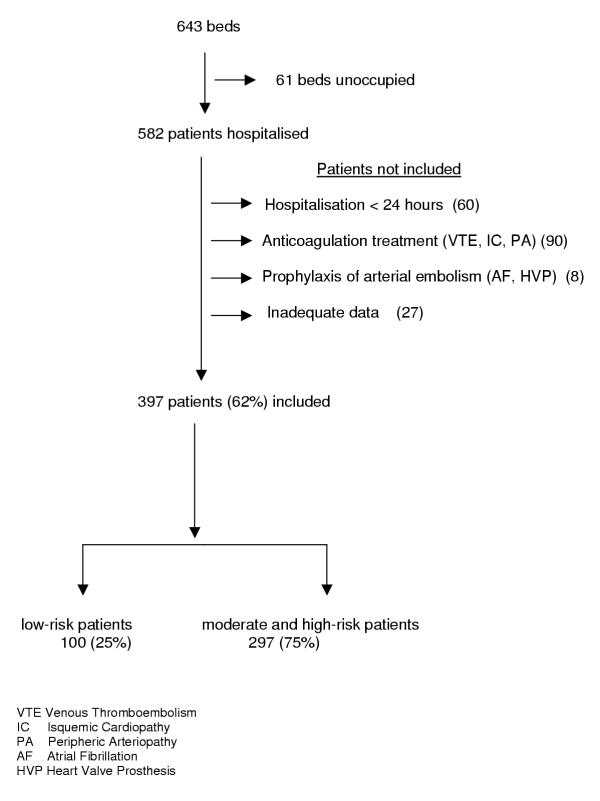
Consensus Conferences and Guidelines for deep vein thrombosis prophylaxis have been published, which recommend the use of prophylactic heparins in patients with risk of venous thromboembolism (VTE). The aim of this study was the assessment of the prophylaxis of VTE and the adherence to accepted guideline recommendations throughout the hospital. METHODS: A cross-sectional study was carried out in a teaching hospital after guidelines were implemented. Patients' risk factors of deep vein thrombosis, risk categories of patients, and prophylaxis used in different wards were recorded. Appropriate adherence to the guidelines was analysed. RESULTS: Of 397 patients, prophylaxis was used in 231 patients (58%), and low-molecular-weight heparins (LMWH) were used in 224 of them (97%). Patients with prophylaxis had a higher mean number of risk factors (SD) than those without prophylaxis [3.1 (1.4) vs 1.9 (1.4); p < 0.05)]. Prophylaxis was used in 72% and 90% of moderate and high-risk patients respectively. Appropriate adherence to all guideline recommendations was observed in 42% of patients. Adherence to guidelines was high as regards the use of prophylaxis according to patients' risk factors (78%) and the use of appropriate types of prophylaxis (99%), but was low regarding appropriate heparin dosage (47%) and preoperative dosage (37%). Appropriate prophylaxis use was higher in critical care and surgical wards than in medical wards. CONCLUSION: Prophylaxis of VTE is generally used in risk patients, but appropriate adherence to guidelines is less frequent and variable among different wards. Continuing medical education, discussion and dissemination of guidelines, and regular clinical audit are necessary to improve prophylaxis of VTE in clinical practice.
已发布深静脉血栓形成预防的共识会议和指南,推荐对有静脉血栓栓塞(VTE)风险的患者使用预防性肝素。本研究的目的是评估整个医院VTE的预防情况以及对公认指南建议的遵循情况。
在指南实施后,于一家教学医院开展了一项横断面研究。记录患者深静脉血栓形成的危险因素、患者风险类别以及不同病房使用的预防措施。分析对指南的适当遵循情况。
在397例患者中,231例(58%)使用了预防措施,其中224例(97%)使用了低分子肝素(LMWH)。接受预防的患者平均危险因素数量(标准差)高于未接受预防的患者[3.1(1.4)对1.9(1.4);p<0.05]。中度和高危患者中分别有72%和90%使用了预防措施。42%的患者对所有指南建议有适当遵循。在根据患者危险因素使用预防措施(78%)和使用适当类型的预防措施(99%)方面,对指南的遵循情况良好,但在适当的肝素剂量(47%)和术前剂量(37%)方面遵循情况较差。重症监护病房和外科病房的适当预防措施使用率高于内科病房。
VTE预防措施通常用于有风险的患者,但对指南的适当遵循在不同病房中不太常见且存在差异。持续医学教育、指南的讨论与传播以及定期临床审核对于改善临床实践中VTE的预防是必要的。