Akhondzadeh Shahin, Mohammadi Mohammad-Reza, Khademi Mojgan
Pychiatric Research Centre, Roozbeh Hospital, Tehran University of Medical Sciences, South Kargar Street, Tehran 13185, Iran.
BMC Psychiatry. 2004 Apr 8;4:9. doi: 10.1186/1471-244X-4-9.
Attention-deficit hyperactivity disorder is an early-onset, clinically heterogenous disorder of inattention, hyperactivity, and impulsiveness. The diagnosis and treatment of attention-deficit hyperactivity disorder continues to raise controversy, and, there is also an increase in treatment options. In this 6-week double blind, placebo controlled-trial, we assessed the effects of zinc plus methylphenidate in the treatment of children with attention deficit hyperactivity disorder. To the best of our knowledge, this study is the first double blind and placebo controlled clinical trial assessing the adjunctive role of zinc in ADHD.
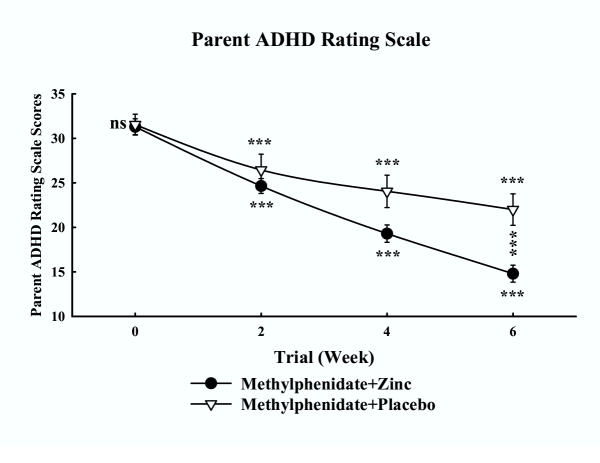
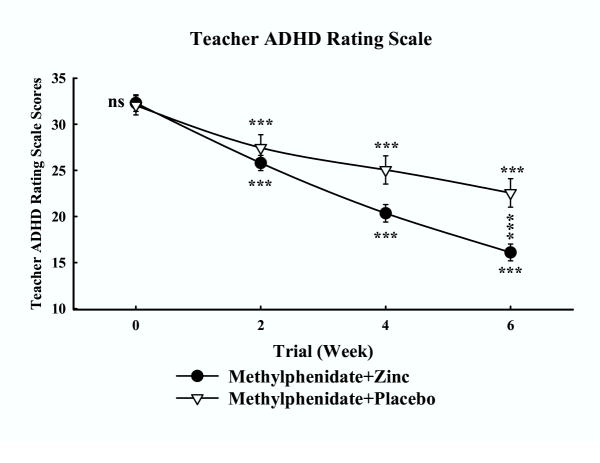
Our subjects were 44 outpatient children (26 boys and 18 girls) between the ages of 5-11 (mean +/- SD was 7.88 +/- 1.67) who clearly met the DSM IV diagnostic criteria for attention-deficit hyperactivity disorder and they were randomized to methylphenidate 1 mg/kg/day + zinc sulfate 55 mg/day (with approximately 15 mg zinc element) (group 1) and methylphenidate 1 mg/kg/day + placebo (sucrose 55 mg) (group 2) for a 6 week double blind clinical trial. The principal measure of the outcome was the Teacher and Parent ADHD Rating Scale. Patients were assessed by a child psychiatrist at baseline, 14, 28 and 42 days after the medication started.
The present study shows the Parent and Teacher Rating Scale scores improved with zinc sulfate over this 6-week, double blind and placebo controlled trial. The behavior of the two treatments was not homogeneous across the time. The difference between the two protocols was significant as indicated by the effect on the group, the between-subjects factor (F = 4.15, d.f. = 1, P = 0.04; F = 4.50, d.f. = 1, P = 0.04 respectively). The difference between the two groups in the frequency of side effects was not significant.
This double-blind, placebo-controlled study demonstrated that zinc as a supplementary medication might be beneficial in the treatment of children with attention-deficit hyperactivity disorder. However, further investigations and different doses of zinc are required to replicate these findings in children with ADHD.
注意力缺陷多动障碍是一种起病早、临床上表现为注意力不集中、多动和冲动的异质性疾病。注意力缺陷多动障碍的诊断和治疗一直存在争议,而且治疗选择也在增加。在这项为期6周的双盲、安慰剂对照试验中,我们评估了锌加哌甲酯治疗注意力缺陷多动障碍儿童的效果。据我们所知,本研究是第一项评估锌在注意力缺陷多动障碍中辅助作用的双盲、安慰剂对照临床试验。
我们的研究对象是44名门诊儿童(26名男孩和18名女孩),年龄在5至11岁之间(平均±标准差为7.88±1.67),他们明确符合《精神疾病诊断与统计手册》第四版注意力缺陷多动障碍的诊断标准,并被随机分为两组,一组接受哌甲酯1毫克/千克/天加硫酸锌55毫克/天(含约15毫克锌元素)(第1组),另一组接受哌甲酯1毫克/千克/天加安慰剂(蔗糖55毫克)(第2组),进行为期6周的双盲临床试验。主要结局指标是教师和家长注意力缺陷多动障碍评定量表。在用药开始后的基线、第14天、第28天和第42天,由儿童精神科医生对患者进行评估。
本研究表明,在这项为期6周的双盲、安慰剂对照试验中,硫酸锌可改善家长和教师评定量表得分。两种治疗方法在不同时间的行为并不一致。两组方案之间的差异具有显著性,这在组间效应、受试者间因素方面得到体现(F分别为4.15,自由度 = 1,P = 0.04;F为4.50,自由度 = 1,P = 0.04)。两组在副作用发生频率上的差异不显著。
这项双盲、安慰剂对照研究表明,锌作为一种辅助药物可能对治疗注意力缺陷多动障碍儿童有益。然而,需要进一步的研究和不同剂量的锌来在患有注意力缺陷多动障碍的儿童中重现这些发现。