Lagoa Claudio Esteves, de Figueiredo Luiz Francisco Poli, Cruz Ruy Jorge, Silva Eliézer, Rocha e Silva Maurício
Division of Applied Physiology, Heart Institute (InCor), University of São Paulo Medical School, São Paulo, Brazil.
Crit Care. 2004 Aug;8(4):R221-8. doi: 10.1186/cc2871. Epub 2004 May 27.
We conducted the present study to investigate whether early large-volume crystalloid infusion can restore gut mucosal blood flow and mesenteric oxygen metabolism in severe sepsis.
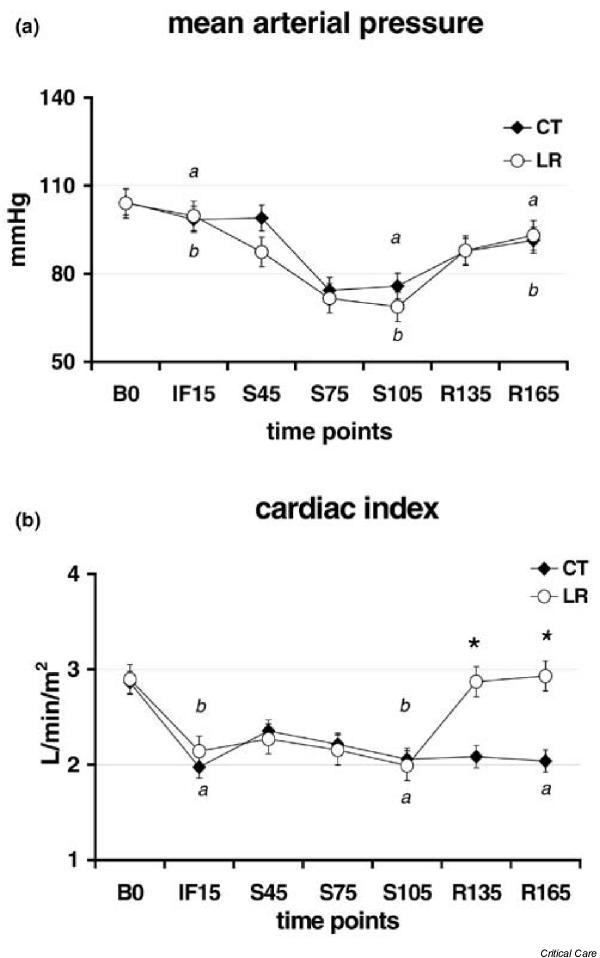
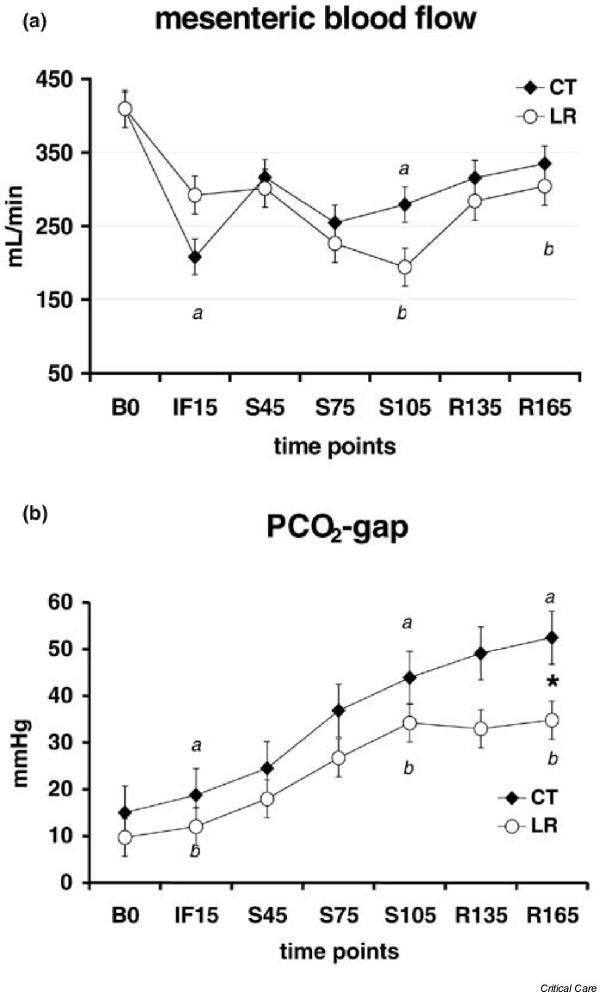
Anesthetized and mechanically ventilated male mongrel dogs were challenged with intravenous injection of live Escherichia coli (6 x 10(9) colony-forming units/ml per kg over 15 min). After 90 min they were randomly assigned to one of two groups - control (no fluids; n = 13) or lactated Ringer's solution (32 ml/kg per hour; n = 14) - and followed for 60 min. Cardiac index, mesenteric blood flow, mean arterial pressure, systemic and mesenteric oxygen-derived variables, blood lactate and gastric carbon dioxide tension (PCO2; by gas tonometry) were assessed throughout the study.
E. coli infusion significantly decreased arterial pressure, cardiac index, mesenteric blood flow, and systemic and mesenteric oxygen delivery, and increased arterial and portal lactate, intramucosal PCO2, PCO2 gap (the difference between gastric mucosal and arterial PCO2), and systemic and mesenteric oxygen extraction ratio in both groups. The Ringer's solution group had significantly higher cardiac index and systemic oxygen delivery, and lower oxygen extraction ratio and PCO2 gap at 165 min as compared with control animals. However, infusion of lactated Ringer's solution was unable to restore the PCO2 gap. There were no significant differences between groups in mesenteric oxygen delivery, oxygen extraction ratio, or portal lactate at the end of study.
Significant disturbances occur in the systemic and mesenteric beds during bacteremic severe sepsis. Although large-volume infusion of lactated Ringer's solution restored systemic hemodynamic parameters, it was unable to correct gut mucosal PCO2 gap.
我们开展本研究以探究早期大容量晶体液输注能否恢复严重脓毒症时的肠道黏膜血流及肠系膜氧代谢。
将麻醉并机械通气的雄性杂种犬静脉注射活的大肠杆菌(每千克体重6×10⁹菌落形成单位/毫升,持续15分钟)进行刺激。90分钟后,将它们随机分为两组之一——对照组(不输液;n = 13)或乳酸林格液组(每小时32毫升/千克;n = 14)——并观察60分钟。在整个研究过程中评估心脏指数、肠系膜血流、平均动脉压、全身及肠系膜氧衍生变量、血乳酸和胃二氧化碳张力(通过气体张力测定法)。
两组中,输注大肠杆菌均显著降低动脉压、心脏指数、肠系膜血流以及全身和肠系膜氧输送,并增加动脉和门静脉乳酸、黏膜内二氧化碳分压、二氧化碳分压差(胃黏膜与动脉二氧化碳分压之差)以及全身和肠系膜氧摄取率。与对照动物相比,乳酸林格液组在165分钟时心脏指数和全身氧输送显著更高,氧摄取率和二氧化碳分压差更低。然而,输注乳酸林格液未能恢复二氧化碳分压差。研究结束时,两组在肠系膜氧输送、氧摄取率或门静脉乳酸方面无显著差异。
菌血症性严重脓毒症期间全身和肠系膜床出现显著紊乱。尽管大容量输注乳酸林格液恢复了全身血流动力学参数,但未能纠正肠道黏膜二氧化碳分压差。