del Real Gustavo, Jiménez-Baranda Sonia, Mira Emilia, Lacalle Rosa Ana, Lucas Pilar, Gómez-Moutón Concepción, Alegret Marta, Peña Jose María, Rodríguez-Zapata Manuel, Alvarez-Mon Melchor, Martínez-A Carlos, Mañes Santos
Department of Immunology and Oncology, Centro Nacional de Biotecnología/CSIC, UAM Campus de Cantoblanco, E-28049 Madrid, Spain.
J Exp Med. 2004 Aug 16;200(4):541-7. doi: 10.1084/jem.20040061.
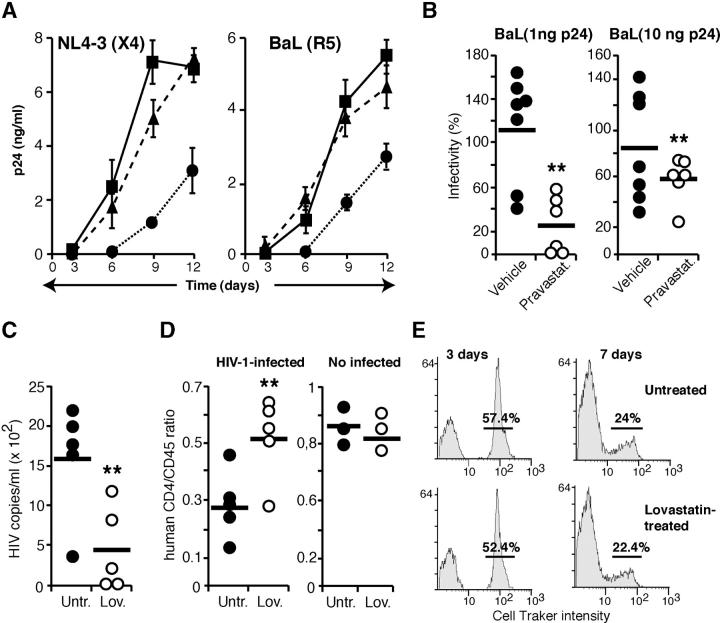
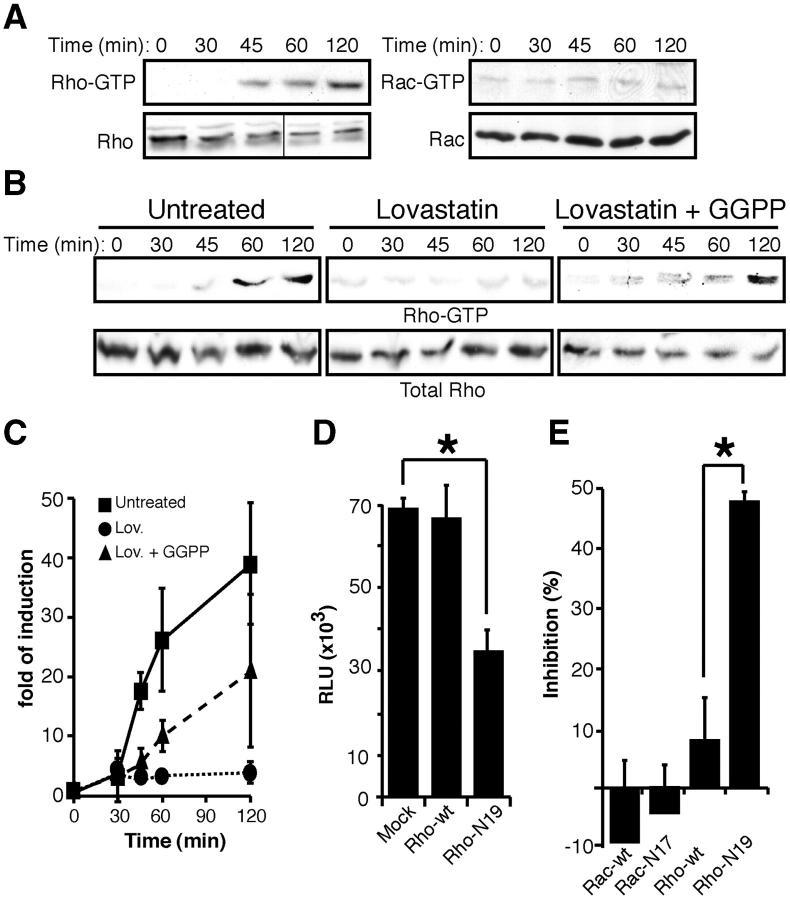
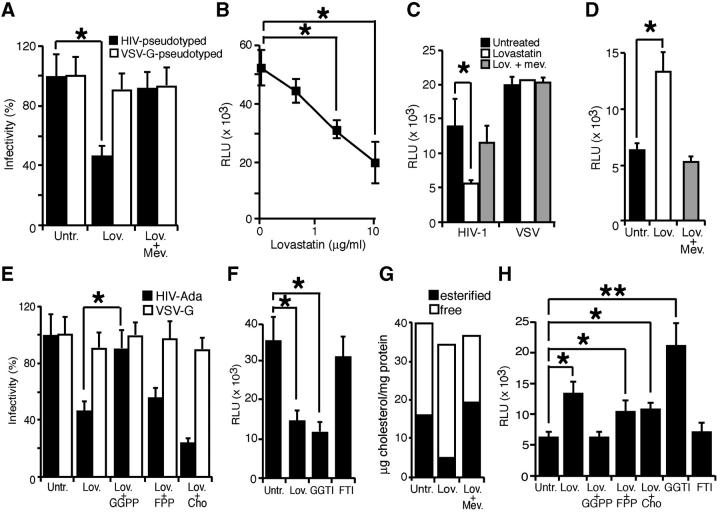
Human immunodeficiency virus (HIV)-1 infectivity requires actin-dependent clustering of host lipid raft-associated receptors, a process that might be linked to Rho guanosine triphosphatase (GTPase) activation. Rho GTPase activity can be negatively regulated by statins, a family of drugs used to treat hypercholesterolemia in man. Statins mediate inhibition of Rho GTPases by impeding prenylation of small G proteins through blockade of 3-hydroxy-3-methylglutaryl coenzyme A reductase. We show that statins decreased viral load and increased CD4+ cell counts in acute infection models and in chronically HIV-1-infected patients. Viral entry and exit was reduced in statin-treated cells, and inhibition was blocked by the addition of l-mevalonate or of geranylgeranylpyrophosphate, but not by cholesterol. Cell treatment with a geranylgeranyl transferase inhibitor, but not a farnesyl transferase inhibitor, specifically inhibited entry of HIV-1-pseudotyped viruses. Statins blocked Rho-A activation induced by HIV-1 binding to target cells, and expression of the dominant negative mutant RhoN19 inhibited HIV-1 envelope fusion with target cell membranes, reducing cell infection rates. We suggest that statins have direct anti-HIV-1 effects by targeting Rho.
人类免疫缺陷病毒1型(HIV-1)的感染性需要宿主脂筏相关受体的肌动蛋白依赖性聚集,这一过程可能与Rho鸟苷三磷酸酶(GTPase)的激活有关。Rho GTPase活性可被他汀类药物负调控,他汀类药物是一类用于治疗人类高胆固醇血症的药物。他汀类药物通过阻断3-羟基-3-甲基戊二酰辅酶A还原酶来阻止小G蛋白的异戊二烯化,从而介导对Rho GTPases的抑制作用。我们发现,在急性感染模型和慢性HIV-1感染患者中,他汀类药物可降低病毒载量并增加CD4+细胞计数。在经他汀类药物处理的细胞中,病毒的进入和释放减少,加入L-甲羟戊酸或香叶基香叶基焦磷酸可阻断这种抑制作用,但加入胆固醇则不能。用香叶基香叶基转移酶抑制剂而非法尼基转移酶抑制剂处理细胞,可特异性抑制HIV-1假型病毒的进入。他汀类药物可阻断HIV-1与靶细胞结合诱导的Rho-A激活,显性负性突变体RhoN19的表达可抑制HIV-1包膜与靶细胞膜的融合,降低细胞感染率。我们认为,他汀类药物通过靶向Rho对HIV-1具有直接的抗病毒作用。