Carroll Patrick A, Brazeau Elizabeth, Lagunoff Michael
Department of Microbiology, University of Washington, Seattle, WA 98195, USA.
Virology. 2004 Oct 10;328(1):7-18. doi: 10.1016/j.virol.2004.07.008.
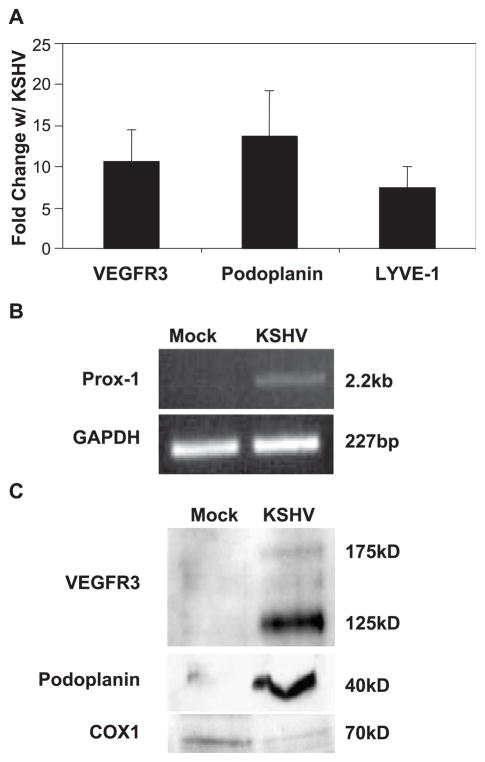
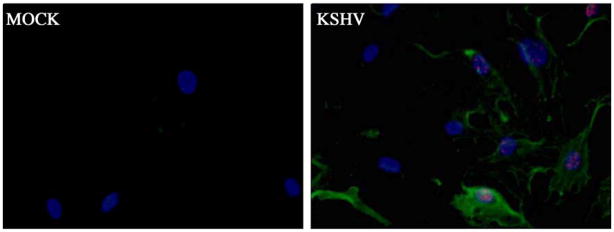
Kaposi's sarcoma-associated herpesvirus (KSHV) is necessary for KS, a highly vascularized tumor predominated by endothelial-derived spindle cells that express markers of lymphatic endothelium. Following KSHV infection of TIME cells, an immortalized human dermal microvascular endothelial cell (DMVEC) line, expression of many genes specific to lymphatic endothelium, including VEGFR3, podoplanin, LYVE-1, and Prox-1, is significantly increased. Increases in VEGFR3 and podoplanin protein are also demonstrated following latent infection. Examination of cytokine secretion showed that KSHV infection significantly induces hIL-6 while strongly inhibiting secretion of IL-8, a gene product that is decreased by differentiation of blood to lymphatic endothelial cells. These studies support the hypotheses that latent KSHV infection of blood endothelial cells drives their differentiation to lymphatic endothelial cells.
卡波西肉瘤相关疱疹病毒(KSHV)是卡波西肉瘤(KS)发病所必需的,KS是一种高度血管化的肿瘤,主要由表达淋巴管内皮标志物的内皮来源的梭形细胞组成。在永生化的人真皮微血管内皮细胞(DMVEC)系TIME细胞感染KSHV后,许多淋巴管内皮特异性基因的表达,包括血管内皮生长因子受体3(VEGFR3)、血小板反应蛋白-1(podoplanin)、淋巴管内皮透明质酸受体-1(LYVE-1)和Prox-1,均显著增加。潜伏感染后,VEGFR3和血小板反应蛋白-1蛋白水平也有所升高。细胞因子分泌检测表明,KSHV感染显著诱导人白细胞介素-6(hIL-6)的产生,同时强烈抑制白细胞介素-8(IL-8)的分泌,IL-8是一种在血液内皮细胞向淋巴管内皮细胞分化过程中表达降低的基因产物。这些研究支持以下假说:血液内皮细胞的潜伏性KSHV感染促使其分化为淋巴管内皮细胞。